Hello! Welcome to the third lesson in our module on "The Architecture of Global Power."
In the last lesson, we broke down the concept of Comprehensive National Power (CNP) and identified the key military, economic, technological, and demographic metrics used to measure a state's strength. We saw that measuring power is the first step in geopolitical analysis.
Today, we take the logical next step. We will move from measuring the power of individual states to analyzing the structure of the entire international system based on how that power is distributed. This concept is known as polarity.
This lesson directly addresses the learning outcome: Explain the concepts of unipolarity, bipolarity, and multipolarity and assess which best describes the current global system.
Understanding polarity provides a crucial framework for analyzing the great power competition you're interested in. The distribution of power—whether it's concentrated in one, two, or multiple poles—fundamentally shapes the strategic environment, defining the constraints and opportunities for major powers and the smaller states that navigate their influence.
1. Visualizing the Global Power Structure
Let's begin by defining the three main types of international systems. Polarity refers to the number of independent, major power centers in the world.
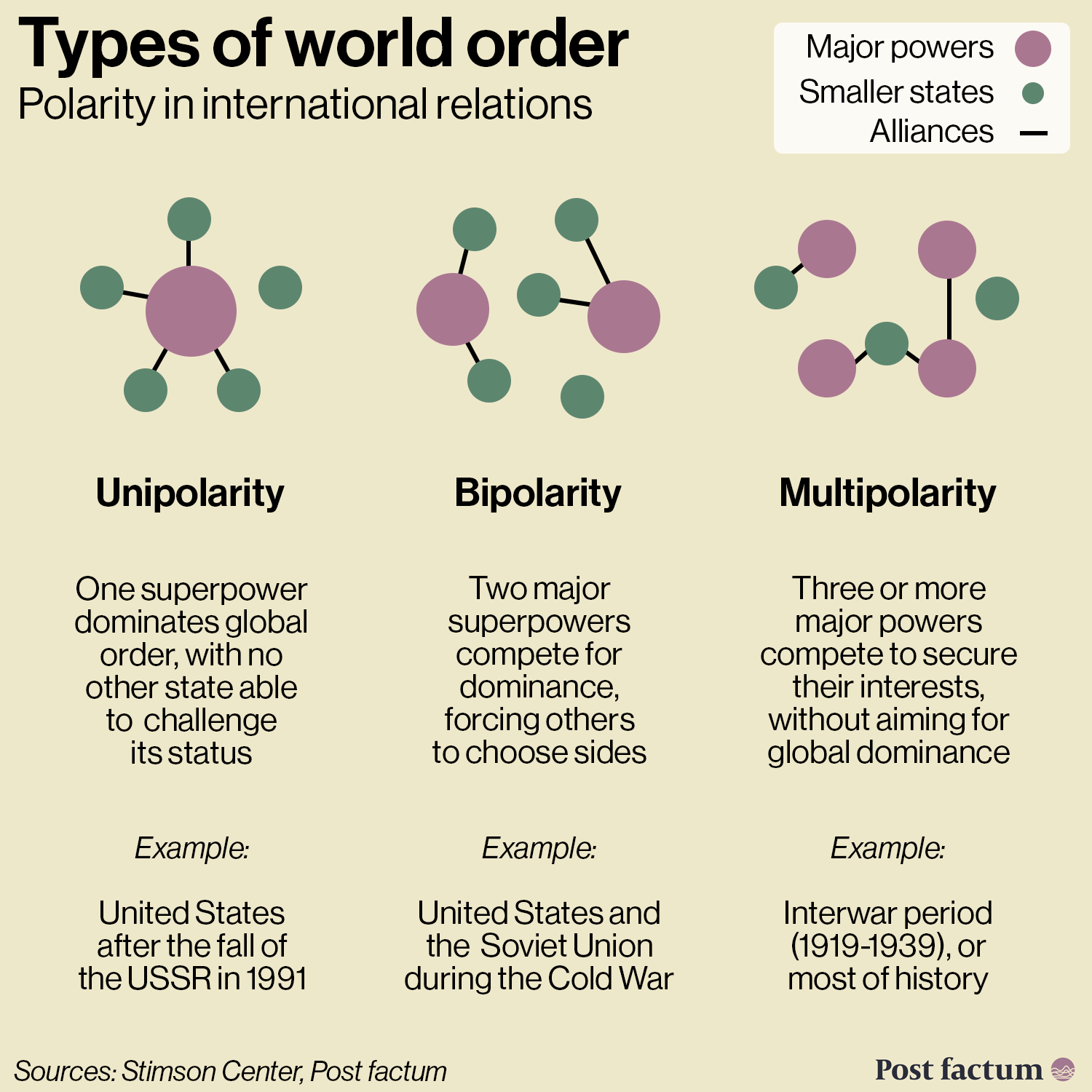
As the image illustrates:
- Unipolarity is a system with a single dominant power, or hegemon, whose capabilities are unmatched. The classic recent example is the United States in the decade following the Cold War.
- Bipolarity is a system structured around two major powers or blocs. The Cold War, dominated by the rivalry between the United States and the Soviet Union, is the quintessential bipolar era.
- Multipolarity is a system with three or more great powers of comparable strength. The 19th-century "Concert of Europe" is a historical example.
To solidify these definitions, let's watch a short video that explains these concepts and their importance.
This video, 'Security - Polarity' by Noah Zerbe, provides a concise academic overview of the three systems. Focus on how power is defined and how each system is characterized.
Please watch from the beginning until 02:01. This segment will cover: The definition of polarity as the distribution of power (0:00 - 0:57). The characteristics of a unipolar system (0:57 - 1:16). The features of a bipolar system (1:16 - 1:34). The nature of a multipolar system (1:34 - 2:01).
2. The Great Debate: Which System is More Stable?
A central question in international relations theory is which of these systems is the most stable and least prone to large-scale war. There is no consensus, and different schools of thought offer competing arguments.
Let's continue with the same video, which explores this very debate.
Now, let's watch the second half of Noah Zerbe's video, where he outlines the main arguments for why each system might be more or less stable.
Please watch from 02:39 to 03:57. The video discusses the competing schools of thought on stability.
To summarize and expand on these arguments, which are also detailed in the Wikipedia article on "Polarity (international relations)":
- Pro-Unipolar Stability: Proponents argue that a single hegemon can act as a "global policeman," enforcing rules, providing public goods (like protecting sea lanes), and deterring aggression from other states. The periods of Pax Romana and Pax Britannica are often cited as historical examples.
- Pro-Bipolar Stability (Neorealist View): Scholars like Kenneth Waltz argue that bipolar systems are the most stable. With only two major players, monitoring each other is simpler, miscalculations are less likely, and the system is more predictable. During the Cold War, for instance, the US and USSR engaged in proxy wars but avoided direct, catastrophic conflict.
- Pro-Multipolar Stability (Classical Realist View): Thinkers like Hans Morgenthau argued that multipolar systems are more stable because they offer greater flexibility. States can form and reform alliances to balance against any would-be aggressor. Power is more diffuse, making it harder for one state to dominate.
- Anti-Multipolar Stability (Neorealist View): Conversely, other neorealists like Waltz and John Mearsheimer argue multipolarity is the least stable. The complexity of interactions between multiple powers increases the chances of miscalculation. It also encourages dangerous behaviors like buck-passing (hoping another state will bear the cost of confronting a threat) and chain-ganging (being dragged into a conflict by a reckless ally).
3. Assessing the Current System: Uni, Bi, or Multipolar?
Now we arrive at the central question for today's geopolitical analysts: which model best describes our current world? There is no easy answer, and strong arguments exist for all three.
For an up-to-date and data-rich analysis of this debate, let's dive into a recent report from the Munich Security Conference.
MSR 2025, Chapter 1 – Introduction: Multipolarization
This chapter from the 2025 Munich Security Report, titled 'Multipolarization', directly engages with the debate about the current international order. It presents compelling evidence for unipolar, bipolar, and multipolar interpretations.
Please read the section titled 'Pole Positions: Uni-, Bi-, Multi-, or Nonpolarity?'. As you read, make a mental note of the strongest piece of evidence for each of the three arguments.
Let's break down the arguments presented in the report and other resources:
The Case for Continued Unipolarity
Proponents argue that despite perceptions of decline, the United States remains the sole superpower.
- Military Dominance: The US accounts for nearly 40% of global military spending, far surpassing any other nation. It also maintains a globe-spanning network of alliances and over 100 overseas military bases.
- Economic & Financial Power: The US dollar remains the world's dominant reserve currency, giving Washington immense financial leverage (e.g., through sanctions).
- Technological Lead: The US still leads in many critical technology sectors, and its military-technological superiority is difficult for competitors to overcome.
The Case for an Emerging Bipolarity
This view holds that the world is increasingly defined by the US-China rivalry, with all other powers falling into a second tier.
- The Power Gap: As the MSR report notes, the power gap between the US and China is narrowing, while the gap between China and the third-ranking power is widening.
- Economic Clout: In terms of purchasing power parity (PPP), China is already the world's largest economy.
- A Peer Competitor: The US National Security Strategy explicitly names China as the only competitor with the intent and capability to reshape the international order.
The Case for Multipolarity
This perspective argues that power is diffusing to multiple centers of influence beyond just the US and China.
- Rise of the Rest: Powers like the European Union, India, Russia, Japan, and Brazil exert significant influence, at least regionally.
- Economic Rebalancing: The BRICS bloc now surpasses the G7 in combined GDP (at PPP). These emerging economies are demanding a greater say in global governance.
- Issue-Specific Power: As the MSR report mentions, some states that aren't global great powers can still be crucial "poles" on specific issues or in specific regions (e.g., Turkey, Saudi Arabia).
A More Complex View: The 3D Chessboard
Given the conflicting evidence, some analysts propose a more nuanced model. Joseph Nye, a prominent scholar, suggests thinking of today's power distribution as a three-dimensional chess game.
How Do Unipolar, Bipolar, And Multipolar Power Structures Affect Global Politics?
This short video provides an excellent explanation of Joseph Nye's '3D Chessboard' analogy, which helps reconcile the competing arguments for unipolarity, bipolarity, and multipolarity.
Please watch the segment from 03:21 to 04:57. It details the three levels of Nye's model.
Nye's model breaks down the system as follows:
- Top Board (Military Power): Largely unipolar. The US remains the only state with truly global military reach.
- Middle Board (Economic Power): Clearly multipolar. The US, China, the EU, and Japan are all major economic players.
- Bottom Board (Transnational Relations): Nonpolar. Power is widely dispersed among a vast array of state and non-state actors, such as corporations, NGOs, terrorist groups, and hackers. This is the realm of challenges that cross borders, like pandemics, climate change, and cyber warfare.
This layered model is useful because it shows that the answer to "What is the polarity of the system?" depends on which dimension of power you are focused on.
4. A Quantitative Approach to Polarity
Given your background in computer engineering, you might appreciate that scholars have also tried to quantify polarity. One of the classic methods was developed by J. David Singer for the Correlates of War project.
The formula for the Concentration of Power is:
Where:
- is the time of measurement.
- is the number of states in the great power system at time .
- is the proportion of power held by state at time . This is calculated as the state's share of the total in six categories: military spending, military personnel, iron/steel production, energy consumption, total population, and urban population.
- The term represents the sum of the squared proportions of power held by all states.
The result is a score between 0 and 1:
- A score close to 1 indicates a highly concentrated, unipolar system.
- A score around 0.4 - 0.5 often suggests unipolarity.
- A score around 0.2 - 0.4 typically indicates a bipolar or multipolar system.
- A score close to 0 indicates that power is very evenly distributed.
This formula provides a systematic way to measure and track the distribution of power over time, turning an abstract concept into a tangible metric. It demonstrates how quantitative methods can be applied to geopolitical analysis, though its reliance on industrial-age metrics means it must be adapted for modern analysis.
Conclusion
In this lesson, we have explored the concept of polarity as a way to understand the fundamental structure of the international system. We've seen that the distribution of power has profound implications for global stability and the behavior of states.
Key Takeaways:
- Polarity describes the distribution of power in the international system, which can be unipolar (one great power), bipolar (two great powers), or multipolar (three or more great powers).
- There is a long-standing academic debate about which system is most stable, with compelling arguments for each.
- The current international system is a subject of intense debate. Strong evidence can be marshaled to support claims of continued unipolarity, emerging bipolarity, or established multipolarity.
- Complex models, like Joseph Nye's 3D chessboard, offer a more nuanced understanding by suggesting that the system's polarity can differ across various domains of power (military, economic, and transnational).
In our next lesson, we will build on this understanding of global power structures by examining how great powers project their influence regionally. We will explore the concepts of spheres of influence and buffer states, which will be particularly relevant to your interest in how countries like Nepal navigate the competitive dynamics between their larger neighbors.