Hello! Welcome to the second lesson in our module, "The Architecture of Global Power."
In our previous lesson, we explored the institutional framework of the post-WWII international order—the UN, the Bretton Woods institutions, and the U.S.-led alliance system. We described this as the "operating system" for global politics. Today, we shift our focus from the system's architecture to the actors within it. We'll examine how to measure and compare the power of nations, moving from a qualitative description of the system to a quantitative assessment of its players.
This lesson directly addresses the learning outcome: Identify the key metrics used to assess a state's comprehensive national power (military, economic, technological, demographic).
Understanding these metrics is the foundation of geopolitical analysis. It allows us to move beyond vague statements like "Country X is powerful" to a more nuanced analysis of why it is powerful, where its strengths and weaknesses lie, and how its power is changing relative to others. This is especially crucial for analyzing the US-China rivalry and its impact on regional dynamics, which is a central interest of yours.
1. Beyond Armies and Economies: Defining Comprehensive National Power
When we think of national power, the first things that often come to mind are military strength and economic size. While these are critical, strategists and governments, particularly China's, have developed a more holistic concept: Comprehensive National Power (CNP).
CNP is an attempt to measure a state's total capacity to pursue its national interests and influence the international environment. It acknowledges that power in the 21st century is derived not just from tanks and GDP, but also from technological innovation, social cohesion, diplomatic influence, and even national will.
Let's begin with a video from the Observer Research Foundation that introduces this concept and its significance.
National Security Dialogues | What is Comprehensive National Power? The Case of China | Manoj Joshi
In this video, 'What is Comprehensive National Power? The Case of China,' Dr. Manoj Joshi explains the evolution of this concept. We'll focus on the foundational definition and the inclusion of both tangible and intangible elements.
Please watch the following two clips: 04:01 - 05:43: Dr. Joshi explains that national power is not just military or economic might, but stems from fundamental societal qualities like productivity, innovation, social cohesion, and national will. 13:07 - 14:04: This brief clip introduces the idea of 'soft power' (culture, national cohesion, international legitimacy) and other hard-to-measure variables like 'national will' and 'sense of purpose' as key components of power.
As Dr. Joshi highlights, accurately measuring power is vital for any state's grand strategy. The challenge lies in quantifying not only the tangible assets a country possesses but also the more elusive, qualitative factors that can determine success or failure on the world stage.
2. Frameworks for Measuring Power
Given your background in computer engineering, you can think of measuring CNP as building a complex model with multiple weighted variables. Different models use different variables and weights, leading to different outputs. Let's look at a few influential frameworks.
A Conceptual Framework: The Web of Power
One useful way to visualize the components of power is as an interconnected web. The CaspianReport channel breaks this down into three core, interacting domains:
- Geostrategy: The use of military power to control territory and influence the distribution of power.
- Geo-economics: Using economic means (trade, investment, resources) to achieve strategic goals.
- Geotechnology: The application of technology to master physical space and gain a strategic advantage. This is a critical component in modern geopolitics, linking directly to your interests in AI, cyber, and other emerging fields.
These three elements are not independent; they reinforce one another. A strong economy funds advanced military technology, which in turn can be used to secure vital trade routes and resources.
Quantitative Frameworks: From CINC to GPI
Analysts have long tried to create a single index to rank states.
-
The Composite Index of National Capability (CINC), developed in the 1960s, is one of the most famous. It uses six indicators: total population, urban population, military personnel, military expenditures, energy consumption, and iron/steel production. While historically important, its industrial-age focus makes it less relevant today. For instance, it doesn't account for technological prowess or nuclear weapons.
-
A more modern approach is the Global Power Index (GPI), which was developed to provide a more accurate picture for the information age.
Let's turn to a RAND Corporation report that explains this evolution and breaks down the components of a modern power index.
The RAND report 'measuring power' provides an excellent overview of the challenges and methods of quantifying national power. It contrasts older methods with newer ones and details the components of the GPI.
Please read the section 'Global Power Metrics' (starts on page 5) and pay close attention to Table 1: Elements and Weights of the Modified GPI Used in This Report (page 7). This table provides a clear, structured list of key metrics.
The modified GPI from the RAND report gives us a clear, structured answer to our learning outcome. It organizes power into five key dimensions, each with specific, measurable indicators:
| Dimension | Indicator | Source of Power |
|---|---|---|
| Military Capacity | Nuclear Weapons, Military Power (expenditures) | Hard power, deterrence, coercive capability |
| Economic Capacity | GDP (PPP), Trade (exports + imports) | Financial resources, global influence, leverage |
| Technological Capacity | Innovation (R&D expenditure) | Future growth, military edge, economic competitiveness |
| Political Capacity | Governance (government revenues) | State's ability to mobilize resources effectively |
| Human Capacity | Population (working-age) | Labor force, economic potential, military manpower |
This framework explicitly identifies the key metrics: military spending, economic output, technological investment, and demographic potential (human capacity).
3. A State-of-the-Art Example: The Lowy Institute Asia Power Index
To see how these concepts are applied in the real world, we can examine the Lowy Institute's Asia Power Index. This is one of the most comprehensive and respected public analyses of national power, and its focus on Asia makes it particularly relevant.
The Lowy Index expands on the GPI framework, breaking power down into eight distinct measures with 131 specific indicators. It's a great example of a sophisticated, multi-faceted power assessment.
Methodology - Lowy Institute Asia Power Index
The methodology page for the Lowy Institute Asia Power Index provides a masterclass in how modern analysts quantify power. We will focus on the main 'Measures of Power' to see the specific metrics used.
Please read the section titled 'Measures of Power'. For each of the eight measures, read the main definition (in bold) and the bulleted sub-measures. Don't worry about the sub-sub-measures for now. Focus on understanding the broad categories.
Let's map Lowy's eight measures onto the core categories from our learning outcome:
- Economic Capability: This is a direct measure of economic power, looking at GDP, international financial leverage, and connectivity (trade, investment).
- Military Capability: This assesses military power through spending, force size, weapons platforms, and "signature capabilities" like cyber and long-range missiles.
- Future Resources: This is a proxy for demographic and future economic potential. It looks at the projected size of the working-age population by 2050 and forecasts of future economic and defense resources.
- Resilience: This unique measure assesses a state's ability to withstand shocks, including its resource security, internal stability, and even nuclear deterrence.
- Economic Relationships: This measures influence derived from trade and investment networks.
- Defence Networks: This captures the "force multiplier" effect of alliances.
- Diplomatic Influence: This measures a state's diplomatic footprint and effectiveness in multilateral institutions.
- Cultural Influence: A measure of soft power, looking at cultural projection and appeal.
Notice how Technological Capability isn't a standalone category but is woven throughout the index, appearing in:
- Economic Capability (high-tech exports, R&D spending, supercomputers).
- Military Capability (cyber capabilities, sophisticated weapons platforms).
This reflects how central technology is to all forms of power today.
4. Visualizing Power: US vs. China and the Rise of India
Abstract indices become much clearer when visualized.
First, let's look at a direct comparison of the two leading global powers, the US and China, using a similar multi-metric approach from investor Ray Dalio's work.
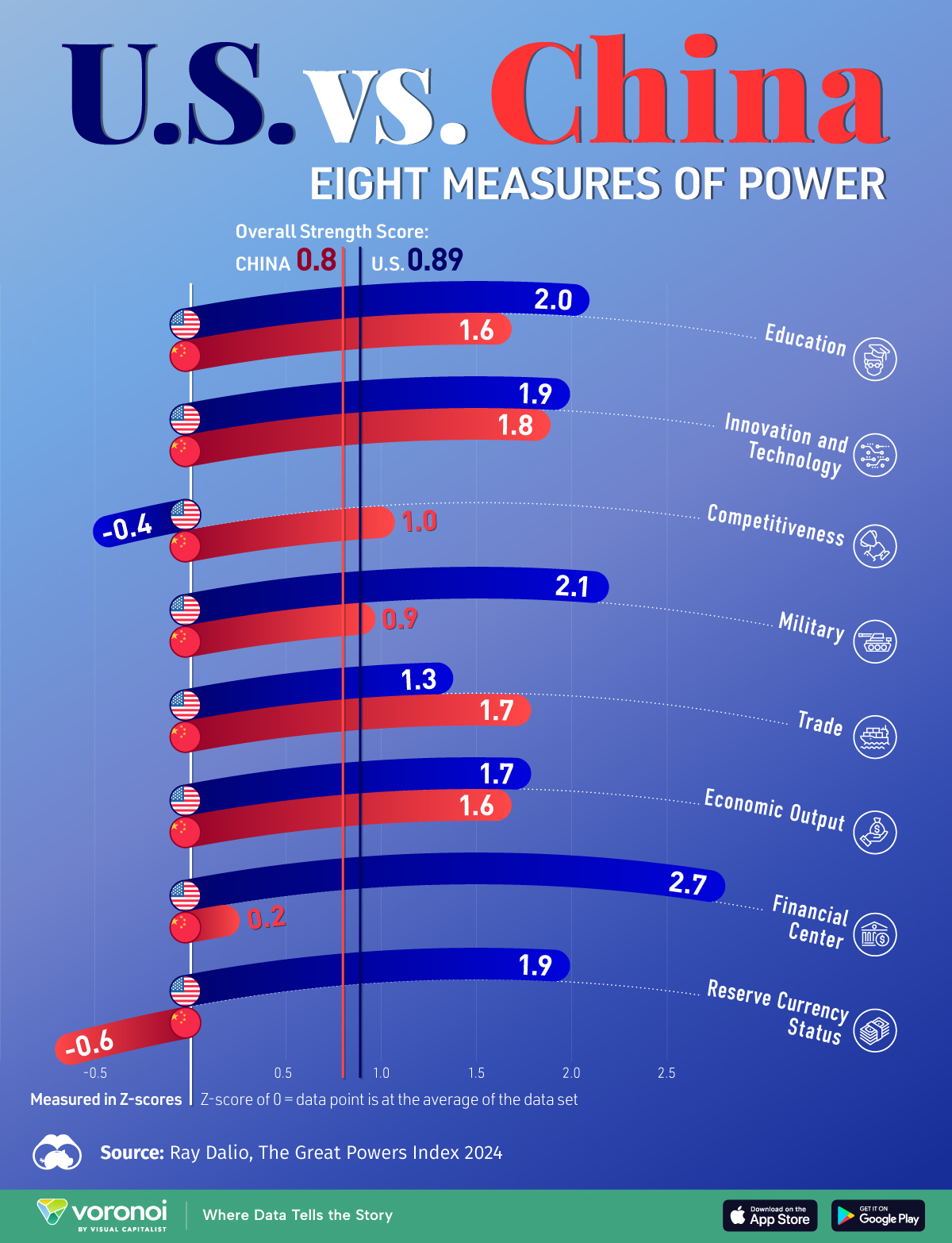
This chart vividly illustrates that neither country dominates across the board. They have different profiles of power, which fuels their complex competitive relationship.
Next, let's look at the dynamic nature of power using the Lowy Index we just discussed. Power rankings are not static; they change over time.

This visual is a perfect real-world example of why we measure CNP. It allows us to track shifts in the balance of power, such as India's rise, which has profound implications for the strategic calculations of every country in the region, including Nepal as it navigates its relationships with both India and China.
Conclusion
In this lesson, we moved from the abstract concept of power to the concrete metrics used to measure it. We've seen that assessing a nation's strength requires a comprehensive approach that looks far beyond just its military and economy.
Key Takeaways:
- Comprehensive National Power (CNP) is a holistic concept that includes military, economic, technological, demographic, and "soft power" elements like diplomatic and cultural influence.
- Analysts use structured frameworks like the Global Power Index (GPI) and the Lowy Asia Power Index to quantify and compare national power using dozens of specific indicators.
- The four core pillars of national power are Military Capability (spending, forces), Economic Capability (GDP, trade), Technological Capability (R&D, innovation), and Demographic Potential (working-age population).
- The choice of metrics and their weighting is a subjective process. Different models can produce different results, highlighting the complexity of power assessment.
- Measuring power is not a static exercise; it allows us to track the rise and fall of nations and understand the shifting dynamics of the international system.
In our next lesson, we will use this new understanding of how to measure power to analyze the overall structure of the global system. We will address the learning outcome: Explain the concepts of unipolarity, bipolarity, and multipolarity and assess which best describes the current global system. We will ask: based on these power metrics, is there one dominant power, two, or many competing for influence?