Hello! Welcome to the first lesson of our third module, "The Architecture of Global Power."
In our last lesson, we explored Dependency and World-Systems theory. These critical perspectives argue that the global system is a hierarchy where "core" nations benefit at the expense of "periphery" nations. Today, we will examine the concrete institutional framework built after World War II. You'll see how this framework can be viewed from two angles: as the foundation of a prosperous, rules-based world, and as the very architecture that perpetuates the core-periphery dynamics we just discussed.
This lesson directly addresses the learning outcome: Describe the structure of the post-WWII international order: the UN, Bretton Woods institutions, and the alliance system.
Think of this order as the global "operating system" designed in the mid-20th century. We will dissect its core components—the political, economic, and security "kernels"—that continue to run in the background of international politics today. We will also explore how a country like Nepal has used this system to navigate its own complex geopolitical environment.
1. The Blueprint for a New World
After the devastation of two world wars and the Great Depression, the victorious Allied powers, led by the United States, aimed to create a system that would prevent such catastrophes from happening again. Their goal was to build an international order based not just on raw power, but on shared rules, economic openness, and multilateral institutions. This is what's often called the Liberal International Order (LIO).
To understand the vision and the key terms, let's start with a foundational video.
The Liberal International Order
The video 'The Liberal International Order' from the channel of political science professor Noah Zerbe provides a clear introduction to the purpose and characteristics of this post-war system.
Please watch the following segments: 00:31 - 02:39: This part explains the post-WWII motivation and defines what an 'order' is in international relations—a patterned set of relationships governed by rules and norms. 03:03 - 04:11: Focus on the three meanings of 'liberal' in this context: political (democracy), economic (free markets), and institutional (reliance on organizations). 04:11 - 06:00: This section discusses the origins of the LIO, highlighting the 1941 Atlantic Charter as the blueprint for the institutions that would follow.
The key idea is that the United States used its dominant position not just to assert its power, but to lock other countries into a system that it designed and led. This system was built on the belief that economic interdependence and cooperation through international institutions would make major war less likely.
2. The Three Pillars of the Post-War Order
This new order wasn't just an idea; it was a concrete structure built on three distinct but interconnected pillars: a political-security pillar, an economic pillar, and a trade pillar.
The following reading from the RAND Corporation provides a detailed framework for understanding these components.
[PDF] Understanding the Current International Order
This report, 'Understanding the Current International Order,' offers a strategic overview of the system's architecture. We'll focus on a section that cleanly summarizes its core elements.
Please read the section titled 'The International Order in U.S. National Security Strategy Documents' (page 45). It's very short. Focus on the four core components and the key institutions listed, as they provide a perfect roadmap for what we'll discuss next.
As the reading highlights, the order rests on institutions for security, finance, and trade. Let's examine each.
Pillar 1: Political and Security Architecture
This pillar was designed to manage political disputes and prevent military aggression. It consists of two main parts:
A. The United Nations (UN):
Founded in 1945, the UN was intended to be the central institution for global governance and collective security.
- The General Assembly (UNGA): A forum where every member state has one vote, embodying the Westphalian principle of sovereign equality. It serves as a platform for global dialogue and diplomacy.

- The Security Council (UNSC): The UN's most powerful body, responsible for maintaining international peace and security. Its decisions are legally binding. Critically, it has 15 members, but five are permanent (P5)—the US, UK, France, China (originally the Republic of China), and the Soviet Union (now Russia)—and each holds a veto. This explicitly recognizes the special status of great powers, blending liberal ideals with hard-nosed realism.
B. The Alliance System:
Running parallel to the UN was a web of U.S.-led security alliances. This was the "hard power" backbone of the order.
- NATO (North Atlantic Treaty Organization): Formed in 1949, this is a collective defense pact binding the US, Canada, and Western European allies. An attack on one was considered an attack on all.
- "Hub-and-Spoke" System in Asia: In the Pacific, the US created a series of bilateral alliances with key countries like Japan, South Korea, and the Philippines, rather than a single multilateral pact like NATO.
These alliances served to contain the Soviet Union during the Cold War and underwrote the security of major economic hubs, allowing them to focus on post-war recovery.
Pillar 2: Economic Architecture - The Bretton Woods System
To prevent a repeat of the 1930s economic chaos, representatives from 44 nations met in Bretton Woods, New Hampshire, in 1944. They designed a new global economic system to manage international finance, promote stability, and fund reconstruction.
This system had three key features:
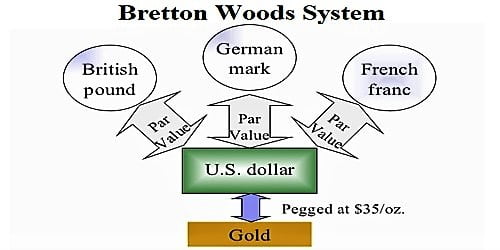
1. A Fixed Exchange Rate System: Currencies were pegged to the U.S. dollar, which was, in turn, convertible to gold at a fixed rate of $35 per ounce. This created stable and predictable exchange rates, which are essential for international trade and investment.
2. The International Monetary Fund (IMF): Its primary role was to ensure the stability of this fixed exchange rate system. It would provide short-term loans to countries facing "balance of payments" problems to prevent them from devaluing their currencies and starting a "race to the bottom."
3. The World Bank (initially the IBRD): The International Bank for Reconstruction and Development was created to provide long-term loans for rebuilding war-torn Europe. Its mission later shifted to financing economic development projects in developing countries.
To understand the specifics of these crucial institutions, the following video provides an excellent summary.
Bretton Woods Agreement#WorldBank#IMF | International Business | From A Business Professor
The video 'Bretton Woods Agreement' from the Business School 101 channel clearly explains the historical context and the roles of the IMF and World Bank.
Please watch these key segments: 00:00 - 00:48: Introduction to the agreement and the two institutions it created. 05:01 - 06:13: Explanation of the IMF and World Bank's initial tasks and the fixed exchange rate system. 07:14 - 08:00: A description of the World Bank's structure (IBRD and IDA) and its mission. 09:48 - 11:20: A breakdown of the IMF's mission, its methods (surveillance, lending), and the crucial concept of the 'quota system'.
The video's explanation of the IMF's quota system is vital. A country's contribution (quota) determines its voting power. Since quotas are based on the size of a country's economy, this gives wealthier "core" countries—like the US—dominant influence over the IMF's decisions. This is a primary exhibit for Dependency Theorists, who argue that these institutions were designed to enforce the rules of an economic game that primarily benefits the rich.
Pillar 3: Trade Architecture - GATT to WTO
The third pillar was designed to liberalize world trade by reducing tariffs and other barriers. The initial plan was to create an International Trade Organization, but it failed. Instead, countries established the General Agreement on Tariffs and Trade (GATT) in 1947.
GATT was not an organization but a legal agreement that worked through a series of negotiating "rounds" to progressively lower tariffs. This process was enormously successful in boosting global trade and was a key driver of post-war prosperity. In 1995, GATT was replaced by a formal organization, the World Trade Organization (WTO), which continues this mission today.
3. A Small State's Perspective: Nepal in the Post-War Order
How does this grand global architecture look from the perspective of a small, landlocked country? For Nepal, strategically positioned between India and China, these new international institutions offered a critical tool for survival and the assertion of its sovereignty.
Before 1951, Nepal was largely isolated. However, facing a newly independent India and a newly Communist China, Nepal realized it needed to engage with the world.
[PDF] Nepal: Quest for Survival.
This 1983 military thesis, 'Nepal: Quest for Survival,' provides a fascinating historical look at Nepal's foreign policy. It shows how Nepal viewed the post-war order as a strategic asset.
Please read the two paragraphs on page 10 under the section 'Chapter I. THE SETTING', starting with 'Nepal's entry in the international arena is recent...' and ending with '...general and complete disarmament.' This short section directly addresses how Nepal utilized the post-war institutions.
As the text highlights, several steps were crucial for Nepal:
- Joining the UN (1955): This was the most significant landmark. As the thesis preface states, "Nepal views the United Nations as the only guarantor of...the interest of the small nations." Membership provided international recognition of Nepal's sovereignty, separate from its giant neighbors.
- Participating in the Bandung Conference (1955): This conference of Asian and African states was the genesis of the Non-Aligned Movement. For Nepal, this was a way to formally adopt a policy of non-alignment, refusing to be drawn into either the Western or Soviet bloc.
- Embracing UN Ideals: Nepal's commitment to UN peacekeeping missions and its advocacy for a "New International Economic Order" were ways to increase its international standing and assert its identity as an independent global actor.
For Nepal, the post-war order was not just an abstract concept; it was a practical toolkit for navigating the immense pressures of its geography.
Conclusion
Today, we have dissected the architecture of the international system established after World War II. This US-led effort created a complex web of institutions designed to foster peace and prosperity through rules, economic openness, and multilateral cooperation.
Key Takeaways:
- The post-WWII order was a deliberate project to avoid the failures that led to global war and depression.
- It is built on three pillars: Political-Security (the UN and US alliances), Economic (the Bretton Woods institutions: IMF and World Bank), and Trade (GATT, now the WTO).
- There is an inherent tension in this order: it champions sovereign equality (in the UN General Assembly) while also institutionalizing great power hierarchy (in the UN Security Council and the IMF's voting structure).
- For small states like Nepal, these institutions provided a crucial platform to assert sovereignty, gain international recognition, and navigate a dangerous geopolitical landscape.
In our next lesson, we will delve deeper into the concept of power within this system. We'll move from describing the architecture to measuring the actors, addressing the learning outcome: Identify the key metrics used to assess a state's comprehensive national power (military, economic, technological, demographic).