Hello! Welcome back to our course on geopolitics.
In our last lesson, we established the "rules of the game" by exploring the Westphalian system, which defines the modern world as a collection of sovereign states. We looked at how concepts like the nation-state and sovereignty create the fundamental structure of international politics.
Today, we'll examine how these states, the primary actors on the global stage, actually play the game. Having established who the players are, we now ask: what tools do they use to achieve their goals and influence one another? This is the essence of power in international relations.
Our learning outcome is to distinguish between hard power, soft power, and sharp power with real-world examples. We will explore how states use everything from military might to cultural charm to digital manipulation to advance their interests.
1. The Core of Statecraft: Defining Power
Before we dissect the different types of power, let's establish a clear, foundational definition. For this, we'll turn to Joseph Nye, the Harvard political scientist who pioneered much of the modern thinking on this topic.
Joseph Nye on global power shifts
In this short clip from his TED talk, Joseph Nye, the originator of the 'soft power' concept, provides a clear and concise definition of power and its three main forms.
Watch the segment from 04:49 to 06:16. Focus on how Nye breaks down power into three methods: coercion ('sticks'), payments ('carrots'), and attraction ('soft power').
As Nye explains, at its most basic level, power is the ability to get the outcomes you want. The traditional methods for this—coercion and payment—fall under the category of hard power.
2. Hard Power: The Power to Coerce
Hard power is the oldest and most easily understood form of power. It is the ability to force or induce another actor to do what you want through the threat or use of military and economic might.
Soft Power vs. Hard Power vs. Smart Power in Global Politics
The video 'Soft Power vs. Hard Power vs. Smart Power' gives a straightforward explanation of hard power, detailing its primary instruments.
Please watch the segment from 00:58 to 01:59. Note the two key tools of hard power discussed: military force and economic sanctions.
The core of hard power is its coercive nature. It operates on the logic of command and control. Its tools include:
- Military Force: The threat or deployment of armed forces, naval blockades, or military intervention. This is the most direct form of coercion.
- Economic Sanctions: Using a country's economic strength to punish or pressure another, for example, by imposing tariffs, freezing assets, or cutting off access to financial markets.
To see how economic hard power is used in a contemporary geopolitical rivalry, let's examine a specific case involving China and South Korea.
Hard Power, Soft Power, and China's Turn to Political Warfare ...
The academic article 'Hard Power, Soft Power, and China's Turn to Political Warfare' provides a detailed analysis of China's power strategies. We will look at a specific instance of its use of hard power.
Please read the paragraph that begins 'Beijing's retrenched but resilient backing for North Korea...'. It discusses China's reaction to South Korea's deployment of the THAAD missile defense system. Focus on how China used its economic leverage over the South Korean company Lotte to achieve a political outcome.
The THAAD incident is a classic example of economic hard power. China didn't need to deploy its military; instead, it inflicted significant financial pain on a South Korean corporation to pressure the South Korean government, demonstrating that economic strength can be a potent weapon.
3. Soft Power: The Power to Attract
While hard power forces others to act against their will, soft power is about shaping their preferences through attraction and persuasion. As Joseph Nye puts it, it's making others want what you want.
Soft power stems from the attractiveness of a country's:
- Culture: The global appeal of its music, films, food, and sports.
- Political Values: The extent to which its democratic and liberal values are respected and emulated.
- Foreign Policies: When its policies are seen as legitimate and having moral authority.
Soft Power vs. Hard Power vs. Smart Power in Global Politics
Let's return to the 'Soft Power vs. Hard Power' video to explore the various dimensions of soft power.
Watch the segment from 01:59 to 05:26. Pay attention to the different 'soft power resources' it outlines, such as economic partnerships, cultural influence (like Hollywood or the BBC), and shaping global norms (structural power). The mention of 'cyber power' as a soft power resource is particularly relevant to how information spreads in the modern age.
The following infographic provides a useful visual summary comparing the two concepts we've covered so far.
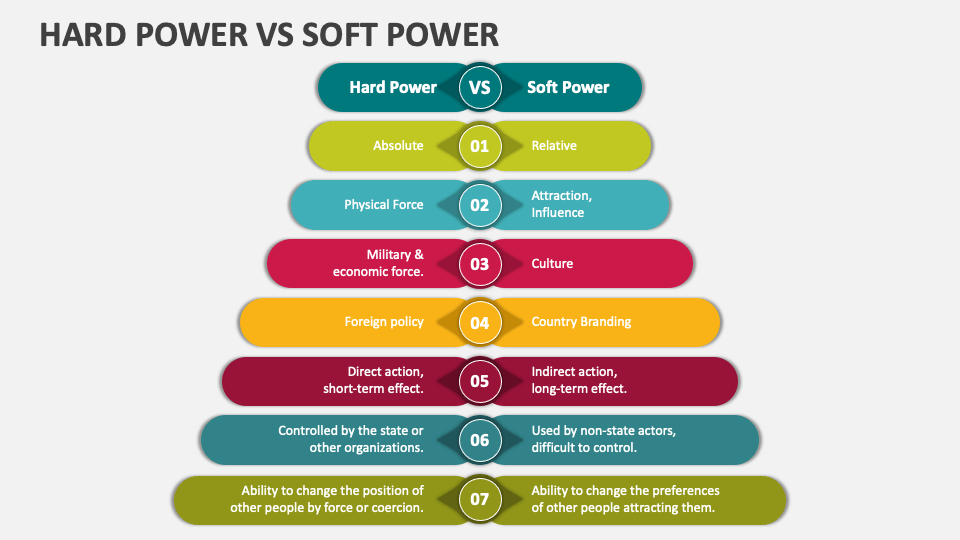
Unlike hard power, which can be deployed quickly, soft power is cultivated over decades and relies on credibility. It's not state-controlled in the same way; it often arises from a country's civil society, universities, and private sector. Its effectiveness can even be measured, as shown by global rankings.
For a regionally relevant example, let's look at how China attempts to cultivate soft power in South Asia.
[PDF] China in South Asia: In the Open and Behind the Scenes - CSEP
The report 'China in South Asia' details how Beijing uses various instruments of influence in the region. The first section offers clear examples of its soft power efforts.
Read the section titled 'Civil Society and Culture'. Notice the examples of China's soft power strategy in Pakistan, Nepal, and Afghanistan, such as awarding journalists, investing in tourism and heritage conservation, and promoting narratives of a common Asian civilization. These are all efforts to build attraction and positive perception.
4. Sharp Power: The Power to Manipulate
Recently, analysts have identified a third category of power that is neither hard nor soft. Sharp power is the use of manipulative diplomatic policies to influence and subvert the political and information environment in a target country.
If hard power is a fist and soft power is a hug, sharp power is a needle. It seeks to pierce or penetrate a society's political and information landscape to sow discord, manipulate debate, and silence critics. It's inherently deceptive.
This concept is particularly relevant in the digital age, where your computer science background gives you an intuitive grasp of how information systems can be manipulated.
Hard Power, Soft Power, and China's Turn to Political Warfare ...
Let's return to the article on China's strategies to understand the definition and application of sharp power.
Read the first two paragraphs of the section 'Politics with Other Means—China's Influence and U.S. Responses.' Focus on the definition: sharp power lies between hard and soft power and seeks to 'pressure and subvert, rather than coerce or persuade.' Also, note the reference to Sun Tzu, whose work you've read.
Sharp power often masquerades as soft power—for example, by funding cultural centers or media outlets—but its intent is not open persuasion; it is covert manipulation. Key tools include:
- Disinformation Campaigns: Using state-controlled media and social media bots to spread false narratives and propaganda.
- Covert Influence: Funding political parties, influencing academics, and using economic leverage behind the scenes to pressure institutions (like businesses or universities) into self-censorship.
- Cyber Operations: Hacking and leaking sensitive information to destabilize a political rival.
The CSEP report on South Asia offers concrete examples of this in action, which directly addresses your interest in the region.
[PDF] China in South Asia: In the Open and Behind the Scenes - CSEP
The 'China in South Asia' report categorizes Chinese influence by its visibility. The least visible activities fall under the umbrella of sharp power.
Read the section titled 'Influence Operations.' Focus on the examples given: China's operations targeting the Tibetan diaspora in India and Nepal, and the use of digital forensics to trace 'wolf warrior' narratives on Sri Lankan social media back to official Chinese accounts. This is a direct application of sharp power in the digital domain.
5. Smart Power: The Strategic Combination
In reality, states rarely rely on just one form of power. Effective foreign policy often involves combining these tools. Joseph Nye calls this smart power: the ability to strategically integrate hard and soft power resources to achieve national interests.
For instance, a country might use the soft power of its development aid and cultural exchanges while maintaining the hard power of its military alliances and economic sanctions as a backstop. Barack Obama's 2009 speech in Cairo, which combined promises of development aid with a continued military fight against extremists, is often cited as an attempt at a smart power strategy.
The following table summarizes the key distinctions we've discussed.
| Feature | Hard Power | Soft Power | Sharp Power |
|---|---|---|---|
| Goal | Coercion (changing what others do) | Attraction (changing what others want) | Manipulation (subverting what others think) |
| Method | Command, threat, inducement | Persuasion, agenda-setting, cultural appeal | Deception, subversion, information warfare |
| Key Currency | Military force, economic sanctions | Values, culture, legitimate policies | Disinformation, covert funding, cyber-espionage |
| Analogy | A stick or a carrot | A magnet | A poison or a targeted information weapon |
Conclusion
Today, we have unpacked the different ways states wield power on the world stage. Understanding these distinctions is crucial for analyzing any geopolitical issue, from a trade dispute to a full-scale war.
Key Takeaways:
- Hard Power uses military and economic coercion ('sticks' and 'carrots') to force others to change their behavior.
- Soft Power relies on the attraction of a country's culture, values, and policies to persuade others to want the same outcomes.
- Sharp Power employs manipulative and deceptive tactics, often in the digital realm, to subvert and penetrate a target society's information and political environments.
- Smart Power is the skillful combination of hard and soft power to create a comprehensive and effective foreign policy strategy.
In this module, we've defined geopolitics, examined its classical theories, and explored the foundational concepts of the state system and power. We are now equipped with the basic analytical toolkit.
In our next lesson, we will begin Module 2: International Relations Theory as an Analytical Lens. We will start by exploring realism, a theory that places the concepts of power and anarchy at the very center of its explanation for how the world works. You'll see how the types of power we've discussed today are fundamental building blocks for these broader theories.