Welcome back to our course on geopolitics.
In the last lesson, we deconstructed the tools of statecraft, distinguishing between hard, soft, and sharp power. We now understand what states use to influence each other. Today, we move from the what to the why. Why is the world so often a stage for competition and conflict? Why do states relentlessly pursue power?
To answer these questions, we turn to International Relations (IR) theory. These theories are not just abstract academic exercises; they are powerful analytical frameworks that help us organize complex global events into coherent patterns. Think of them as different operating systems for viewing the world.
Today, we will install the first and perhaps most influential of these operating systems: Realism. Our learning outcome is to explain the core assumptions of classical realism (human nature, power) and structural realism (anarchy, distribution of capabilities). These are the two main branches of the realist family, and understanding their core logic is fundamental to geopolitical analysis.
1. The Realist Worldview: A Primer
Realism is a school of thought that views international relations as a competitive and conflictual struggle for power among self-interested states. If you found Tim Marshall's Prisoners of Geography or Sun Tzu's The Art of War compelling, you were engaging with a fundamentally realist perspective.
Realists of all stripes share a few core beliefs. To get a handle on these, please start by reading this introductory text.
Introducing Realism in International Relations Theory
The following article, 'Introducing Realism in International Relations Theory' from E-IR, provides a concise summary of the foundational tenets shared by all realist thinkers.
Please read the section titled 'The basics of realism'. Focus on the four key assumptions it outlines: the state as the principal actor, the state as a unitary actor, rational decision-making, and the anarchic nature of the international system.
As the article notes, the realist worldview rests on these pillars:
- State-centrism: States are the main actors.
- Unitary Actor: States act with a single voice.
- Rationality: States make decisions to advance their national interest.
- Anarchy: There is no overarching global authority or "world police."
While all realists agree on these points, they diverge on the ultimate cause of this competitive reality. This is where the distinction between classical and structural realism becomes crucial.
2. Classical Realism: The Lust for Power
Classical realism is the older of the two traditions, with intellectual roots stretching back to thinkers like Thucydides (who chronicled the Peloponnesian War) and Machiavelli. Its modern form was most powerfully articulated by Hans J. Morgenthau in the aftermath of World War II.
Classical realists argue that the root cause of conflict is found in human nature itself.
Core Assumptions:
- Human Nature: Humans are fundamentally driven by self-interest, egoism, and an insatiable desire for power. Morgenthau called this the animus dominandi—the "desire to dominate." Since states are led and populated by humans, they exhibit this same drive for power on the international stage.
- Power as an End: In this view, the pursuit of power is the primary goal of any state. Power is not just a tool to achieve security; it is an end in itself. International politics, therefore, is an unending struggle for power rooted in our unchanging nature.
Political Realism in International Relations
To understand Morgenthau's influential theory, we'll consult the Stanford Encyclopedia of Philosophy, a highly respected academic resource.
Read section 2.2, 'Hans Morgenthau’s Realist Principles'. Pay close attention to his first principle (objective laws rooted in human nature) and his second principle (the concept of interest defined as power).
In essence, for classical realists, the game of geopolitics is aggressive and competitive because the players (humans, and by extension, states) are inherently wired that way.
3. Structural Realism (Neorealism): The Logic of Anarchy
In the late 1970s, a new form of realism emerged that sought to make the theory more "scientific." Known as structural realism or neorealism, its key architect was Kenneth Waltz.
Waltz argued that we don't need to make unprovable assumptions about human nature. Instead, the cause of conflict can be found in the structure of the international system itself.
Given your background in computer science, you can think of this as the difference between blaming a software bug on a flawed component (like a single line of bad code) versus blaming it on a flawed system architecture that forces all components to behave in a certain way. Waltz argues for the latter.
Core Assumptions:
- Anarchy: Like classical realists, neorealists see anarchy (the absence of a central authority) as the defining feature of the international system. This creates a "self-help" environment where no state can rely on another for its security.
- Distribution of Capabilities: State behavior is driven not by an innate lust for power, but by the need to survive in this dangerous, anarchic system. A state's actions are determined by its relative power (its "capabilities" - military, economic, etc.) compared to other states. Power is simply a means to the ultimate end: survival.
Watch this video featuring John Mearsheimer, a leading contemporary structural realist, as he explains this core logic.
Structural Realism - International Relations (1/7)
In this clip from OpenLearn, John Mearsheimer clearly articulates the central argument of structural realism and contrasts it with the classical, human-nature-based view.
First, watch from 00:07 to 02:16. Focus on how he explains that the structure of the system (anarchy and uncertainty) forces states to pursue power for survival. Then, watch from 03:14 to 05:30, where he directly contrasts this structural view with the 'human nature realist' theories of thinkers like Morgenthau.
Waltz's theory abstracts away from the internal characteristics of states (like their government type or ideology) and the nature of their leaders. In his model, two states with similar power capabilities, placed in the same structural position, will tend to behave in similar ways regardless of whether they are democracies or autocracies. The system's structure is the primary determinant.
This diagram visually captures Waltz's "systemic explanation." It shows that he attributes state behavior to the international structure, deliberately rejecting "reductionist" explanations that focus on the internal makeup of states or individuals.

4. A Tale of Two Realisms: A Summary
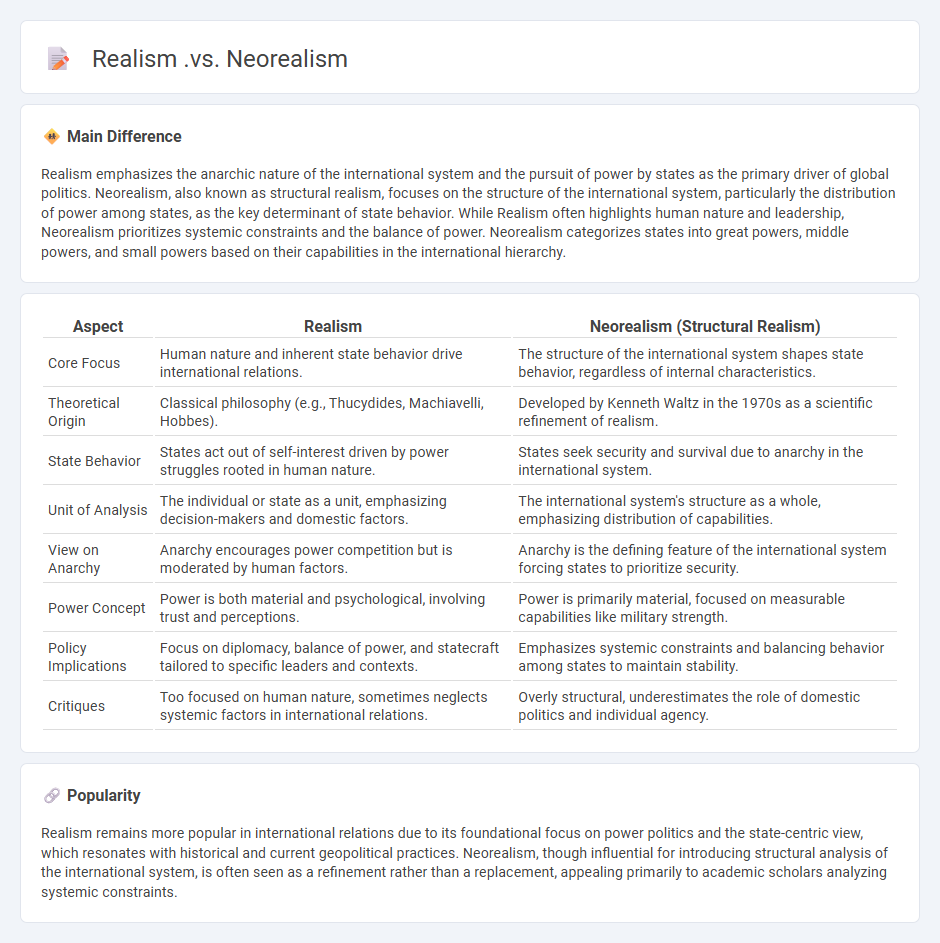
The fundamental difference between these two theories is their level of analysis.
- Classical Realism finds the cause of conflict at the individual/state level: flawed human nature.
- Structural Realism finds the cause of conflict at the systemic level: the anarchic structure of the international system.
This infographic provides an excellent side-by-side comparison of the two theories.
Conclusion
Today we've explored the realist family of IR theory, a lens that sees the world as a grim arena of power politics. While both branches of the family agree on the centrality of power and anarchy, they offer different explanations for why this is the case.
Key Takeaways:
- Realism is a theoretical tradition that emphasizes state-centrism, self-interest, and the struggle for power in an anarchic international system.
- Classical Realism posits that this struggle is a product of an unchanging and egoistic human nature that has an insatiable lust for power. For them, power is often an end in itself.
- Structural Realism (Neorealism) argues that it is the anarchic structure of the international system that forces states to compete for power. In this view, power is simply a means to the ultimate goal of survival.
Understanding this distinction is not just an academic exercise. It changes how you analyze world events. Do you see conflict as the result of aggressive leaders and states (a classical view), or as the inevitable outcome of a system that pits states against each other (a structural view)?
In our next lesson, we will apply these powerful realist ideas. We will use concepts like the security dilemma and the balance of power to analyze a current interstate rivalry, transforming these abstract theories into practical analytical tools.