Hello! Welcome back to our course on geopolitics.
In our last lesson, we laid the theoretical groundwork by exploring the two main branches of realism: classical and structural. We learned that while classical realism attributes the struggle for power to human nature, structural realism (or neorealism) argues that the anarchic structure of the international system forces states to compete for power simply to ensure their own survival.
Today, we put that theory into practice. Our goal is to apply realist concepts like the security dilemma and the balance of power to analyze a current interstate rivalry. These two concepts are the core mechanisms of structural realism, and they provide a powerful, if stark, lens for understanding why competition and conflict persist in the world. We will define each concept and then use them to dissect two major rivalries: India-Pakistan and US-China.
1. The Security Dilemma: The Tragedy of Power Politics
The security dilemma is one of the most important concepts in international relations. It describes a situation where the actions a state takes to increase its own security—such as building up its military or forming an alliance—are perceived as threatening by another state. This second state then reacts with its own security-enhancing measures, which in turn makes the first state feel even less secure. The result is a spiral of tension and mistrust that can lead to conflict, even if neither side originally had aggressive intentions.
At its heart, the dilemma stems from the uncertainty of intentions in an anarchic system. You can't be sure if your neighbor is building a wall for defense or to lay siege to your house. Since you can't risk being wrong, you prepare for the worst.
To explore this tragic logic, we'll hear from two prominent scholars, Jeffrey Sachs and John Mearsheimer. Mearsheimer, whom you'll recognize from our last lesson, is a leading structural realist.
Jeffrey Sachs & John Mearsheimer: Spheres of Security to Prevent World War III
In this video, 'Jeffrey Sachs & John Mearsheimer: Spheres of Security to Prevent World War III' from the Glenn Diesen channel, John Mearsheimer explains the core logic of the security dilemma and why cooperation is so difficult in an anarchic world.
Please watch the segment from 19:40 to 23:25. Pay close attention to Mearsheimer's explanation of the 'security dilemma' and why he describes the world as 'zero sum'. He argues that one state cannot enhance its security without diminishing the security of others, which is the core of the dilemma.
As Mearsheimer explains, the security dilemma creates a "zero-sum" dynamic. Steps taken to make yourself safer inherently make your rival feel less safe. This isn't necessarily because of aggressive leaders or ideologies (as a classical realist might argue), but because the structure of the system—anarchy plus uncertainty—breeds fear and competition. In a self-help system, assuming the worst about your rival's intentions is the most rational survival strategy.
2. Balance of Power: How States Respond to Threats
If the security dilemma describes the problem, balance of power theory describes the solution—or at least, the typical reaction. Realists argue that states will always try to prevent any single state from becoming overwhelmingly powerful and dominating the system (achieving hegemony). When one state's power grows and appears threatening, other states will act to "balance" against it.
There are two primary ways states balance:
- Internal Balancing: Strengthening one's own capabilities. This involves increasing military spending, developing new technologies, and growing the economy to support a stronger military.
- External Balancing: Forming alliances with other states to counter the rising power. The combined power of the alliance works to check the ambitions of the threatening state.
A great academic resource provides a clear definition of these realist concepts.
Rivalry in the Pacific: Realist Insights
The paper 'Rivalry in the Pacific: Realist Insights into U.S.-China Geopolitical Contest' provides an excellent overview of the realist theoretical framework before applying it to a case study.
Please read Sections 1.2 ('The Realist Framework'), 2.2 ('Structural Realism: Anarchy and the Balance of Power'), and 2.3 ('The Balance of Power: A Key Concept in Realism'). Focus on how the authors define the security dilemma and the balance of power. Notice how they link a state's rising power directly to the balancing behavior of its rivals.
As the paper highlights, balancing is a natural and predictable response to shifts in the distribution of capabilities. When a rising power threatens to disrupt the existing order, established powers and their neighbors will work to restore the equilibrium.
3. Application: Analyzing Interstate Rivalries
Now, let's use these concepts as analytical tools to examine two enduring rivalries.
Case Study 1: The India-Pakistan Security Dilemma
The rivalry between India and Pakistan is a textbook example of a deep-seated security dilemma. Since their violent partition in 1947, both states have been locked in a cycle of fear and mistrust, leading to multiple wars and a persistent arms race, which now includes nuclear weapons.
This short academic paper analyzes the rivalry explicitly through the lens of structural realism and the security dilemma.
The Security Dilemma between India and Pakistan
The paper 'Looking at the "Security Dilemma" between India and Pakistan from Structural Realism' breaks down the core drivers of this conflict.
Please read sections 2 ('The Historical Origin and Connotation of the "Security Dilemma"'), 3 ('The Main Reason Why the Current "Security Dilemma"...is Difficult to Get Rid of'), and 5 ('Conclusion'). Focus on how each country's actions, intended to secure itself, are perceived as aggressive by the other, perpetuating a 'zero-sum game'.
Let's break down this case using our concepts:
- Security Dilemma in Action: As the paper points out, India's military superiority and its ambition to be a regional and world power creates intense insecurity in Pakistan. Pakistan's response—developing nuclear weapons and allegedly supporting militant groups to create "strategic depth"—is seen by India as an existential threat.
- Balancing Behavior:
- Internal Balancing: Both countries engage in a constant arms race. When India develops a new missile system, Pakistan feels compelled to match it, and vice versa. This is a classic security dilemma spiral.
- External Balancing: Pakistan has historically sought a powerful external balancer to counter India's regional dominance. For decades, this was the United States. More recently, Pakistan has forged a deep strategic partnership with China, exemplified by the China-Pakistan Economic Corridor (CPEC). India, in turn, has strengthened its partnerships with the US, Japan, and Australia (through the Quad alliance) partly to balance against the combined weight of China and Pakistan.
The tragedy here is that both states are spending immense resources on their militaries that could be used for economic development, all because the anarchic structure of the system and their history of conflict make trust impossible.
Case Study 2: US-China and the Balance of Power in the Pacific
The competition between the United States and China is the defining great power rivalry of our era. It is a classic case of a rising power (China) challenging the position of the established hegemon (the US), triggering a system-wide balancing dynamic. The paper you read earlier (LINK) is all about this.
- Security Dilemma: China's rapid military modernization, particularly the growth of its navy (PLAN) and its anti-access/area denial (A2/AD) capabilities, is designed to secure its coastline and trade routes. However, the US and its allies see this as an offensive strategy designed to push them out of the Western Pacific and threaten their security.
- Balancing in the Pacific:
- China's Actions (Challenging the Balance): China is engaging in massive internal balancing to change the status quo. It is building a world-class military to secure what it views as its rightful sphere of influence.
- US Response (Restoring the Balance): The US is responding with both internal and external balancing.
- Internal: Developing new military technologies (hypersonics, AI-enabled systems) to maintain its qualitative edge.
- External: Reinforcing its traditional alliances with Japan and South Korea, and creating new ones like AUKUS (with Australia and the UK) and the Quad (with Australia, India, and Japan). These are explicit attempts to form a coalition to balance against China's power.
This map of China's "Island Chain Strategy" provides a clear visual for this geopolitical chess match.
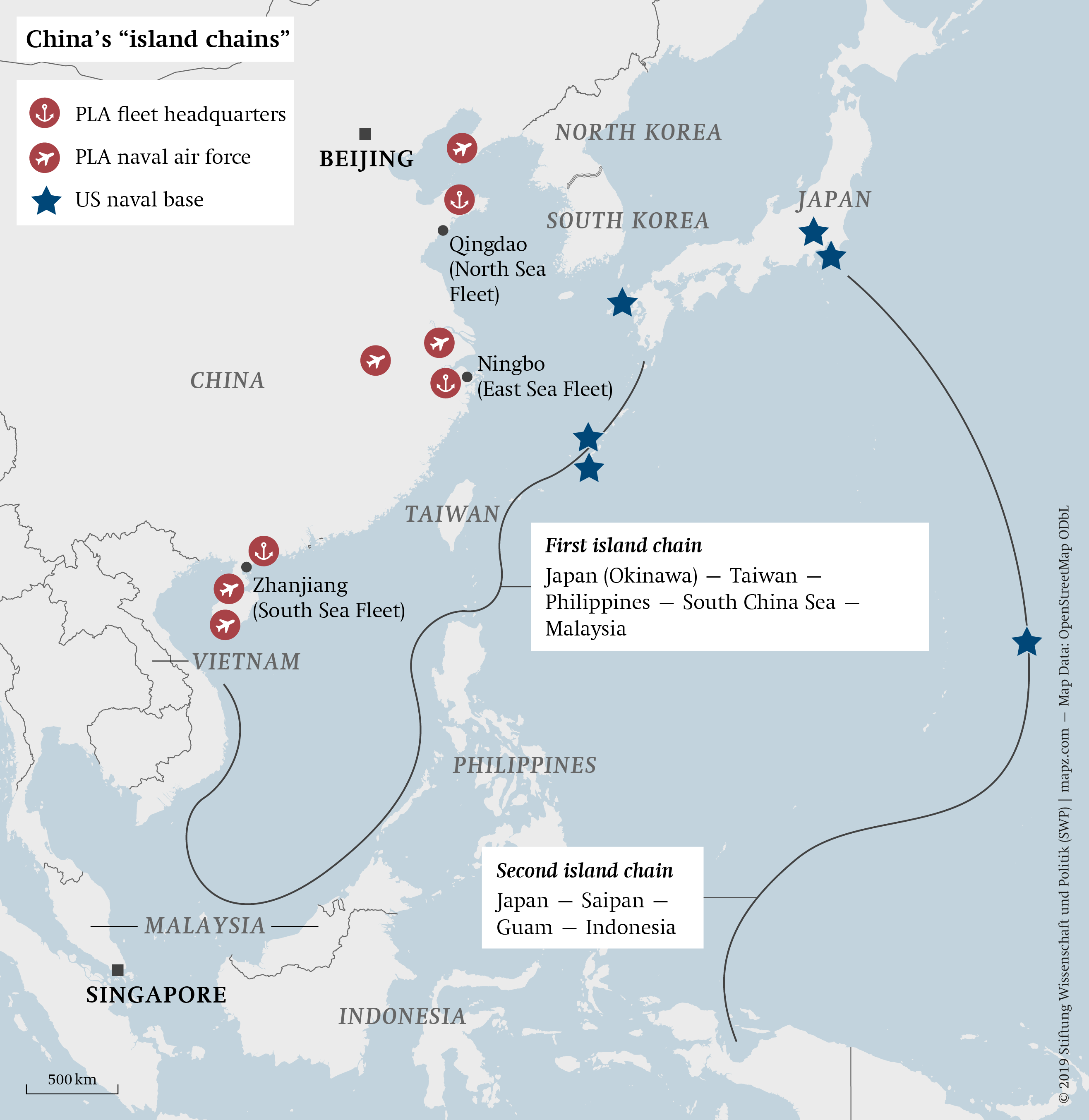
The entire dynamic—China's push, and the US-led pushback—is a perfect illustration of the balance of power theory in action on a global scale.
Conclusion
Today we translated abstract theory into a concrete analytical framework. We saw how the concepts of the security dilemma and the balance of power can help explain the persistent nature of interstate rivalry.
Key Takeaways:
- The Security Dilemma explains how in an anarchic system, one state's defensive actions can be perceived as offensive by another, leading to a spiral of mistrust and arms races, even without aggressive intent.
- Balance of Power theory describes how states react to a rising power that threatens to dominate the system. They use internal balancing (building their own strength) and external balancing (forming alliances) to counter the threat and restore equilibrium.
- These concepts provide a powerful realist lens for analyzing rivalries like India-Pakistan, which is defined by a deep-seated security dilemma, and US-China, which is a textbook case of a system-wide balancing act against a rising power.
So far, we have been operating within the realist worldview, which is pessimistic about the prospects for lasting peace. But is this the only way to see the world? What about the roles of trade, international law, and democracy?
In our next lesson, we will explore a competing theory: Liberalism. Liberalism offers a more optimistic vision of international relations, arguing that cooperation is not only possible but can be systematically fostered through institutions and economic interdependence. We will see how a liberal would analyze the same world but come to very different conclusions.