Hello! Welcome back.
In our last lesson, we explored the realist worldview, where the international system is a grim arena of power politics. We saw how concepts like the security dilemma and the balance of power explain why states are often locked in competition, using the India-Pakistan and US-China rivalries as case studies.
Today, we shift gears to examine a more optimistic perspective: liberal internationalism. While realists see a world trapped in a cycle of conflict, liberals see pathways to cooperation and lasting peace. This lesson directly addresses your interest in understanding the major theoretical frameworks of international relations.
Our goal is to explain the core assumptions of liberal internationalism and assess its predictions about how trade, institutions, and democracy can create a more peaceful world.
1. A Different Starting Point: From Power Politics to Individual Liberty
Realism starts with states competing for power in an anarchic system. Liberalism, drawing on the philosophy of thinkers like John Locke and Immanuel Kant, starts with the individual.
Introducing Liberalism in International Relations Theory
To understand this foundational difference, let's start with a clear overview of liberalism's core tenets from the E-International Relations textbook.
Please read the introduction and the section 'The basics of liberalism'. Pay close attention to how liberalism's primary goal is protecting individual rights (life, liberty, property) and how this domestic goal shapes its view of foreign policy.
As the reading explains, liberalism's core argument is that the highest goal of government is to protect individual freedom. Unchecked power, whether from a domestic dictator or a foreign aggressor, is the greatest threat to that freedom.
This "bottom-up" view, where the interests of individuals and societal groups shape the state's actions, is a fundamental departure from realism's state-centric "top-down" approach.
International Relations – Liberal Theory (2/7)
This short video from The Open University provides a concise explanation of this 'bottom-up' logic, where globalization and societal interests drive state behavior.
Watch the first 1 minute and 28 seconds. Focus on how the narrator describes liberalism as a theory where the demands of social groups 'drive what states do'.
2. The Three Pillars of the Liberal Peace
So, if the goal is to tame violent power, how do liberals propose to achieve this internationally? The theory rests on three core pillars, often referred to as the "Kantian Triangle," named after the philosopher Immanuel Kant. He argued that peace could be built upon a foundation of democracy, economic interdependence, and international institutions.
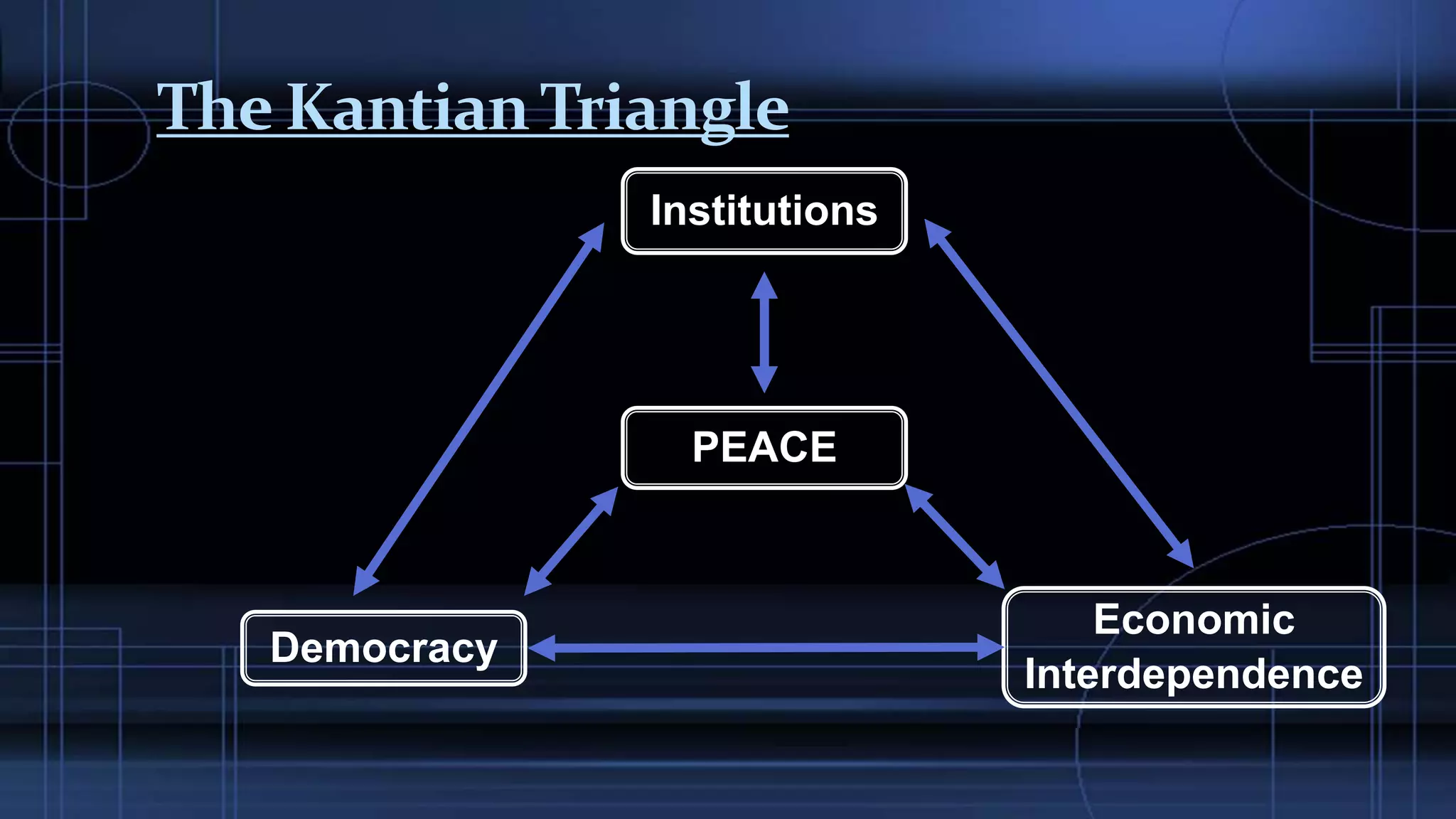
Let's break down each pillar.
Pillar 1: Democratic Peace Theory
This is one of the most powerful claims in all of international relations: democracies do not go to war with other democracies.
The explanation is twofold:
- Institutional Constraints: In a democracy, leaders are accountable to their people, who bear the costs of war (in blood and taxes). Checks and balances, a free press, and public debate make it much harder for leaders to launch reckless wars compared to an autocrat who answers to no one.
- Normative Logic: Democracies tend to view other democracies as legitimate and unthreatening. They share common values of compromise and rule of law, and they expect to be able to resolve disputes peacefully.
Introducing Liberalism in International Relations Theory
The E-International Relations article provides a solid overview of this important theory.
Now, read the section 'Democratic peace theory'. Note the two-part explanation (internal restraints and mutual legitimacy) and the debates surrounding the evidence.
Pillar 2: Economic Interdependence (Commercial Liberalism)
The second pillar is the idea that free trade fosters peace. The logic is straightforward: when countries have extensive trade and investment ties, the cost of going to war becomes prohibitively high. War would disrupt profitable supply chains, destroy markets, and wipe out investments.
This creates a powerful incentive for states to maintain peaceful relations. From this perspective, war is simply not profitable. Liberals focus on absolute gains, where cooperation can make everyone better off, contrasting with the realist focus on relative gains, where states worry about a rival gaining more than they do.
Pillar 3: International Institutions (Neoliberal Institutionalism)
Realists argue that the anarchic nature of the international system forces states into competition. Liberals—particularly a modern branch called neoliberal institutionalists—agree that the system is anarchic but argue that international institutions can overcome this problem.
How? Institutions like the United Nations (UN), the World Trade Organization (WTO), and the European Union (EU) act as mediators and rule-setters. They:
- Provide a forum for negotiation and diplomacy.
- Increase transparency and share information, reducing mistrust.
- Monitor compliance with treaties and agreements.
- Establish frameworks for resolving disputes peacefully.
Given your background in computer engineering, you can think of international institutions as analogous to protocols or APIs in a distributed system. The individual nodes (states) remain sovereign, but the protocols (international law and organizations) create a standardized framework for interaction. This reduces uncertainty and allows for complex cooperative behavior that would be impossible if every interaction had to be negotiated from scratch in an environment of total distrust.
Neoliberalism and Complex Interdependence
This video explains how neoliberal institutionalism evolved to directly challenge realism's claims about anarchy, and it introduces the crucial concept of 'complex interdependence'.
Please watch from 01:29 to 07:08. Pay close attention to how neoliberals accept the realist assumption of anarchy but arrive at a different conclusion about cooperation. Note the three dimensions of neoliberalism (social, economic, political) and the specific roles of international organizations.
3. Assessing Liberalism: Is It a Realistic Vision?
The learning outcome requires us to not just explain the theory but also to assess it. Liberalism's predictions are powerful, but how well do they hold up?
The Case for Liberalism
The theory's greatest strength is its ability to explain the "long peace" that has held between major liberal democracies since World War II. North America and Western Europe, once the epicenter of global conflict, have become a "zone of peace." Liberalism also explains the unprecedented levels of international cooperation through institutions like the EU, which has made war between France and Germany—once historic rivals—unthinkable.
The Liberalism of Peace... and the Liberalism of War
However, the historical record is not entirely peaceful. While liberal states may not fight each other, they have a long history of fighting non-liberal states. This reveals a crucial nuance. Liberalism has two legacies: a peace among liberals, and a tendency toward conflict with those outside the liberal circle.
To understand this complex legacy, we turn to the work of Immanuel Kant, as explained in a more advanced article.
Liberal internationalism: peace, war and democracy
This Nobel Prize-commissioned article by Michael Doyle delves into the different faces of liberalism and provides the definitive explanation of Kant's framework.
Please read the sections 'Liberal internationalism' and the first four paragraphs of the next section explaining Kant's theory (up to '...can exacerbate disputes and lead to restrictions on the range of contacts between societies...'). Focus on the two legacies: the 'pacific union' of peace among liberal states, and the 'international imprudence' or conflict with non-liberal states. Kant's three 'definitive articles' directly map onto the three pillars we just discussed.
As Doyle explains through Kant, the very factors that create peace among liberals can create conflict with non-liberals:
- Presumption of Amity: Liberals tend to trust other liberal states because they are seen as legitimate and consensual.
- Presumption of Enmity: They are suspicious of non-liberal states, seeing them as aggressive and oppressive towards their own people, and thus untrustworthy.
This can lead to "crusades for freedom" or interventions aimed at promoting democracy, which are often seen by others as liberal imperialism.
4. Liberalism and Today's Great Power Competition
How does liberalism view the rise of China, a powerful non-liberal state?
The dominant Western policy towards China for decades was "engagement." This was a quintessentially liberal strategy. The bet was that by integrating China into the global economy (Pillar 2: Trade) and international institutions like the WTO (Pillar 3: Institutions), China would eventually become more prosperous, and this prosperity would lead to internal political reform, making it a "responsible stakeholder" in the liberal order (Pillar 1: Democracy).
International Relations – Liberal Theory (2/7)
The Open University video you watched earlier concludes by applying liberal theory directly to the US-China relationship, framing it as this very 'wager'.
Now watch the final part of the video, from 07:26 to 09:50. The speaker argues that the policy of engagement is a direct application of liberal theory.
The assessment of this "liberal bet" is one of the most critical debates in geopolitics today. Has it worked? Or have realists been proven right that a rising power will inevitably challenge the existing order, regardless of trade ties? The recent shift towards a more confrontational US-China relationship suggests that many policymakers believe the liberal wager has failed.
For a state like Nepal, squeezed between a democratic-but-nationalist India and an authoritarian China, liberal theory offers a different set of strategic prescriptions than realism. A realist might advise balancing between the two giants. A liberal might advise focusing on strengthening ties through international law, joining regional institutions, and maximizing trade to create mutual dependencies that would make conflict too costly for either neighbor.
Conclusion
Today, we've explored liberalism, a major theoretical tradition that offers a powerful counterpoint to realism.
Key Takeaways:
- Core Assumptions: Liberalism starts with the individual and believes that protecting liberty requires limiting state power. It sees the possibility of progress and cooperation in international affairs.
- Predictions for Peace: Liberalism argues that a combination of democracy (accountable government), economic interdependence (trade), and international institutions (rule of law) can overcome the anarchy of the international system.
- A "Separate Peace": The theory's strongest claim is the Democratic Peace Theory, which accurately explains the absence of war between liberal democracies.
- A Dual Legacy: Liberalism is not purely pacifist. The same principles that foster trust among liberal states can generate suspicion and conflict in relations with non-liberal states.
In our first two theory lessons, we've focused on material factors: power and security for realists; trade and institutions for liberals. But what about the power of ideas, identity, and shared norms? What if a state's interests are not fixed, but are shaped by its culture and relationships?
In our next lesson, we will explore Constructivism, a third major IR theory that argues our social world, including international politics, is shaped by the ideas we hold about it.