Hello! Welcome back.
In our previous lessons, we've examined how great power competition can destabilize smaller states, looking at the proxy war in Syria and the continent-wide scramble for influence in Africa. We saw how external powers, pursuing their own interests, can erode the sovereignty and undermine the governance of other nations.
Today, we pivot from the perspective of the great power to that of the small state. Are they merely passive victims on a geopolitical chessboard? Far from it. This lesson addresses the learning outcome: Assess how small states navigate great power competition through hedging, bandwagoning, and balancing strategies.
We will explore the active, strategic choices that smaller nations make to preserve their autonomy, security, and prosperity. These strategies are a fascinating exercise in constrained optimization—maximizing national interest within a system dominated by larger actors. This is particularly relevant given your interest in how Nepal navigates its position between India and China, and we will use Nepal as a central case study.
1. The Classic Choices: Balancing and Bandwagoning
When faced with a powerful or threatening state, a smaller state has historically been seen as having two primary, opposing options rooted in realist international relations theory: balancing and bandwagoning.
To get a clear and concise definition of these core concepts, let's start with a short video.
NATO Expansion: Balancing, Bandwagoning, or Buck Passing?
This video from the 'IR Explainer' series introduces the foundational strategies states use when confronted by a more powerful opponent. It will give us a quick, clear overview of balancing and bandwagoning.
Please watch from 02:51 to 04:14. As you watch, focus on the distinction between these two strategies: Balancing: What are the two ways a state can 'balance' against a threat? Bandwagoning: Why would a weaker state choose to join with the most powerful state instead of resisting it?
To summarize and expand on the video:
-
Balancing: This is a strategy of resistance. A state concludes that the dominant power is aggressive and its intentions are hostile. The goal is to preserve one's independence by pushing back against the powerful state.
- Internal Balancing: Building up one's own capabilities (e.g., strengthening the military, growing the economy).
- External Balancing: Forming alliances with other states to create a coalition that can counter the threatening power. The creation of NATO to balance against the Soviet Union is a classic example.
-
Bandwagoning: This is a strategy of appeasement and alignment. A state concludes that resistance is too costly or futile. It decides to align with the dominant power. The goal might be to gain favor, avoid being attacked, or even share in the spoils of the powerful state's conquests.
These two strategies present a stark choice: resist or submit. However, in today's complex and interconnected world, especially for states that are not facing an immediate military invasion, a more nuanced "middle path" has become increasingly common. This is the strategy of hedging.
2. Hedging: The Art of Strategic Ambiguity
Hedging is a risk-management strategy. The term comes from finance, where an investor hedges their bets to protect against losses. In geopolitics, a small state hedges to protect its autonomy and maximize its benefits amidst the uncertainty of great power rivalry. Instead of choosing a side, a hedging state deliberately cultivates a middle position.
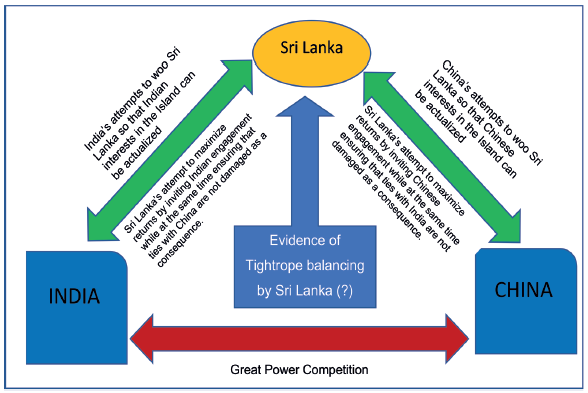
To understand the mechanics of hedging, we will turn to a detailed policy brief from the Lakshman Kadirgamar Institute, a Sri Lankan foreign policy think tank.
This policy brief, 'Deciphering Hedging,' provides an excellent theoretical framework and applies it to South Asian states, including Nepal. It will be our primary guide for this section.
Please read the Introduction (Section 1.1) and the section on The Concept of Hedging (Section 1.2.2). You can find these on pages 3 and 5-7. As you read, focus on answering these questions: How is modern hedging different from the Cold War-era policy of 'non-alignment'? What are the three core features of hedging identified by scholar Cheng-Chwee Kuik?
As the paper explains, hedging is more than just not picking a side. It is an active and complex strategy. Kuik's three-part framework provides a powerful analytical tool for identifying it:
- Eschewing Rigid Alignments: The state purposefully avoids binding security alliances with any major power. It might engage in military exercises or buy arms from multiple powers, but it refuses to be locked into a formal treaty that would obligate it to support one power against another.
- Inclusive Diversification (for Fallback Options): The state actively cultivates a wide range of diplomatic, economic, and security partnerships. This creates a safety net. If relations with one great power sour, the state can lean on its relationships with others. It's about not putting all your eggs in one basket.
- Pursuing Contradictory Measures: This is the heart of hedging's strategic ambiguity. A hedging state deliberately sends mixed signals. It might cooperate deeply with China on an infrastructure project (pleasing Beijing) while simultaneously joining a U.S.-led maritime security exercise (pleasing Washington). This intentional inconsistency keeps the great powers uncertain about the state's ultimate loyalties, thereby preserving its freedom of action.
3. Case Study: Nepal's Geopolitical Tightrope
Your home country, Nepal, is a quintessential example of a state navigating extreme geopolitical pressures through hedging. Landlocked between the regional giant, India, and the global superpower, China, Nepal's foreign policy is a masterclass in this strategy.
Let's use the same policy brief to see how Kuik's framework applies directly to Nepal.
We will now focus on the section of the policy brief dedicated to Nepal's foreign policy.
Please read Section 2.2 on Nepal (pages 15-18). As you read, try to find a specific policy or action that illustrates each of the three features of hedging: An example of eschewing rigid alignments. An example of inclusive diversification. An example of pursuing contradictory measures.
Let's break down the examples from the text, which perfectly illustrate the strategy:
-
Eschewing Rigid Alignments: Nepal has no formal military alliance with India, China, or the US. However, it maintains active military relationships with all three. It conducts the annual Surya Kiran exercise with India, the Sagarmatha Friendship exercise with China, and participates in exercises like Pacific Angel with the U.S. This diversified military engagement prevents dependency on any single security patron.
-
Inclusive Diversification: The paper highlights Nepal's broad diplomatic engagement. It actively courts high-level visits from Indian, Chinese, and American officials, often in quick succession. Economically, it engages with Japan on the Nagdhunga Tunnel and the EU on the 'Global Gateway' energy project, showing it is looking for partners beyond its immediate, powerful neighbors.
-
Pursuing Contradictory Measures: This is where Nepal's strategy is most apparent. It is a signatory to China's Belt and Road Initiative (BRI), yet as the paper notes, no major projects have actually materialized. At the same time, it ratified the US Millennium Challenge Corporation (MCC) compact, a development grant widely seen as a U.S. tool to counter Chinese influence. By being part of both competing initiatives, Nepal signals to both Washington and Beijing that it is open for business but not for sale, maximizing its development options while minimizing political commitment.
4. Why Do Great Powers Tolerate Hedging?
A logical question arises: if a great power wants a small state on its side, why would it tolerate such ambiguity? Why not force a choice?
The answer lies in the strategic calculation of the great powers themselves. Forcing a choice is risky; it could push the small state decisively into the rival's camp. Often, it's better to have a small state's partial support than none at all. Furthermore, small states offer assets beyond just military alignment—most notably, diplomatic legitimacy.
China's Small State Diplomacy Strategy in Latin America
This video discusses China's diplomatic strategy toward small states, in this case in Latin America, but the logic is universally applicable. It explains why a great power might invest significant effort in courting small nations.
Please watch the segment from 14:38 to 18:22. Focus on the core reason given for why a tiny state like Dominica, with a small population and economy, matters to China.
The key insight from the video is the power of one vote in multilateral institutions like the United Nations. In the UN General Assembly, Dominica's vote is equal to that of the United States. By cultivating relationships with dozens of small states—even if those states are hedging—a great power can build coalitions to support its positions, legitimize its actions, and shape the narrative of global governance. This diplomatic support is a valuable prize, often worth the price of tolerating a small state's strategic ambiguity.
Conclusion
Today, we've established that small states are not just passive objects in great power politics. They are active agents employing sophisticated strategies to navigate a dangerous world.
Key Takeaways:
- Faced with great power competition, small states can resort to balancing (resisting the threat) or bandwagoning (aligning with the threat).
- A more common modern strategy is hedging, which seeks to manage risk and maximize autonomy by avoiding rigid alliances, diversifying partnerships, and pursuing deliberately contradictory policies.
- Nepal's foreign policy toward India, China, and the US serves as a classic example of hedging in action, simultaneously engaging with competing initiatives like the BRI and the MCC.
- Great powers often tolerate hedging because the diplomatic support of small states (e.g., votes in the UN) is strategically valuable, and the cost of forcing alignment can be counterproductive.
Preview of the Next Lesson:
Having explored how small states navigate the pressures from global powers, we will now zoom in on a regional rivalry that intersects with these global dynamics. Our next lesson will address the learning outcome: Analyze the India-Pakistan rivalry as a persistent regional conflict and its intersection with great power politics. We will examine the historical roots and current state of this conflict and see how the involvement of powers like China and the US shapes the strategic calculus of both New Delhi and Islamabad.