Hello! Welcome to the next lesson in our exploration of Great Power Competition.
In our last session, we discussed the strategic toolkit available to smaller states caught between larger powers, focusing on the theories of balancing, bandwagoning, and hedging. We used Nepal as a prime example of a state employing a sophisticated hedging strategy to maintain its autonomy.
Today, we move from theory to practice to address the learning outcome: Explain how smaller South Asian states (e.g., Nepal, Sri Lanka) navigate their relationships with India and China. We will build directly on our previous discussion, examining the specific, real-world challenges and opportunities these countries face. Given your background and interests, this lesson will offer deep insights into the geopolitics of your home region, showcasing how nations like Nepal and Sri Lanka actively shape their own destinies rather than being passive pawns.
1. Nepal: The Art of Being "Land-Linked"
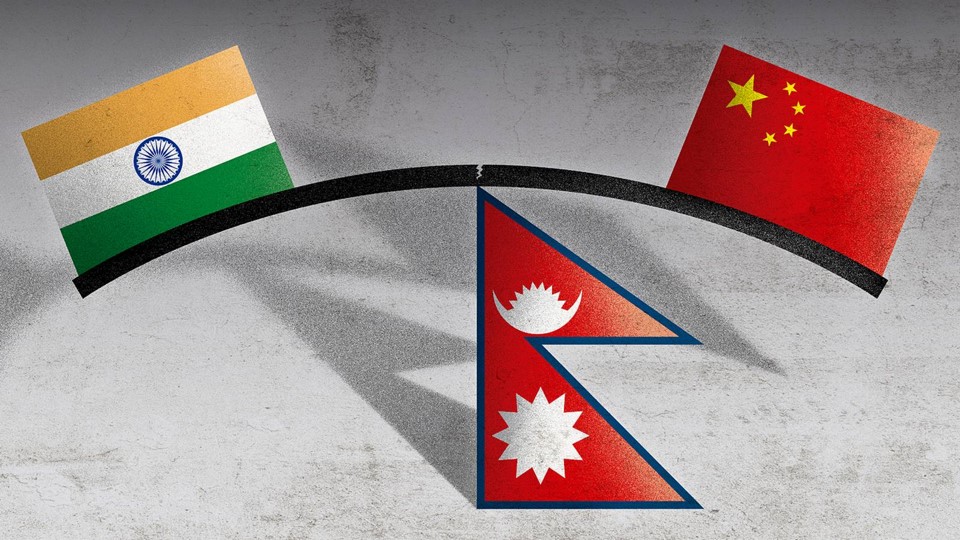
We've established that Nepal is a classic "buffer state," but modern Nepali strategic thinking aims to reframe this position. The goal is to transform from a "yam between two boulders"—a vulnerable position—to a dynamic, land-linked bridge between two of the world's largest economies.
To understand this perspective from the inside, let's begin with a talk by Dr. Minendra Rijal, a prominent Nepali politician.
Navigating Nepal's Geopolitics | Dr. Minendra Rijal | TEDxKathmanduUniversity
In this TEDx talk, 'Navigating Nepal's Geopolitics,' Dr. Rijal outlines Nepal's foreign policy aspirations and the practical challenges of managing its relationships with India, China, and the wider world. This provides an authentic Nepali viewpoint on the very issues we are studying.
Please watch from the beginning until 06:22. As you watch, consider these points: How does Dr. Rijal want to change the narrative from Nepal being 'landlocked' to 'land-linked'? What are the key differences he highlights in Nepal's relationship with India versus its relationship with China? How does the global competition between the US and China affect Nepal's strategic calculus with India?
Dr. Rijal's talk highlights the core of Nepal's strategy: leveraging its position not just for survival, but for prosperity. This involves a complex, multi-layered approach that we can analyze more formally.
Hedging in Action: Competing Initiatives
As we discussed in the previous lesson, a key feature of hedging is the simultaneous pursuit of contradictory policies. Let's look at how this plays out with specific examples of India-China rivalry in Nepal.
The paper 'Navigating India-China Rivalry' provides concrete details on the competition for influence in Nepal. We'll read the section dedicated to this topic.
Please read the section 'India-China Rivalry in Nepal' by Pramod Jaiswal. It starts on page 49. Focus on the subsections 'Competition and Confrontation' and the paragraphs that follow. As you read, note down the specific sectors where India and China are directly competing in Nepal (e.g., infrastructure, security, trade).
The paper details a fascinating pattern of competition:
- Infrastructure: China's proposal for the Trans-Himalayan Railway connecting to Kathmandu is countered by India's proposals for multiple cross-border rail links from its territory. China builds one strategic road, and India counters by funding another.
- Economic Aid & Investment: China has overtaken India in foreign direct investment (FDI) and competes directly in sectors like hydropower and cement. When one country provides development aid to a region like Mustang, the other quickly follows suit.
- Security Cooperation: India's long-standing, deep-rooted military ties (Gurkha recruitment, training, arms supply) are now met with Chinese efforts. China initiated the "Sagarmatha Friendship" joint military exercise, provides military aid, and offers training for the Nepalese Army, directly competing with India's influence.
- Trade and Transit: Nepal signing a Transit and Transport Agreement with China gives it access to Chinese seaports, a landmark move explicitly designed to reduce its historical, and at times politically fraught, dependence on India for access to the sea.
This is hedging in its purest form. By engaging both sides, Nepal creates a competitive environment where it becomes the beneficiary, gaining infrastructure, aid, and investment from two suitors eager to outdo each other. It diversifies its options, reducing dependency and thereby increasing its strategic autonomy.
2. Sri Lanka: Navigating the Maritime Great Game
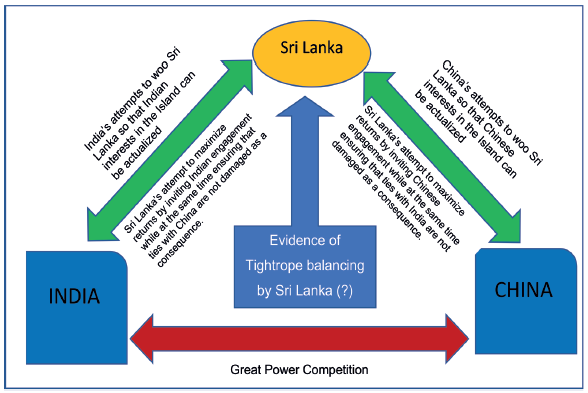
Like Nepal, Sri Lanka is a small state in a strategic location, but its challenges and strategies are shaped by its maritime geography at the heart of the Indian Ocean. Its approach is often described as a "tightrope walk."
For decades, Sri Lanka maintained a non-aligned foreign policy. However, the end of its civil war in 2009 created a massive need for reconstruction and development funding, an opportunity China eagerly seized. This has led to a perceived "tilt" in its foreign policy.
Sri Lanka's Foreign Policy Tilting Towards China, Says Author-Analyst
This interview with analyst Asanga Abeyagoonasekera discusses Sri Lanka's foreign policy dynamics. It provides excellent insight into the strategic thinking behind Sri Lanka's engagement with China and the concept of 'bandwagoning'.
Please watch from 03:24 to 13:03. Focus on these questions: The analyst uses the term 'bandwagoning with China.' Based on what he says, do you think this is pure bandwagoning (total alignment) or a form of hedging that looks like bandwagoning? What are the strategic concerns surrounding Chinese-funded projects like the Hambantota Port and the Colombo Port City? How does the analyst describe the dilemma Sri Lanka faces when visited by high-level US and Chinese officials, and what is his recommended path forward?
The Infrastructure Battleground
The video highlights the centrality of large-scale infrastructure projects in the India-China competition in Sri Lanka. These projects are not just economic; they are deeply geopolitical.
The paper we consulted for Nepal, "Navigating India-China Rivalry," also contains an excellent chapter on Sri Lanka that details this competition.
Sri Lanka: Navigating Sino-Indian Rivalry
We will now read the chapter on Sri Lanka to understand the specifics of the Sino-Indian rivalry on the island.
Please read the section titled 'Sri Lanka: Navigating Sino-Indian Rivalry' by Chulanee Attanayake and Archana Atmakuri, starting on page 67. Focus on the section 'Competition for Investment Infrastructure Development' (pages 70-76). Pay attention to how competition in one project often directly triggers a counter-project from the rival power.
The key takeaways from the reading and video are:
- Port Politics: This is the main arena of competition. China's development of Hambantota Port, a project India initially declined, was a major strategic move. In response, India, along with Japan, has invested in developing the East Container Terminal at the Colombo Port, geographically close to the Chinese-operated Colombo International Container Terminal and the massive Colombo Port City project.
- Strategic Proximity: India is particularly sensitive to Chinese activity in Sri Lanka's north, which is geographically and culturally close to Southern India. India's development of the Jaffna International Airport and housing projects in the north are clear strategic moves to maintain influence in this region and counter Chinese projects elsewhere.
- Debt and Leverage: The discussion around Hambantota Port—which Sri Lanka leased to a Chinese company for 99 years after struggling with debt repayments—is a focal point for the "debt-trap diplomacy" debate you will encounter frequently in this course. While the reality is complex, the episode demonstrates how economic leverage can translate into strategic control.
Sri Lanka, like Nepal, masterfully plays both sides. The Rajapaksa government welcomed massive Chinese investment. The subsequent government sought to rebalance by strengthening ties with India and the West. The current government again emphasizes a neutral, "equidistant" foreign policy, stating it is open to investment from all, effectively inviting competition that it can leverage for its own development.
3. An Indian Perspective: The "Neighborhood First" Response
How does the regional hegemon, India, view these developments? Unsurprisingly, with significant concern. China's deepening economic, political, and military footprint in South Asia is seen in New Delhi as a strategic encroachment into its traditional sphere of influence.
India's "Neighborhood First" policy, articulated under Prime Minister Narendra Modi, can be understood as a direct response to this challenge. It is an attempt to reinvigorate relationships and re-establish India as the primary partner for its smaller neighbors.
The concluding essay in the "Navigating India-China Rivalry" paper offers this perspective. It notes that while India cannot match China's deep pockets dollar-for-dollar, it competes by:
- Improving Project Delivery: Expediting projects like the oil pipeline with Nepal and housing in Sri Lanka.
- Leveraging Cultural Ties: Promoting shared Hindu and Buddhist heritage.
- Providing Humanitarian Aid: Being the "first responder" during crises like the 2015 Nepal earthquake.
- Partnering with Other Powers: Collaborating with Japan and the US on development and security initiatives to offer an alternative to China's Belt and Road Initiative.
This shows that the great powers are also adapting their strategies in response to the hedging and balancing of the smaller states.
Conclusion
Today, we've moved beyond theoretical definitions to see how the strategic navigation of great power competition works in practice in South Asia.
Key Takeaways:
- Nepal transforms its landlocked geography into a "land-linked" opportunity by fostering intense competition between India and China in infrastructure, security, and trade, thereby maximizing its development gains and strategic autonomy.
- Sri Lanka leverages its strategic maritime location to attract competing investments, particularly in port infrastructure. It walks a "tightrope," balancing its deep economic engagement with China against the security sensitivities of its traditional partner, India.
- Both countries demonstrate that small states are not passive. They use sophisticated hedging strategies—balancing, diversification, and strategic ambiguity—to advance their national interests.
- Regional powers like India are actively responding with their own policies, such as "Neighborhood First," to counter China's influence and maintain their strategic position.
Preview of the Next Lesson:
We have focused on how small states manage their relationships with larger, often competing, powers. Next, we will shift our focus to a direct, long-standing conflict between two of the region's major powers themselves. Our next lesson will address: Analyze the India-Pakistan rivalry as a persistent regional conflict and its intersection with great power politics. We will explore the historical roots of this conflict and analyze how external powers, especially China and the US, are deeply intertwined in its dynamics.