Hello! Welcome back to our course on geopolitics.
In our last lesson, we traced the broad historical shifts in American grand strategy, from its early isolationism to the Cold War policy of containment and the recent pivot back to great-power competition. We established that a core U.S. objective has been to prevent any single power from dominating the Eurasian landmass.
Today, we will examine the primary instruments the U.S. uses to achieve this objective. This lesson directly addresses the learning outcome: Explain the strategic logic behind the US alliance network (NATO, hub-and-spoke in Asia) and forward military basing. We will deconstruct how these military and political structures allow the United States to project power, deter rivals, and maintain its global influence.
1. The Logic of Forward Presence: Overcoming Geography
Before we can discuss alliances, we need to understand why the U.S. places its military forces thousands of miles from its own shores. The core concept is about overcoming the constraints of geography.
A central idea in military strategy is the "loss of strength gradient." This theory states that the further a country projects its military power from its homeland, the weaker and less effective that power becomes due to logistical challenges. A global network of military bases is the primary solution to this problem.
Let's watch a video that explains this logic clearly.
The US' Overseas Military Base Strategy
The Wendover Productions video, 'The US' Overseas Military Base Strategy,' provides an excellent overview of the strategic rationale for forward basing. It's a perfect starting point for our discussion.
Please watch two key segments: The Loss of Strength Gradient (04:50 - 05:46): This section explains the core theoretical reason for overseas bases. Power Projection (08:58 - 10:43): This part explains how bases translate into the ability to deter threats and respond to crises rapidly. Notice how the map shown reinforces the idea of placing bases near potential adversaries like Russia and China.
The video effectively explains that forward bases are about pre-positioning military capability. This allows the U.S. to:
- Deter aggression by making its commitment to an ally credible and raising the immediate costs for any potential attacker.
- Respond to crises far more quickly than if it had to deploy forces from North America.
- Maintain operational access to critical regions, preventing rivals from closing off areas through their own military capabilities.
The U.S. Army publication, "The Role of Forward Presence in U.S. Military Strategy," reinforces this by distinguishing between deterrence by punishment (threatening to strike back later) and deterrence by denial (making an attack impossible to succeed in the first place). Forward-deployed land forces are the key to deterrence by denial, as they signal that any aggression will immediately meet armed resistance.
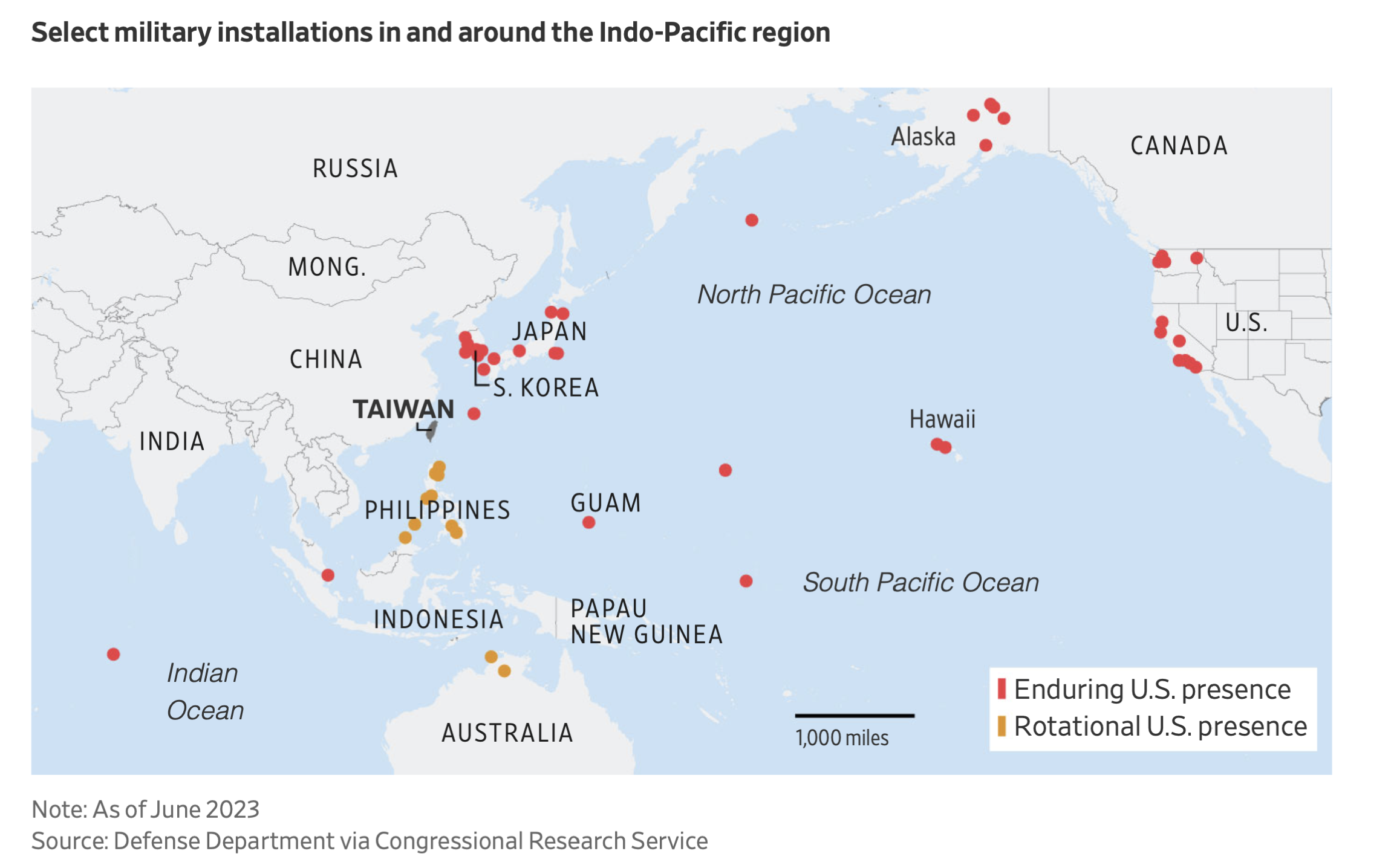
2. Structuring Alliances: Two Models for Two Theaters
Forward bases don't exist in a vacuum; they require the political consent and cooperation of a host nation. This is where alliances come in. The U.S. has historically used two different models for its major alliance networks.

Your background in computer engineering provides a useful analogy here. You can think of NATO as a more "meshed" network topology, offering redundancy, while the traditional Asian system is a classic "star" or "hub-and-spoke" topology. Let's analyze each.
The Asian "Hub-and-Spoke" System
In Asia, the U.S. did not create a NATO equivalent. Instead, it forged a series of separate, bilateral defense treaties with key countries like Japan, South Korea, the Philippines, and Australia.
To understand the origins and logic of this system, let's turn to an academic paper.
[PDF] Great-Power Rivalry and the US Hub-and-Spoke Security System in ...
The paper 'Great-Power Rivalry and the US Hub-and-Spoke Security System in East Asia' explains why this model was chosen and how it functions.
Please read two sections: Start under the heading '1.2 US Hub-and-Spoke Security System in East Asia' (page 86) and read to the end of that subsection. This explains the historical reasons for the bilateral model (e.g., Japan's preference, lack of common identity among Asian states). Next, read the subsection '(1) Reasons and Shackles' under '3.2.2 Hub-and-Spoke Security System' (page 89). Focus on the strategic advantages this gives the U.S., such as preventing 'free-riding' and maintaining greater control over its allies.
As the paper highlights, the hub-and-spoke system was a product of its time but also a deliberate strategic choice. By keeping the alliances bilateral, the U.S. could:
- Tailor each security relationship to the specific country.
- Prevent historical rivalries (e.g., between Japan and South Korea) from complicating a broader alliance.
- Maintain maximum leverage and prevent allies from "ganging up" on the U.S. or dragging it into unwanted conflicts.
Evolving the Model: From Spokes to a Network
This classic hub-and-spoke model is now evolving. Faced with a rising China, U.S. strategists see the old system as too disjointed. The new approach is to "knit together" the spokes, creating a more integrated network of allies who can cooperate not just with the U.S., but also with each other.
The following video features a former senior Pentagon official, Eli Ratner, discussing this exact strategic shift. It provides a fascinating, high-level view of current U.S. policy.
Would an Asian NATO Be Good for America?
In this discussion from the Carnegie Endowment, Eli Ratner outlines the case for evolving the Asian alliance system. This is a direct window into the thinking that drives U.S. strategy in the Indo-Pacific today.
We'll focus on three key clips: Explaining the Old Model's Limits (12:20 - 15:00): Ratner describes the traditional 'hub-and-spoke' model and argues its informal nature is insufficient to deter China. Why These Allies? (15:00 - 19:52): He explains why the U.S. is focusing on networking Japan, the Philippines, and Australia, citing their strategic alignment on the China challenge and increasing defense cooperation among themselves. The Military Benefits (30:24 - 34:09): This segment details the concrete military advantages of a networked alliance: integrated planning, coordinated command and control, and seamless multilateral operations. This answers the 'how' and 'why' of the strategic shift.
Ratner's proposal illustrates a key theme of modern U.S. strategy: strengthening alliances by encouraging allies to take on more responsibility and work together, creating a more resilient and capable deterrent network against a peer competitor.
NATO: The Multilateral Collective Defense Model
In Europe, the U.S. took a completely different approach. The North Atlantic Treaty Organization (NATO) is a multilateral alliance built on the principle of collective defense, enshrined in Article 5 of its treaty: an attack on one member is an attack on all.
NATO was the military backbone of the containment strategy against the Soviet Union. Its strategic logic went beyond simple deterrence.
The Role of Forward Presence in U.S. Military Strategy
Let's return to the Army University Press article, which explains the stabilizing effect of the NATO alliance in Europe.
Please read the section titled 'Assuring Allies' (starts on page 4). Focus on the subsection 'Mitigating Regional Security Dilemmas.' This explains how the U.S. security guarantee through NATO prevented European states from engaging in their own destabilizing arms races.
The U.S. presence in NATO served two crucial purposes:
- To deter the Soviet Union: A massive, combined military force backed by U.S. nuclear weapons made a conventional invasion of Western Europe unthinkable for Moscow.
- To pacify Europe: By providing an external security guarantee, the U.S. solved the security dilemma for countries like France and Germany. They no longer needed to build up massive armies to defend against each other, allowing for the economic and political integration that led to the European Union. This was a monumental achievement in geopolitical management.
Today, NATO has expanded and found renewed purpose in deterring a resurgent Russia, demonstrating the enduring logic of collective defense in Europe.
Conclusion
Today we've unpacked the core machinery of American global power. We've seen that forward military basing and alliance networks are not just historical artifacts but are deeply intertwined, mutually reinforcing tools of grand strategy.
Key Takeaways:
- Forward Military Basing: This is the physical solution to the "loss of strength gradient," allowing the U.S. to project power, deter by denial, and respond to crises effectively.
- The Hub-and-Spoke System (Asia): A network of bilateral alliances that gives the U.S. flexibility and control. It is currently evolving into a more integrated "networked" structure to present a more credible deterrent to China.
- NATO (Europe): A multilateral, collective defense alliance that successfully deterred the Soviet Union and stabilized Western Europe by solving its internal security dilemmas. It is now repurposed to deter Russia.
- Synergy: Alliances provide the political framework for forward basing, while the bases provide the military credibility that makes alliance guarantees meaningful.
In our next lesson, we will pivot from the military and diplomatic instruments of power to the economic ones. We will investigate how the U.S. dollar's unique status as the world's reserve currency provides enormous geopolitical leverage, particularly through the use of economic sanctions.