Hello! Welcome to the first lesson of our fourth module, "American Grand Strategy and Global Influence."
In our last lesson, we concluded our study of the fundamental architecture of global power by analyzing how nuclear deterrence creates a "balance of terror." We saw that while these weapons constrain all-out war between great powers, they paradoxically can make lower-level conflicts more likely. Now, we shift from these universal principles to examine how a specific great power has navigated this system.
This lesson will trace the grand sweep of American foreign policy, addressing the learning outcome: Trace the evolution of US foreign policy from isolationism through containment to the post-Cold War era. We will explore the pendulum swing between the United States' deep-seated impulse to remain apart from the world's conflicts and the strategic imperatives that have repeatedly pulled it toward global leadership. This historical journey is essential for understanding America's current role and the international order it helped to build.
1. The Founding Tradition: Isolationism and Regional Hegemony (c. 1796-1917)
For much of its early history, the United States pursued a policy of "isolationism," but this term requires careful definition. It was not about cutting off the U.S. from the world, but rather about avoiding entanglement in the persistent power struggles of Europe.
Let's begin by reading a short text that frames this core tension in American foreign policy.
The book 'The American Paradox' uses an interesting metaphor of superheroes torn between saving the world and living a normal life to describe the U.S. struggle with isolationism and interventionism. We'll read the section that lays out the historical roots of this tradition.
Please read the section titled 'CHAPTER 1: THE TRADITION OF ISOLATIONISM AND CHALLENGE OF INTERVENTIONS' (starting on page 19). Focus on George Washington's Farewell Address and the strategic logic of using geographic distance to avoid European wars.
As the reading explains, the policy of avoiding "entangling alliances" was a deliberate strategic choice. However, this isolation from European affairs was paired with a very different strategy in its own neighborhood. While avoiding Europe's wars, the U.S. aggressively expanded across North America and asserted its dominance over the Western Hemisphere.
The following video by the prominent international relations scholar John Mearsheimer explains this dual policy from a realist perspective.
American Foreign Policy from 1783,John Mearsheimer Explains, A History of Hegemony.
In this clip from 'American Foreign Policy from 1783,' Mearsheimer argues that the U.S. was anything but passive, acting as a ruthless rising power to secure its own region.
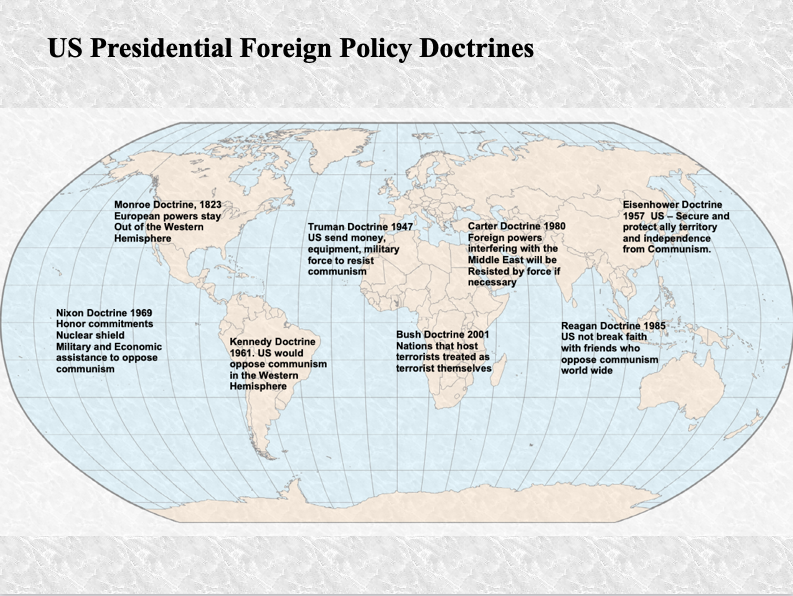
Watch from 00:00 to 04:47. Pay close attention to two key elements: The history of U.S. expansion across the North American continent. The purpose of the Monroe Doctrine (1823) in expelling European great powers and establishing the Western Hemisphere as an exclusive American sphere of influence.
So, the first phase of U.S. foreign policy can be summarized as:
- Isolationism towards Europe: Avoiding involvement in their balance-of-power politics.
- Expansionism and Hegemony at home: Dominating the North American continent and ensuring no other great power could challenge the U.S. in the Americas.
This established the U.S. as a regional hegemon, a power secure in its own backyard, which is a foundational concept we've discussed.
2. The Great Wars: A Reluctant Interventionist (1917-1945)
The dawn of the 20th century, particularly World War I and World War II, shattered the viability of American isolationism. The U.S. was drawn into both conflicts, marking a dramatic shift toward global engagement, even if the public and political establishment remained reluctant.
Let's return to 'The American Paradox' to see how these global shocks forced a change in U.S. policy.
Read the first four paragraphs of the section beginning with 'The ambivalence of superheroes...' (from page 10 up to '...ideological threat did not recognize borders or honor neutrality.'). Focus on the events that shifted public opinion and the key difference between the aftermath of WWI (a return to neutrality) and WWII (the final collapse of isolationism).
From a strategic perspective, why did the U.S. intervene? Mearsheimer provides a compelling realist explanation that builds on the geopolitical theories we covered in our first module.
American Foreign Policy from 1783,John Mearsheimer Explains, A History of Hegemony.
In this next segment of the same video, Mearsheimer explains the strategic logic behind U.S. entry into the World Wars and the Cold War.
Watch from 04:47 to 07:22. The core argument is that the U.S. intervened to prevent a potential peer competitor (Imperial Germany, Nazi Germany, the Soviet Union) from achieving hegemony over Europe or Asia. A state that dominates the Eurasian landmass could marshal enough resources to challenge U.S. power globally.
The end of World War II presented a new reality. With Europe in ruins and the Soviet Union emerging as a powerful ideological and military rival, a return to isolationism was no longer considered a viable option. The U.S. had to embrace a permanent role as a global power.
3. The Cold War: The Strategy of Containment (c. 1947-1991)
The defining U.S. grand strategy for the next four decades was containment. The goal was not to defeat the Soviet Union in a direct war (a terrifying prospect in the nuclear age) but to contain its influence and patiently wait for the internal contradictions of the communist system to cause its collapse.

The architect of this strategy was a diplomat and historian named George F. Kennan. His thinking was remarkably sophisticated, drawing from history, philosophy, and literature. Given your interest in strategic frameworks, you'll find the intellectual foundations of his strategy particularly interesting.
Evening Lecture | John Lewis Gaddis: George Kennan and American Grand Strategy during the Cold War
In this lecture, historian John Lewis Gaddis, Kennan's official biographer, explains the deep thinking behind containment. This is a masterclass in how classical knowledge can inform modern strategy.
This is a rich source, so we'll focus on a few key clips: Prediction of Collapse (19:33 - 24:02): Watch how Kennan used his reading of classical history (Gibbon's Decline and Fall of the Roman Empire) to argue that the Soviet empire, like all empires built on coercion, contained the 'seeds of its own decay.' The Method (29:14 - 34:58): Watch this segment to understand how the military theorist Clausewitz influenced Kennan. Focus on the ideas of proportionality (using only enough force to achieve a political goal) and the virtues of defense (letting an opponent exhaust themselves). The Metaphor (52:06 - 53:17): Watch this final, short clip for Kennan's 'horticultural' metaphor for containment—not destroying the Soviet 'plant,' but patiently guiding its growth in less threatening directions.
Kennan's patient, defensive containment was the dominant theme, but it evolved over time. The Reagan administration in the 1980s adopted a more assertive version, aiming not just to contain the Soviet Union but to actively "roll back" its influence and hasten its demise. This was famously summarized by Reagan's simple mandate: "We win, they lose."
4. The Post-Cold War Era: Unipolarity and the Search for a New Strategy
The collapse of the Soviet Union in 1991 fundamentally changed the world. The U.S. was left as the sole superpower in what became known as the "unipolar moment." This launched a new debate: what should U.S. foreign policy be in a world without a peer competitor?
The following resource analyzes the official National Security Strategy (NSS) documents published by each presidential administration, providing a direct window into their strategic thinking.
Understanding National Security Strategies Through Time
This article, 'Understanding National Security Strategies Through Time,' provides a data-driven overview of how U.S. strategy has been articulated since the late Cold War. Your computer engineering background will appreciate how it uses quantitative data to analyze these texts.
We will focus on two key parts: First, read the subsections for Bill Clinton and George W. Bush within the main section 'Setting the Stage.' This will explain the Clinton strategy of 'Engagement and Enlargement' and the Bush-era shift to the 'Global War on Terror' after 9/11. Next, read the section titled 'Getting Back to Great-Power Competition.' This is crucial. Pay close attention to Figure 3, which charts the frequency of the word 'terror' versus terms related to great-power competition. It visually demonstrates how the 9/11 era can be seen as an 'interregnum' between the Cold War and the current era of competition with China and Russia.
As the analysis shows, the post-Cold War era has had its own distinct phases:
- The 1990s (Clinton): A strategy of "Engagement and Enlargement," based on the liberal idea that promoting free trade and democratic institutions would create a more peaceful world. The U.S. acted as the "indispensable nation" to integrate countries like Russia and China into a U.S.-led global order.
- The 2000s (G.W. Bush): The 9/11 attacks abruptly shifted focus to counter-terrorism. The "Global War on Terror" and the "Freedom Agenda" (promoting democracy to counter extremism) dominated U.S. strategy, leading to wars in Afghanistan and Iraq.
- The Late 2010s-Present (Trump/Biden): A clear pivot back to great-power competition. Both administrations, though different in style, identified China and Russia as the primary strategic challenges, officially ending the era of engagement and marking a return to a strategic framework more familiar to Cold War planners.
Conclusion
Today we've traced the remarkable evolution of American foreign policy through three major epochs. We've seen how it has been shaped by geography, ideology, and the changing distribution of global power.
Key Takeaways:
- Isolationism (c. 1796-1917): Characterized by a dual policy of avoiding European wars while aggressively establishing regional hegemony in the Americas.
- Containment (c. 1947-1991): A long-term, patient strategy to counter Soviet influence during the Cold War, grounded in the belief that the Soviet system would eventually collapse under its own weight.
- Post-Cold War (1991-Present): This era began with a "unipolar moment" of U.S. dominance and a strategy of liberal engagement. It was interrupted by a decade-long focus on counter-terrorism after 9/11, and has now fully pivoted back to an era of great-power competition with China and Russia.
This historical arc provides the essential context for understanding modern U.S. strategy. In our next lesson, we will delve into a critical instrument of this strategy: the U.S. alliance network. We'll examine the logic behind NATO in Europe and the "hub-and-spoke" system of alliances in Asia, and discuss the role of forward-deployed military forces in maintaining American influence.