Welcome to the first lesson in our new module, "China's Rise and Grand Strategy."
In our previous module, we concluded that the rise of China is the single most significant factor shaping contemporary U.S. grand strategy, driving the debate between continued global engagement and strategic retrenchment. To understand this great power competition, we must now turn our attention to the other main actor.
This lesson addresses the foundational question: what are the deep-seated forces that shape China's view of the world? To answer this, we will focus on the following learning outcome: Explain China's geopolitical position: geographic constraints, historical grievances, and the 'Century of Humiliation' narrative.
We will explore three interconnected elements:
- Geographic Constraints: The fundamental physical realities that have defined China's strategic challenges for millennia.
- Historical Grievances: The long history of external threats and internal fragmentation that geography enabled.
- The 'Century of Humiliation': The specific period of foreign domination and internal collapse (c. 1839-1949) that serves as the central motivating narrative for modern China.
By the end of this lesson, you will understand the 'why' behind many of China's contemporary actions on the world stage.
1. China's Geographic Blueprint: The Core and the Buffers
China's strategic posture begins with its geography. For thousands of years, its civilization and power have been concentrated in a specific region, leaving the rest of its vast territory to serve a different, crucial purpose. A demographic line drawn in 1935 by geographer Hu Huanyong, now known as the Hu Line, vividly illustrates this reality.
Why 94% of China Lives East of This Line
To start, let's visualize this fundamental geographic division. This video from RealLifeLore provides an excellent explanation of the 'Hu Line' and why China's population is so heavily concentrated in the east. It also explains the strategic value of the seemingly inhospitable western regions.
Please watch the following segments: Introduction to the Hu Line (00:01 - 03:03): Note the stark contrast in population density between China's eastern and western halves. Geography of East vs. West (03:03 - 08:08): Understand the natural advantages (plains, rivers, rainfall) of the east and the harsh conditions (mountains, deserts) of the west. Why China Controls the West (08:08 - 14:07): Pay close attention to the strategic importance of Tibet as a water source ('Asia's Water Tower') and the northwest as a defense against invasion and a vital trade route (the Silk Road).
This video gives us a powerful visual understanding of China's two distinct geographical zones. Geopolitical analysts formalize this concept by dividing China into the Han Core and the Buffer Regions.
- The Han Core: This is the eastern half of China, roughly east of the Hu Line and within the 15-inch isohyet (the line demarcating areas that receive at least 15 inches of rainfall annually). It contains the fertile river valleys of the Yellow, Yangtze, and Pearl rivers. This is the agricultural, demographic, and economic heartland of the Han Chinese civilization.
- The Buffer Regions: These are the vast, sparsely populated territories surrounding the core: Manchuria (in the northeast), Inner Mongolia, Xinjiang, and Tibet. Historically, these regions were not just empty land; they were the source of existential threats (e.g., nomadic horsemen like the Mongols) or avenues for foreign encroachment.
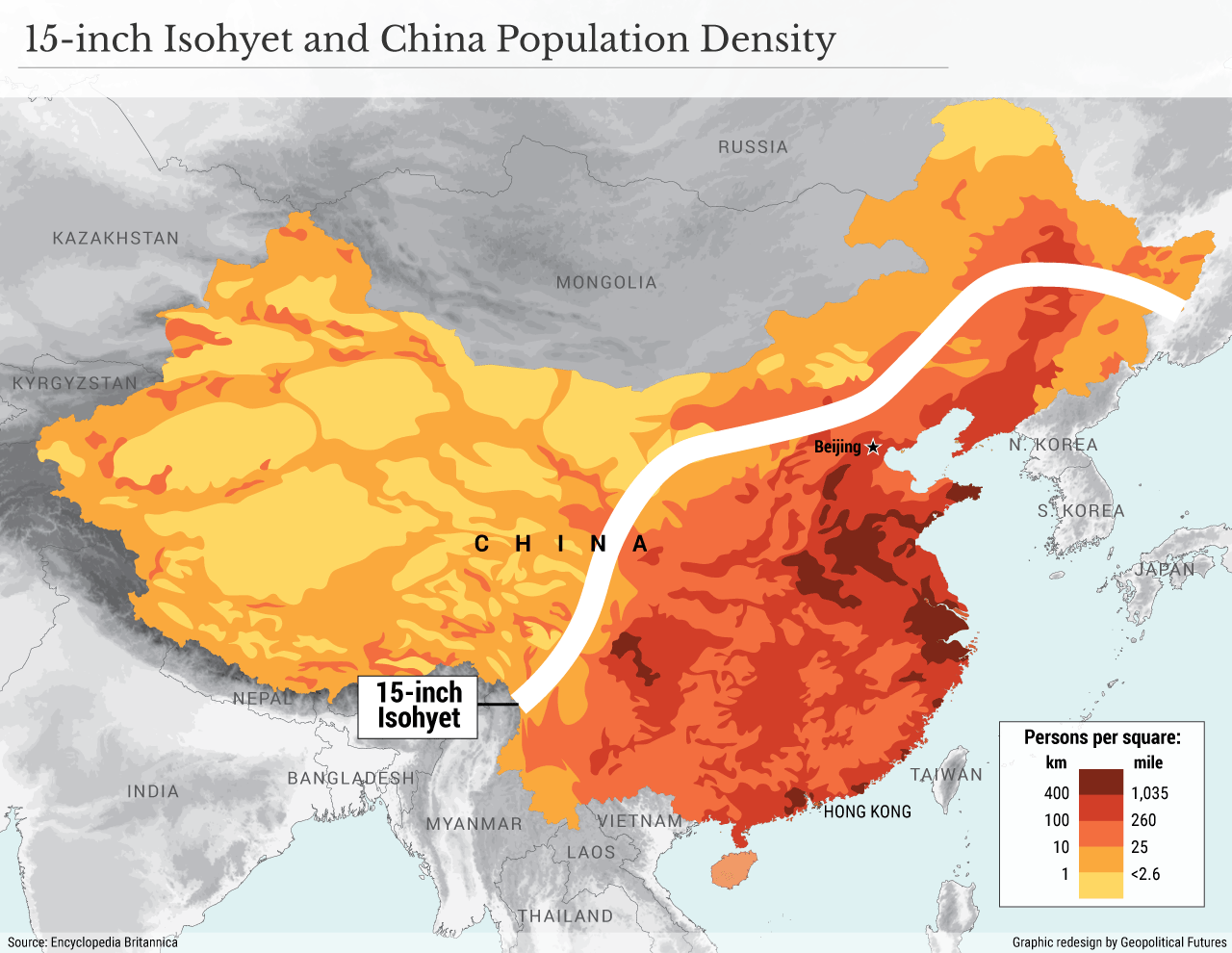
Controlling these buffers is therefore seen as essential to protecting the vulnerable heartland.
The intelligence firm Stratfor provides a concise geopolitical analysis of this structure. This reading will formalize the concepts of the Han Core and buffer regions and introduce China's core strategic imperatives that arise from this geography.
Please read the following sections from the PDF: Start at the beginning with the section titled 'The Han Core' (page 3). Read until the end of the section titled 'The Buffers' (page 5). Then, skip to the section titled 'Strategic Imperatives' (page 8). Read the descriptions for Imperative 1, 'Achieve and maintain internal unity within the Han core,' and Imperative 2, 'Maintain influence or control over the buffer regions' (pages 9-10). Focus on how geography creates the twin imperatives of internal unity and external protection.
From this, we can distill China's two foundational, pre-modern strategic imperatives:
- Maintain Unity in the Han Core: The core itself is geographically fragmented by rivers and mountains, leading to strong regional identities. A weak central government risks internal fragmentation and civil war, leaving the entire country vulnerable.
- Control the Buffer Regions: To prevent invasions from the north and west, a strong China must pacify and control Xinjiang, Inner Mongolia, and Manchuria. To secure its vital river sources and create a formidable barrier against India, it must control the Tibetan plateau.
For most of its history, China's primary strategic axis was east-west (managing the heartland) and north-south (defending against northern nomads). Its long coastline was a relative backwater. This changed dramatically in the 19th century.
2. The Century of Humiliation (c. 1839-1949)
The arrival of European maritime powers exposed a new, critical vulnerability: the coast. Unable to match Western military technology, China was systematically defeated, colonized, and exploited. This period, from the First Opium War to the establishment of the People's Republic of China, is known as the 百年国耻 (bǎinián guóchǐ) — the Century of Humiliation.
This is not just a historical period for China; it is the formative trauma of its modern identity and the central justification for the Communist Party's rule. The narrative holds that a weak, divided China will inevitably be carved up and preyed upon by foreign powers.
Understanding the Chinese mindset
This video from CaspianReport provides a compelling narrative of the key events of the Century of Humiliation. It explains how this period shaped the modern Chinese state's psyche and its deep-seated distrust of the outside world.
Please watch from the beginning to 09:45, and then the concluding summary from 12:38 to 14:12. As you watch, take note of: How the British used the opium trade to reverse a trade deficit. The series of 'unequal treaties' that forced China to cede territory (e.g., Hong Kong) and sovereignty. How other powers, including France, Russia, and Japan, took advantage of China's weakness. The internal chaos, including rebellions and civil war, that compounded the external threats. The final conclusion about how this history leads Beijing to view international law with suspicion and to believe an aggressive military posture is necessary for survival.
3. Synthesis: How Geography and History Shape China's Worldview
China's current geopolitical posture is a direct response to the lessons of the Century of Humiliation, interpreted through its geographic lens. The period proved that vulnerability is multidirectional: threats can come from nomadic horsemen from the steppe, but they can also come from gunboats on the coast.
This created a "geographical dilemma" that persists today:
- To remain isolated is to be secure but poor. A self-enclosed China cannot generate the wealth needed to support its population.
- To engage in global trade is to become rich but vulnerable. Trade enriches the coastal provinces, creating massive internal wealth disparities and giving foreign powers leverage over the Chinese economy and politics. This was the nightmare of the 19th century, where the central government lost control to regional leaders and their foreign partners.
The CCP's grand strategy is its answer to this dilemma. It is an attempt to achieve wealth and power through global engagement without sacrificing central control or allowing foreign influence to compromise its sovereignty.
This leads to the core tenets of Beijing's worldview:
- Internal Stability is Paramount: The highest priority is the unity of the Han Core under the absolute control of the CCP. Any perceived threat to this unity—whether from internal dissent, regionalism, or economic inequality—is treated as an existential risk. This is the lesson of the warlord era and dynastic collapse.
- The Buffer Zones are Non-Negotiable: Firm control over Tibet, Xinjiang, and Inner Mongolia is a non-negotiable security imperative to protect the heartland. This explains the immense resources Beijing dedicates to integrating and controlling these regions, despite international criticism.
- The Coastline Must Be a Fortress: China must be able to deny its maritime periphery to any potential adversary, particularly the United States. This drives the creation of a world-class navy, the fortification of islands in the South China Sea, and the unwavering determination to absorb Taiwan, which it sees as a critical link in this defensive chain and the final piece in reversing the Century of Humiliation.
Conclusion
Today we have explored the foundational pillars of China's geopolitical mindset. You should now be able to explain how the country's strategic imperatives are not arbitrary, but are deeply rooted in a combination of enduring geographic realities and the profound historical trauma of the Century of Humiliation.
Key Takeaways:
- Geographic Duality: China is fundamentally divided into a populous, fertile Han Core and vast, inhospitable but strategically vital Buffer Regions (Tibet, Xinjiang, etc.).
- Core Imperatives: China's primary goals have always been to maintain internal unity within the core and assert control over the buffers to protect it.
- The 'Century of Humiliation': This period of foreign invasion and internal collapse (c. 1839-1949) is the central narrative of modern China. It taught the lesson that weakness and disunity lead to exploitation.
- Modern Strategy as a Synthesis: China's assertive foreign policy, its focus on internal stability, and its actions in places like Xinjiang and the South China Sea are a direct result of combining these geographical and historical lessons to ensure China is never weak and vulnerable again.
Understanding this perspective is essential. For your home country of Nepal, which shares a border with Tibet, China's view of the region not as a simple border but as a critical security buffer has profound implications for bilateral relations and regional stability.
Preview of the Next Lesson:
Having established China's core motivations, we will next examine its primary tool for breaking out of its geographic constraints and reshaping its external environment in the 21st century. Our next lesson is: Describe the Belt and Road Initiative's strategic objectives and its impact on recipient countries' political sovereignty.