Hello! Let's continue our exploration of China's grand strategy.
In our last lesson, we established the deep-seated drivers of China's worldview: its unique geography, which created a vulnerable heartland, and the historical trauma of the "Century of Humiliation," which forged a powerful narrative that weakness and disunity invite foreign predation. This has led to a modern grand strategy focused on ensuring China is never again weak or vulnerable.
Today, we will examine the primary instrument of this strategy in the 21st century—China's grand project to reshape its external environment. This lesson focuses on the following learning outcome: Describe the Belt and Road Initiative's strategic objectives and its impact on recipient countries' political sovereignty.
We will cover:
- The fundamental components of the Belt and Road Initiative (BRI).
- The dual economic and geostrategic objectives driving this multi-trillion-dollar endeavor.
- The complex impact on participating nations, weighing the promise of development against the risks to their political sovereignty.
This topic is especially relevant to your interests, as it sits at the nexus of great power competition, economic development, and the strategic choices facing smaller nations, particularly in South Asia.
1. What is the Belt and Road Initiative?
The Belt and Road Initiative (BRI), first announced by President Xi Jinping in 2013, is one of the most ambitious infrastructure and investment projects in human history. Its stated goal is to improve connectivity and cooperation across continents.
China's trillion dollar plan to dominate global trade
Let's begin with a clear and visually engaging overview of what the Belt and Road Initiative (BRI) is. This video from Vox explains its historical inspiration, its massive scale, and its two main components.
Watch the first two minutes and fifteen seconds (00:00 - 02:15). Focus on understanding: The stated goal of 'rerouting global trade'. The historical connection to the ancient Silk Road. The distinction between the overland 'Economic Belt' and the 'Maritime Silk Road'. The sheer variety of infrastructure projects involved.
As the video explains, the BRI consists of two main corridors:
- The Silk Road Economic "Belt": A series of overland corridors connecting China to Europe via Central Asia and the Middle East. This includes railways, highways, and energy pipelines.
- The 21st Century Maritime Silk "Road": A sea route connecting China’s coast to Europe and Africa through the South China Sea, the Indian Ocean, and the Red Sea. This involves massive investment in ports and related infrastructure.
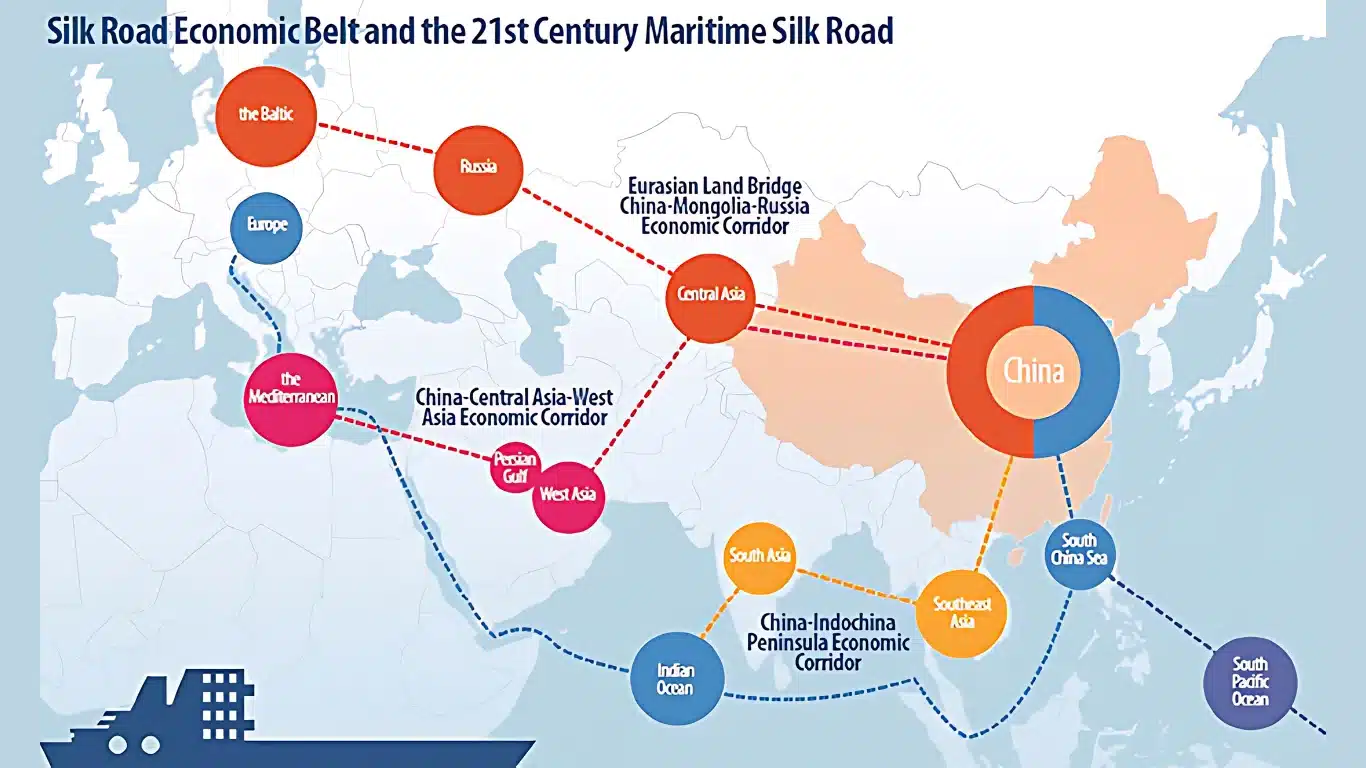
In essence, the BRI is a grand vision to place China at the center of global trade and logistics networks, much like an optimized network architecture designed for maximum efficiency and control.
2. The Strategic Objectives of the BRI
While the BRI is framed in the language of economic development and "win-win cooperation," its objectives are deeply strategic and are a direct response to the geographical and historical vulnerabilities we discussed in the last lesson. We can separate these into economic and geostrategic goals.
Economic Objectives
On the surface, the BRI is a massive economic stimulus project. It allows China to:
- Find new markets for its goods and services.
- Export its industrial overcapacity in sectors like steel, cement, and construction. Chinese construction firms have benefited massively from BRI contracts.
- Promote the international use of its currency, the Renminbi (Yuan), to challenge the dominance of the US dollar.
- Secure long-term access to critical natural resources and energy supplies.
Geostrategic Objectives
Beneath the economic layer, the BRI serves several critical geostrategic functions for Beijing.
Geopolitical Implications of BRI in South Asia
To understand the strategic thinking behind the BRI, especially as it relates to South Asia, this academic paper from a Nepali journal provides an excellent analysis of China's ambitions.
Please read the following sections from this paper, which you can find by searching for the section titles: 'China’s Ambition through BRI' (page 198): This section details the high-level strategic goals, including countering the US 'pivot to Asia' and diminishing India's influence. 'BRI Projects in South Asia' (page 199): Focus on the paragraph that explains the strategic goal of reducing China's 'Malacca Strait dependency.' 'The Maritime Silk Road (MSR)' (page 207): This explains how the MSR connects to Alfred Thayer Mahan's theories of sea power and the 'String of Pearls' strategy. As you read, connect these strategic objectives to the historical and geographical vulnerabilities we discussed in the last lesson.
Based on this reading and other analyses, we can identify three core geostrategic objectives:
-
Solving the "Malacca Dilemma": Over 80% of China's oil imports pass through the Strait of Malacca, a narrow chokepoint between Malaysia and Indonesia. In a conflict, the U.S. Navy could easily blockade this strait, crippling China's economy. The BRI's overland corridors, like the China-Pakistan Economic Corridor (CPEC) and pipelines through Myanmar, provide strategic bypasses to the Indian Ocean, mitigating this critical vulnerability.
-
Building the "String of Pearls": This theory suggests that China is creating a network of commercial ports along the Maritime Silk Road—such as Gwadar (Pakistan), Hambantota (Sri Lanka), and Djibouti (Horn of Africa)—that could potentially be converted into naval supply bases. This would allow China's navy to project power far from its shores, particularly into the Indian Ocean, challenging Indian and US dominance in the region.
-
Establishing the "Digital Silk Road": Your background in computer engineering makes this aspect particularly interesting. The BRI isn't just about concrete and steel; it's also about fiber optic cables, 5G networks, data centers, and surveillance technology. By building the digital backbone for other countries, China can promote its own technological standards (e.g., Huawei's 5G), gain access to vast amounts of data, and enhance its global surveillance capabilities.

3. Impact on Recipient Countries and Political Sovereignty
For countries participating in the BRI, the initiative presents a profound dilemma: the promise of much-needed infrastructure and economic growth versus significant risks to their long-term economic health and political sovereignty.
The Promise: Development and Connectivity
For many developing nations in Asia and Africa, the BRI offers access to capital for roads, ports, power plants, and railways that they could not otherwise afford. The World Bank has estimated that BRI projects could lift millions of people out of poverty.
The Peril: Debt and Sovereignty
The primary criticism leveled against the BRI is the charge of "debt-trap diplomacy." The model often works like this:
- A Chinese state-owned bank provides a massive loan to a developing country for a large infrastructure project.
- The project is often built by Chinese companies using Chinese labor.
- The project may not be economically viable and fails to generate enough revenue to repay the loan.
- When the country defaults, China can demand strategic concessions in lieu of payment, such as a long-term lease or outright control of the asset.
What is China's Belt and Road Initiative? | Start Here
To understand the impact on recipient countries, let's examine the benefits and the significant risks involved. This Al Jazeera video clearly explains the concept of 'debt-trap diplomacy' using powerful examples.
Watch the segment from 04:19 to 06:55. Pay close attention to: The argument that BRI loans, not grants, create debt risks. The case of Djibouti's debt to China reaching 70% of its GDP. The detailed explanation of how Sri Lanka's inability to pay back loans for Hambantota Port resulted in a 99-year lease to China, compromising its sovereignty.
The case of Sri Lanka's Hambantota Port is the most cited example. By handing over control of a strategic port for 99 years, Sri Lanka effectively ceded a piece of its sovereignty—the fundamental right to exercise exclusive control over its territory.
Millennium Challenge Corporation and Belt and Road Initiative
Your interest in South Asian dynamics makes this next resource particularly relevant. It's a research paper that analyzes the political impact of the BRI on Nepal, Sri Lanka, and Pakistan, providing a nuanced view of how these initiatives affect national sovereignty in the region.
Please review the following sections from this paper: 'Findings' (Section 3.4) and the table 'Key Findings: MCC and BRI in South Asia' (Section 3.5): Read the specific findings for Nepal, Sri Lanka, and Pakistan. Note the concerns about debt, dependence, and transparency. 'Discussion' (Section 5): This section synthesizes the findings, confirming that BRI's impact goes beyond economics to shape geopolitical alliances and raises concerns about debt and sovereignty. 'Conclusion' (Section 7): Read the first two paragraphs. They succinctly summarize how the BRI acts as a foreign policy instrument that forces countries to weigh economic benefits against risks to their sovereignty. This paper is particularly insightful as it directly contrasts the BRI with the U.S.'s Millennium Challenge Corporation (MCC), a topic of significant debate in Nepal.
As the research highlights, for countries like Nepal, the BRI represents both a tremendous opportunity for infrastructure development (e.g., the proposed Trans-Himalayan railway) and a major geopolitical hazard. Engaging with the BRI requires a delicate balancing act, navigating the pressures and opportunities presented by both China and India, as well as the United States.
Conclusion
Today we've dissected China's Belt and Road Initiative, moving from its grand vision to its real-world impact. It is far more than an economic project; it is China's primary tool for re-engineering its geopolitical environment to overcome its enduring vulnerabilities.
Key Takeaways:
- A Two-Pronged Initiative: The BRI consists of the overland "Belt" and the maritime "Road," creating a vast, China-centric network of infrastructure.
- Dual Objectives: The BRI serves both economic goals (exporting overcapacity, securing markets) and crucial geostrategic goals (solving the Malacca Dilemma, building a "String of Pearls," and establishing the Digital Silk Road).
- Sovereignty at Stake: While the BRI offers developing nations opportunities for growth, it comes with significant risks. The model of loan-based projects can lead to unsustainable debt and "debt-trap diplomacy," where countries are forced to cede control of strategic assets, thereby compromising their political sovereignty.
- A Strategic Choice: For smaller states, particularly in South Asia, the BRI is not just an economic proposition but a profound strategic choice that affects their relationships with neighboring powers and their position in the unfolding great power competition.
Preview of the Next Lesson:
Now that we understand China's primary tool for external influence, we will zoom in on one of its most critical and contested theaters of operation. In the next lesson, we will: Analyze China's strategy in the South China Sea, focusing on its historical claims, island-building, and challenges to international law.