Hello! Let's continue our exploration of China's grand strategy.
In our last lesson, we analyzed China's actions in the South China Sea, focusing on how it uses "lawfare," island-building, and grey-zone tactics to challenge the existing maritime order. We saw this as a clear example of a rising power attempting to revise regional geography and legal norms in its favor.
Today, we shift our focus to what is arguably the most dangerous geopolitical flashpoint in the world: the Taiwan Strait. While the South China Sea involves disputes with multiple nations, the Taiwan issue strikes at the very core of China's national identity and brings it into direct strategic competition with the United States. Your interest in how great power competition destabilizes regions is central to this topic.
Our learning outcome for this lesson is to: Analyze the geopolitical dynamics of the Taiwan Strait, including the 'One China' policy, US strategic ambiguity, and the military balance.
To achieve this, we will examine:
- The historical origins of the cross-strait conflict.
- Taiwan's critical geostrategic and economic position.
- The complex and often misunderstood diplomatic framework governing the dispute.
- The military balance of power and the strategies each side is pursuing.
1. The Unfinished Civil War and A Critical Island
The tensions across the Taiwan Strait are a direct legacy of the Chinese Civil War (1945-1949). To understand Beijing's intense focus on Taiwan, we must first understand this history.
Why China and the US are so obsessed with Taiwan | Mapped Out
This video from DW News provides an excellent summary of the historical and geographical context. It explains how the current situation came to be and why Taiwan's physical location is so crucial.
Please watch two segments from the video: Historical Background (09:21 - 11:20): This part explains the end of the Chinese Civil War, the flight of the Nationalists (Republic of China, ROC) to Taiwan, and why two governments claim to be 'China'. Geostrategic Importance (01:18 - 04:14): This segment details Taiwan's location at the heart of the 'First Island Chain' and its control over key maritime chokepoints like the Taiwan Strait and Bashi Strait. Focus on why this location is vital to both Chinese and US strategy.
As the video explains, the core of the issue is that the People's Republic of China (PRC), established by the victorious Communists in 1949, views Taiwan as a "breakaway province" that must be "reunified" to complete the civil war and end the "Century of Humiliation."
From a strategic perspective, Taiwan is the lynchpin of the First Island Chain, a concept we've touched on before. For the United States, an allied or friendly Taiwan helps contain China's navy and project power close to the Chinese mainland. For China, taking Taiwan would shatter this containment, giving its navy unrestricted access to the wider Pacific Ocean and fundamentally altering the balance of power in Asia.
2. The Diplomatic Tightrope: A Tale of Two 'Chinas'
The diplomatic language surrounding Taiwan is incredibly precise and deliberately convoluted. Understanding the difference between China's "One China Principle" and the United States' "One China Policy" is essential. They are not the same.
- The PRC's "One China Principle": This is a rigid, non-negotiable stance. It asserts that "there is only one China in the world, Taiwan is a part of China, and the government of the PRC is the sole legal government representing the whole of China."
- The U.S. "One China Policy": This is a more complex, ambiguous policy. The U.S. acknowledges Beijing's position that Taiwan is part of China, but it does not endorse or accept it. The U.S. recognizes the PRC as the sole legal government of China but maintains robust, unofficial relations with Taiwan.
This entire diplomatic structure can be thought of as a complex logical system with competing rules. The PRC asserts a simple, absolute rule. The U.S. has created a set of conditional statements and exceptions that allow it to navigate between its relationships with Beijing and Taipei.
To understand how this complex policy was built, we need to look at the key documents that form its foundation.
Introduction | U.S.-Taiwan Relations in a New Era
The Council on Foreign Relations has published an excellent, in-depth report on U.S.-Taiwan relations. We will read the key sections that trace the evolution of the U.S. 'One China' policy.
Please read the following three sections from the report's 'History of U.S. Policy' chapter: Start from the paragraph beginning 'The formal alliance between the United States and the ROC began to fray...' and read to the end of that section. This covers the U.S.-China rapprochement and the crucial wording of the Shanghai Communiqué. Read the next section, which focuses on the Taiwan Relations Act (TRA). Note how Congress created a legal obligation for the U.S. to provide Taiwan with defensive arms. Read the final section of the history chapter, starting from 'One major sticking point during negotiations...'. This explains the 1982 Communiqué on arms sales and the famous 'Six Assurances' given to Taiwan. As you read, focus on how the U.S. carefully constructed a policy that allowed it to formally recognize the PRC while simultaneously creating a durable, legally-grounded security relationship with Taiwan.
To summarize the intricate U.S. policy framework:
- The Three Communiqués (1972, 1979, 1982): These are agreements with the PRC that form the basis for diplomatic relations, where the U.S. "acknowledges" China's position on Taiwan.
- The Taiwan Relations Act (TRA) (1979): This is U.S. domestic law. It is arguably the most important document, as it legally obligates the U.S. to provide Taiwan with arms for its self-defense and states that any attempt to determine Taiwan's future by non-peaceful means is a "threat to the peace and security of the Western Pacific area and of grave concern to the United States."
- The Six Assurances (1982): These were promises made to Taiwan to clarify what the U.S. had not agreed to in its communiqué with the PRC, such as not setting a date to end arms sales and not pressuring Taiwan to negotiate with Beijing.
3. Strategic Ambiguity and the "Silicon Shield"
The TRA states that a Chinese attack would be of "grave concern" to the U.S., but it doesn't explicitly commit the U.S. to a military defense of Taiwan. This deliberate vagueness is known as strategic ambiguity.
The goal is dual deterrence:
- To deter the PRC from invading by leaving open the possibility of U.S. military intervention.
- To deter Taiwan from formally declaring independence by not giving it a "blank check" of guaranteed U.S. support, which could provoke an invasion.
In recent decades, another powerful deterrent has emerged, one that leverages your field of computer engineering.
Why Taiwan matters to the United States
Let's turn to CaspianReport for a concise explanation of Taiwan's modern strategic assets.
Watch the segment from 07:44 to 09:30. This part discusses the PRC's perspective, the legitimacy tied to reunification, and Taiwan's immense strategic importance in the global semiconductor industry.
As the video highlights, Taiwan's dominance in the manufacturing of advanced semiconductors, led by the company TSMC, has created what many call a "Silicon Shield." Taiwan produces over 60% of the world's semiconductors and over 90% of the most advanced chips. These are the essential building blocks of the modern global economy—found in everything from smartphones and cars to the AI servers and advanced weaponry that both the U.S. and China depend on.
A war in the Taiwan Strait would halt this production, triggering a global economic depression and crippling the tech industry worldwide. This economic interdependence adds a powerful layer of deterrence, making the cost of conflict catastrophically high for all parties, including China itself.
4. The Cross-Strait Military Balance
Despite the diplomatic and economic complexities, the military dimension remains stark. China has spent decades building a force specifically designed to overwhelm Taiwan's defenses and deter U.S. intervention.
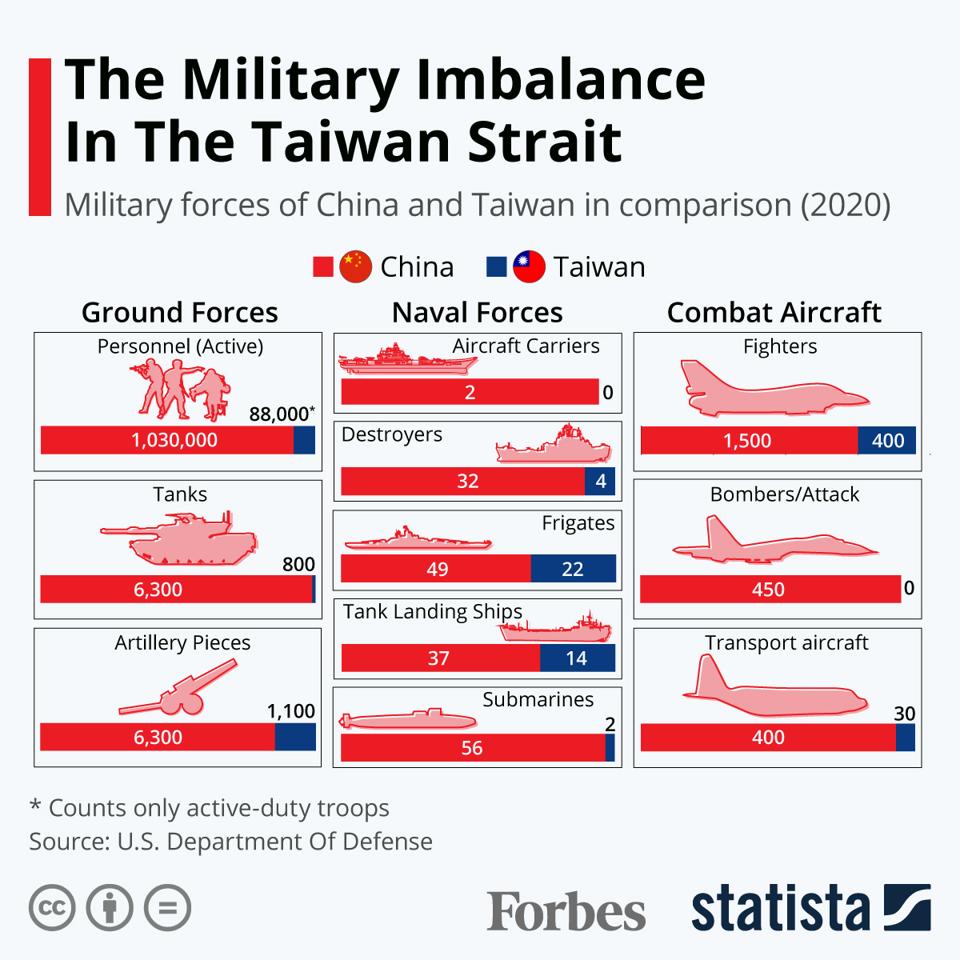
The numerical disparity is immense. However, an invasion of Taiwan would be one of the most difficult military operations imaginable. It would require a massive amphibious assault across 130km of rough seas, against a well-defended coastline.
To counter the U.S. Navy, China has developed a sophisticated Anti-Access/Area Denial (A2/AD) strategy, the same system we saw being deployed in the South China Sea.
Between Rhetoric and Reality: Navigating the Taiwan Strait Crisis
Let's look at a more detailed analysis of the military reality. This article from the Australia-China Relations Institute delves into the strategic calculations of a potential conflict.
Please read the two sections titled 'The Geostrategic Reality that Many Ignore' and 'War Games and the Cost of Conflict'. Focus on: The description of China's A2/AD system and how it is designed to keep the U.S. Navy at a distance. The conclusions from wargaming scenarios, which suggest that even if China has a tactical advantage, a conflict would be devastatingly costly for all sides and highly escalatory.
The key takeaways from the military analysis are:
- China's A2/AD Bubble: China's layered system of missiles, submarines, and aircraft is designed to make it extremely dangerous for U.S. aircraft carriers and other forces to operate close to Taiwan during a conflict.
- Taiwan's "Porcupine" Strategy: Taiwan's defense strategy is not to defeat the PLA outright, but to make an invasion so difficult and costly—by using anti-ship missiles, sea mines, and a resilient defense force—that Beijing will be deterred from attempting it.
- Grey-Zone Pressure: Unable or unwilling to launch a full-scale invasion, China resorts to constant "grey-zone" pressure. This includes near-daily incursions into Taiwan's air defense identification zone and large-scale military exercises that simulate a blockade or attack. These actions are designed to exhaust Taiwan's military, test its defenses, and demoralize its population.

Conclusion
The Taiwan Strait is a complex web of historical grievance, nationalist ambition, strategic calculation, and economic interdependence. It represents a direct clash between the PRC's goal of "national rejuvenation" and the U.S.-led "rules-based order." The delicate balance is maintained by a carefully constructed, yet increasingly fragile, set of diplomatic understandings and military deterrents.
Key Takeaways:
- Historical Core: The conflict is rooted in the unfinished Chinese Civil War, making "reunification" a core issue of legitimacy for the Chinese Communist Party.
- Diplomatic Ambiguity: The international community navigates this issue through the U.S. "One China Policy"—which acknowledges but does not endorse Beijing's claims—and the PRC's rigid "One China Principle." U.S. support for Taiwan is enshrined in the Taiwan Relations Act.
- Dual Deterrence: U.S. strategic ambiguity aims to prevent both a Chinese invasion and a Taiwanese declaration of independence.
- The Silicon Shield: Taiwan's dominance in advanced semiconductor manufacturing provides a powerful economic deterrent, as a conflict would devastate the global economy.
- Military Imbalance: While China has a massive quantitative military advantage and a potent A2/AD system, a full-scale invasion of Taiwan remains an extraordinarily difficult and risky operation.
Preview of the Next Lesson:
Having examined China's use of economic power (BRI), territorial claims (South China Sea), and military pressure (Taiwan), we will next turn to a controversial aspect of its economic statecraft. Our next lesson will be: Explain the concept of debt-trap diplomacy and evaluate evidence for and against it using specific case studies. We will analyze whether China is strategically leveraging debt for geopolitical gain or if the reality is more complex.