Hello! In our last lesson, we delved into the tense dynamics of the Taiwan Strait, analyzing it as a primary military and strategic flashpoint in China's relationship with the US and the region. We saw how historical claims, geostrategic positioning, and military power create a precarious balance.
Today, we shift from the military domain to economic statecraft, another crucial pillar of China's grand strategy. We'll investigate one of the most debated topics surrounding the Belt and Road Initiative (BRI): the charge of "debt-trap diplomacy." This is particularly relevant to your interest in how great power competition affects smaller states, as many of the countries involved are developing nations navigating complex relationships with global powers.
Our learning outcome for this lesson is to: Explain the concept of debt-trap diplomacy and evaluate evidence for and against it using specific case studies.
To do this, we will:
- Define debt-trap diplomacy and examine the narrative that China uses it as a strategic tool.
- Critically analyze the counter-argument, which posits that the "debt-trap" is a myth.
- Use Sri Lanka as our primary case study to weigh the evidence.
- Briefly look at Nepal's approach to the BRI for a comparative perspective relevant to your background.
1. The Belt and Road Initiative and the "Debt-Trap" Narrative
First, let's contextualize. The Belt and Road Initiative (BRI) is a massive global infrastructure development strategy adopted by the Chinese government in 2013. It aims to connect Asia with Africa and Europe via land and maritime networks to improve regional integration, increase trade, and stimulate economic growth.

While promoted as a vehicle for shared prosperity, the BRI has faced criticism. The most prominent charge is that it is a form of debt-trap diplomacy.
Debt-trap diplomacy is the idea that a creditor country intentionally lends excessive credit to a debtor country with the alleged intention of extracting economic or political concessions when the debtor country cannot honor its debt obligations. In this context, the accusation is that China provides huge, opaque loans for infrastructure projects to developing nations that it knows cannot afford to repay them. When the country defaults, China can then seize the strategic asset (like a port) or demand political alignment.
To understand this narrative, let's watch a video that presents it clearly.
China’s Debt Trap: How Xi's BRI is Sinking the World’s Poorest Nations | GRAVITAS
This clip from the news program Gravitas on WION presents the case for China's debt-trap diplomacy. It outlines the core accusation and lists several countries allegedly affected.
Watch the first four minutes of the video (00:00 - 04:18). Pay attention to: The scale of the debt owed to China by developing countries. The specific accusations of China lending to vulnerable countries. The connection made between loans and political leverage (e.g., switching recognition from Taiwan to China).
The narrative presented in the video is powerful and has been influential in shaping perceptions of the BRI in the West and in regional powers like India. The map below illustrates some of the key projects often cited in this debate.
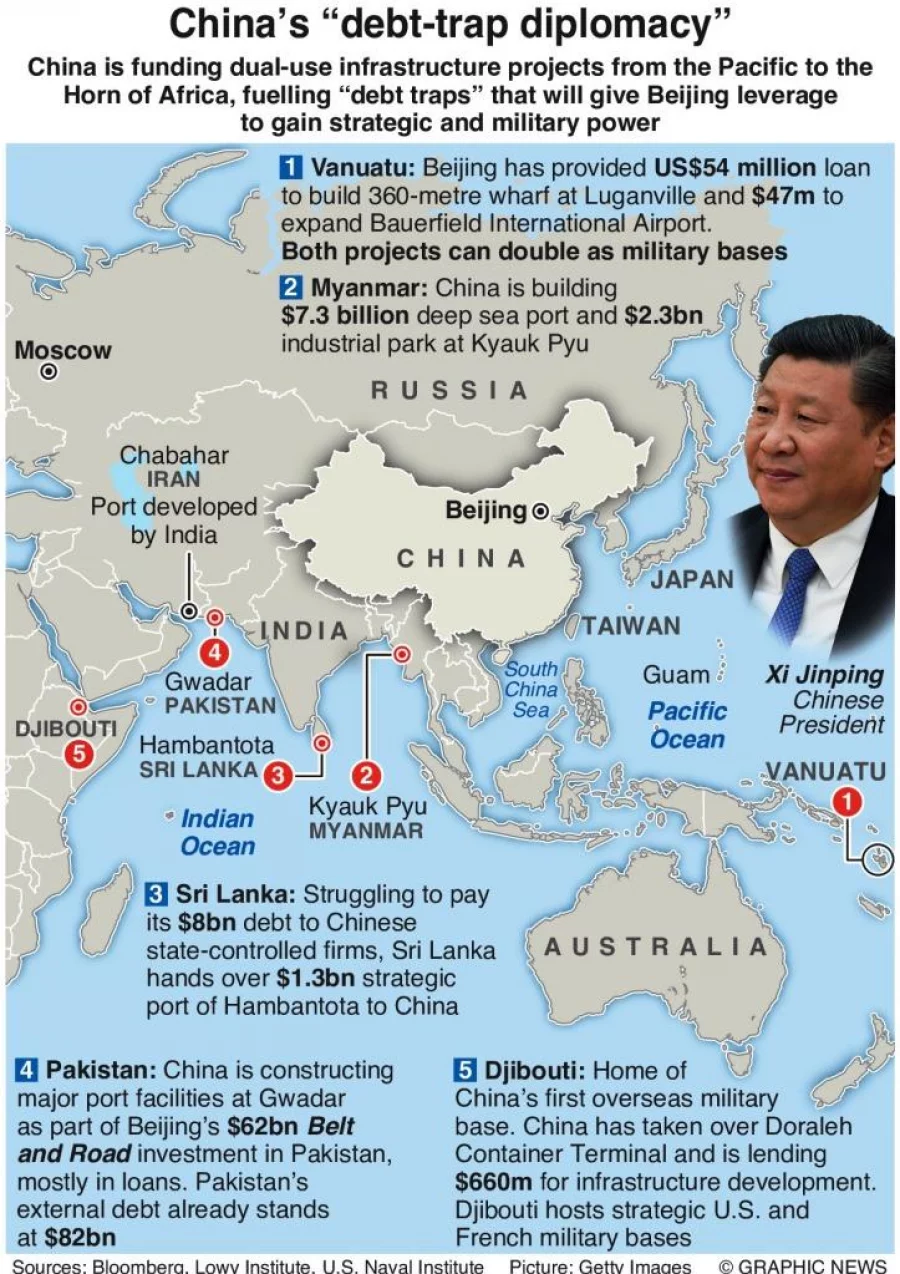
The "poster child" for this argument, mentioned in the video and on the map, is the Hambantota Port in Sri Lanka. The common story is that China funded and built the port; when Sri Lanka couldn't pay back the loans, it was forced to hand over control of the port to a Chinese state-owned company on a 99-year lease.
2. Deconstructing the Narrative: The Case of Hambantota Port
Now, let's engage the second part of our learning outcome: evaluating the evidence. The claim of a deliberate "debt trap" is a serious one, and it has been subjected to intense academic scrutiny. Many researchers have found that the popular narrative often oversimplifies a much more complex reality.
Your work on optimizing systems with hybrid algorithms demonstrates an understanding that complex problems rarely have simple, single-cause explanations. The debt situation in many developing countries is a similar complex system, with variables including local politics, global economic conditions, and the actions of multiple lenders, not just China.
Let's start by watching a counter-analysis.
The BELT & ROAD “DEBT TRAP” MYTH — Why Poor Countries CHOOSE China
This video from the US-China Global Pulse channel directly challenges the debt-trap narrative, focusing heavily on the Hambantota Port case. It presents data and context often missing from mainstream reports.
Watch the segment from 01:53 to 08:00. This section specifically deconstructs the Hambantota Port story. Focus on: The actual composition of Sri Lanka's foreign debt. Who initiated the port project. The details of the lease agreement and where the money went.
The video makes some critical points that challenge the simple debt-trap story. To verify and deepen this analysis, let's turn to a detailed research paper from a leading think tank.
Debunking the Myth of 'Debt-trap Diplomacy' | 4. Sri Lanka and the BRI
The Chatham House report, 'Debunking the Myth of 'Debt-trap Diplomacy'', provides a rigorous, evidence-based analysis of the Hambantota Port case. Reading this will give you the academic foundation to evaluate the claims.
Please read the sections titled '4. Sri Lanka and the BRI', 'The origins of Hambantota Port', 'Sri Lanka’s debt crisis', and 'The Chinese ‘bailout’'. As you read, focus on answering these questions: Origin: Who first proposed the Hambantota Port project? Was it Beijing's idea? Debt Cause: What was the primary source of Sri Lanka's debt crisis? Look closely at Table 3, which breaks down the ownership of Sri Lanka's external debt. What percentage was owed to China versus other creditors like financial markets and other countries? The Deal: Was the port seized in a 'debt-for-asset swap'? Or was it a lease? What did Sri Lanka do with the $1.1 billion it received from the Chinese company? Military Use: Does the agreement allow the Chinese navy to use the port as a military base?
Based on this detailed evidence, the traditional debt-trap narrative surrounding Hambantota appears to be flawed. The key takeaways are:
- Sri Lankan Initiative: The project was driven by Sri Lankan domestic politics, specifically by President Mahinda Rajapaksa, not a strategic imposition by Beijing.
- Debt Composition: Chinese loans constituted a relatively small fraction (around 10%) of Sri Lanka's total foreign debt. The majority was owed to Western-dominated international capital markets (e.g., sovereign bonds), the Asian Development Bank, and Japan.
- Not a Seizure: The deal was a lease, not a seizure. Sri Lanka received $1.1 billion, which it used to bolster its foreign reserves and pay down other, more expensive loans, not the Chinese loan for the port itself. The port debt was transferred to the Sri Lankan treasury and is still being paid.
- Recipient Governance: The crisis was largely a product of internal mismanagement, corruption, and unsustainable borrowing from various international sources by the Sri Lankan government.
3. A Broader Perspective: Lending Models and Recipient Agency
This doesn't mean Chinese lending is without problems. Projects can be overpriced, lack transparency, and have weak environmental or labor standards. However, to evaluate it fairly, we must compare it to the alternatives.
Developing countries have an immense infrastructure gap (estimated in the trillions of dollars) that Western institutions and private markets have not filled. Chinese lending, for all its faults, is often faster and comes with fewer political conditions than loans from the IMF or World Bank, which frequently require "structural adjustments" (e.g., privatization, austerity measures) that can be politically difficult and painful for the population.
This leads to a crucial point: recipient agency. Countries are not passive victims. They are often making rational, if sometimes risky, calculations to secure financing for development that they cannot get elsewhere.
The Case of Nepal
Your home country, Nepal, provides an interesting contrast to Sri Lanka. Despite being a BRI signatory, Nepal has approached Chinese-funded projects with significant caution.
Belt and Road Initiative: Case Studies from Sri Lanka, Nepal and ...
This academic paper by Robert Smith provides brief case studies of BRI in several countries, including Nepal. It offers a useful perspective on how a smaller state can exercise its agency.
Please read the section titled 'Nepal' (starting on page 11). Focus on Nepal's official position regarding the financing of BRI projects. How does this differ from the approach taken by Sri Lanka?
As the paper notes, Nepal has been adamant that it prefers grants or highly concessional loans for BRI projects rather than commercial loans, recognizing the limits of its capacity to take on large debts. This demonstrates a high degree of caution and strategic calculation. The prolonged internal debates in Nepal over funding sources, whether from China's BRI or the US's Millennium Challenge Corporation (MCC), show a country actively weighing its options and trying to navigate the pressures of great power competition, rather than passively falling into a "trap."
Conclusion
So, is "debt-trap diplomacy" real? The evidence suggests that the idea of a deliberate, systematic master plan by Beijing to entrap countries in debt to seize their assets is largely a myth. The most-cited case, Hambantota Port, does not hold up to scrutiny.
However, this does not absolve China of responsibility. Its lending practices can lack transparency and may not always follow rigorous sustainability standards, contributing to debt problems in countries with weak governance. The reality is more nuanced than a simple "trap" narrative:
Key Takeaways:
- The "Debt-Trap" Concept: This is the accusation that China deliberately lends to countries that cannot repay in order to seize strategic assets and gain political leverage.
- Evidence "For": The narrative is supported by the large sums owed to China and a few high-profile cases like the Hambantota Port lease.
- Evidence "Against": Detailed analysis of the Hambantota case shows it was initiated by Sri Lanka, Chinese debt was a small fraction of the total, and the port was leased, not seized, to pay off other creditors.
- Nuanced Reality: The outcomes of BRI projects are a result of complex interactions between China's commercial and strategic interests, the (often poor) governance and agency of recipient countries, and a lack of alternative financing options. China can be seen as an opportunistic lender, but less of a predatory one executing a grand plan for entrapment.
Preview of the Next Lesson:
Having examined China's economic statecraft, we will now turn to a topic that directly intersects with your background in computer engineering. Our next lesson is: Assess China's civil-military fusion strategy and its implications for global technology competition. We will explore how China is systematically integrating its civilian tech sector with its military modernization goals, a strategy that has profound implications for everything from AI development to global supply chains.