Hello! Welcome back.
In our last lesson, we explored the geopolitical implications of Artificial Intelligence, seeing it as the "software" of modern power that reshapes warfare, surveillance, and governance. We discussed how nations are racing for AI supremacy and how the data fueling these systems is a critical resource.
Today, we move from the software to the physical hardware that makes the global digital world possible. If AI models and cloud computing exist in a "cloud," this lesson is about the ground truth: the world runs on wires. These wires, mostly unseen at the bottom of the ocean, form the backbone of the global internet and are a critical arena for geopolitical competition.
Our learning outcome is to analyze the strategic importance of undersea data cables, focusing on physical chokepoints, vulnerabilities, and ownership. We will investigate why these cables matter, who controls them, where their weak points are, and how they can be weaponized.
1. The Physical Reality of the Internet
Before diving into the geopolitics, it's essential to grasp the sheer scale and importance of this hidden infrastructure. The internet is not an ethereal cloud; it's a physical network of over 500 active cables, spanning nearly a million miles across the ocean floor.
These cables, often no thicker than a garden hose, carry over 98% of all international data and voice traffic, underpinning an estimated $10 trillion in daily financial transactions. Given your background in computer engineering, you can think of these cables as the absolute physical layer—Layer 1—of the global network. Without them, the cloud services, APIs, and distributed systems you've worked with would cease to function on an international scale.
How A Million Miles Of Undersea Cables Power The Internet — And Now AI
To start, let's watch an introductory segment from CNBC that provides an excellent overview of the undersea cable network, its economic importance, and its direct link to the growing demands of AI.
Watch the first 1 minute and 52 seconds of the video. Pay attention to the statistics on data traffic and financial transactions, and how tech giants see this infrastructure as essential for connecting their data centers and enabling AI.
2. The New Great Game: Ownership and Control
For decades, undersea cables were built by consortiums of telecom companies. Today, the landscape has fundamentally changed. The biggest investors and owners are now the very companies that need the most bandwidth: Google (Alphabet), Meta, Amazon, and Microsoft.
This privatization of critical infrastructure has major geopolitical implications. While these are American companies, their decisions about where to build cables create new data-rich corridors that often align with US strategic interests. This has sparked a direct competition with China, which is pursuing its own "Digital Silk Road" to create alternative data pathways and expand its sphere of influence.
The Trillion-Dollar Battle for Fiber-Optic Supremacy | WSJ U.S. vs. China
This video from The Wall Street Journal focuses specifically on the US-China rivalry for fiber-optic supremacy. It clearly explains the strategic motivations behind China's investments and the US response.
Please watch the segments from 00:58 to 04:13: (00:58 - 02:17): Focus on China's strategy, the role of HMN Tech (formerly Huawei Marine), and the connection between cable projects and the Belt and Road Initiative. (02:17 - 04:13): Note the US concerns about espionage and its policy actions to exclude Chinese firms from cable projects connecting to American infrastructure.
The competition is not just about building new cables; it's about creating entire digital ecosystems. The choice of which cable a country connects to is no longer just a technical decision; it's a statement of geopolitical alignment.
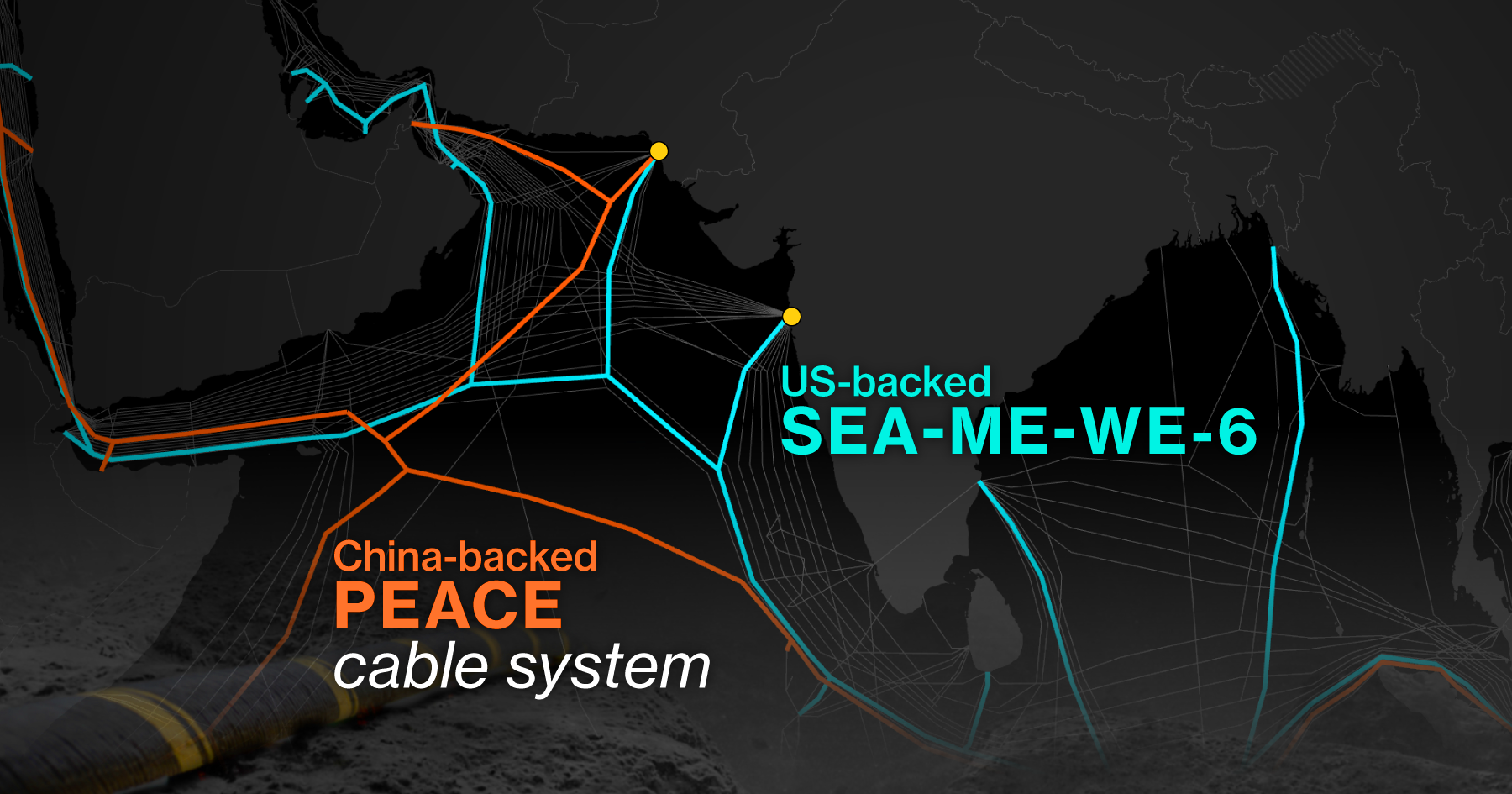
This dynamic is creating what some analysts call a bifurcated global network, with distinct US- and Chinese-centric spheres of influence.
3. Geopolitical Chokepoints and Vulnerabilities
The global cable network is not evenly distributed. Cables converge in narrow geographic passages, creating strategic chokepoints. Disruption in one of these locations—whether accidental or deliberate—could have cascading effects, severing connectivity for entire regions.
Geopolitics of Undersea Cable Infrastructure and Security
This article, "Geopolitics of Undersea Cable Infrastructure and Security," provides a sharp analysis of these chokepoints. It moves beyond a simple map to explain their strategic significance.
Please read the section titled 'What Defines a Chokepoint in the Digital Age?'. Focus on the three key examples provided: the Luzon Strait, the Suez Canal/Red Sea, and the Strait of Malacca. Understand why each location is strategically critical and vulnerable.
These chokepoints are vulnerable to a range of threats:
- Accidental Damage: The most common cause of disruption, often from fishing trawlers and ship anchors.
- Natural Disasters: Earthquakes and underwater landslides can sever multiple cables at once, as often happens near Taiwan and the Luzon Strait.
- Sabotage: The most serious geopolitical threat. A state actor could deliberately cut cables to isolate a rival nation or create economic chaos. Attributing such an act can be difficult, allowing it to be used as a "gray zone" tactic—an aggressive act that falls below the threshold of open war.

The permitting process for laying cables through these contested waters is itself a geopolitical tool.
How A Million Miles Of Undersea Cables Power The Internet — And Now AI
Let's return to the CNBC report. This segment highlights the real-world complexities of routing cables through politically sensitive areas and the growing concern over sabotage.
Watch the following two clips: Permitting and Geopolitics (11:55 - 13:06): Notice how disputes in the Mediterranean, Red Sea, and South China Sea force cable planners to make geopolitical decisions about routing. Sabotage and Surveillance (14:42 - 18:22): Focus on the concept of 'gray zone' tactics, the challenge of discerning intent, and the national security responses from governments like the US and France.
4. Weaponization and Regional Dynamics
The strategic use of cables goes beyond simply cutting them. A more sophisticated threat is "fiber shaping," where a state controlling a chokepoint could subtly degrade the quality of service for a rival's data—for instance, slowing down financial data just enough to disrupt high-frequency trading while maintaining plausible deniability.
This "Escalation Ladder" shows how cable infrastructure can be weaponized:
| Level of Escalation | Action | Description | Plausible Scenario |
|---|---|---|---|
| Level 1: Espionage | Passive Tapping | Covertly intercepting data for intelligence gathering. | An agency compromises a landing station to monitor diplomatic traffic. |
| Level 2: Coercion | Threat of Disruption | Leaking the capability to sever a critical cable to influence policy. | Leaking satellite imagery of naval assets near a rival’s economic data cable. |
| Level 3: Degradation | Traffic Shaping | Subtly slowing specific data streams to cause disruption. | A state at a chokepoint adds latency to a rival's financial data. |
| Level 4: Limited Attack | Targeted Severing | Cutting a non-critical cable to send a political signal. | A cable to a military outpost is severed during a regional conflict. |
| Level 5: Strategic Attack | Multiple Severing | Cutting multiple cables to isolate a nation from the global network. | Severing all primary cables to a target nation before a military operation. |
This table, adapted from the Prism article "Geopolitics of Undersea Cable Infrastructure and Security," clarifies the spectrum of threats.
This competition is playing out intensely in South Asia. For India, which relies on these cables for over 95% of its data traffic, securing its connectivity is a paramount economic and security concern. This brings us to a topic of particular interest to you: the India-China dynamic as it relates to this critical infrastructure.
[PDF] The geopolitical and strategic implications of undersea cable expansion by global powers
This academic paper offers a valuable perspective on India's strategic position within the global cable network and its concerns regarding China's Digital Silk Road.
Please read the section 'India's Role and Strategic Implications in the Undersea Cable Network' (page 745). Focus on India's role as a connectivity hub, its vulnerabilities, and its strategic concerns about Chinese-backed projects in neighboring countries like Sri Lanka and the Maldives.
For a country like Nepal, landlocked but digitally connected, the reliability of these submarine networks and the strategic choices made by its neighbors, India and China, have direct consequences for its own digital future.
Conclusion
Today, we've pulled back the curtain on the physical foundation of our digital world. Undersea cables are not just passive infrastructure; they are active arenas of geopolitical competition that are being built, routed, and potentially weaponized for strategic advantage.
Key Takeaways:
- Strategic Importance: Undersea cables form the indispensable physical backbone of the global economy and the internet, carrying over 98% of international data.
- Ownership as Power: The shift in ownership from telecom consortia to US tech giants and the rise of China's state-backed "Digital Silk Road" have turned cable construction into a geopolitical contest for control over global data flows.
- Chokepoints and Vulnerabilities: The network's reliance on a few narrow geographic chokepoints (like the Suez Canal and Luzon Strait) creates significant vulnerabilities to both accidental damage and deliberate sabotage.
- Weaponization: Beyond simple cuts, cables can be used for coercion and subtle economic warfare, while their security has become a key national security concern for states like India in contested regions like the Indian Ocean.
Preview of the Next Lesson:
Now that we have examined the physical network layer, our next lesson will move up the stack to analyze what happens on that network. We will tackle the learning outcome: "Analyze a case study of state-sponsored cyber espionage and its geopolitical consequences (e.g., OPM hack)." We will explore how intelligence agencies exploit this global connectivity to steal data and gain strategic advantages.