Hello! Welcome to our next lesson.
In our previous session, we dove deep into the world of undersea data cables, the physical "Layer 1" of the global internet. We saw how these hidden assets are central to economic life and have become a key arena for geopolitical competition between powers like the US and China.
Today, we move from the ocean floor to the skies above, exploring another critical layer of global information infrastructure: Low Earth Orbit (LEO) satellite constellations. These vast networks are reshaping connectivity and creating new geopolitical realities.
Our learning outcome is to assess the geopolitical impact of LEO satellite constellations (e.g., Starlink) on information access, sovereignty, and modern warfare. We'll examine how this technology works, how it's being used on the battlefield, how it challenges state control over information, and how nations are responding to its strategic implications.
1. The LEO Revolution: Low Latency from the Heavens
First, it's important to understand why LEO constellations are such a game-changer. For decades, satellite internet has been provided by large satellites in Geostationary Earth Orbit (GEO), about 36,000 km above the Earth. While effective for broadcasting, the immense distance creates high latency (lag), making them unsuitable for real-time applications like video calls, online gaming, or controlling military drones.
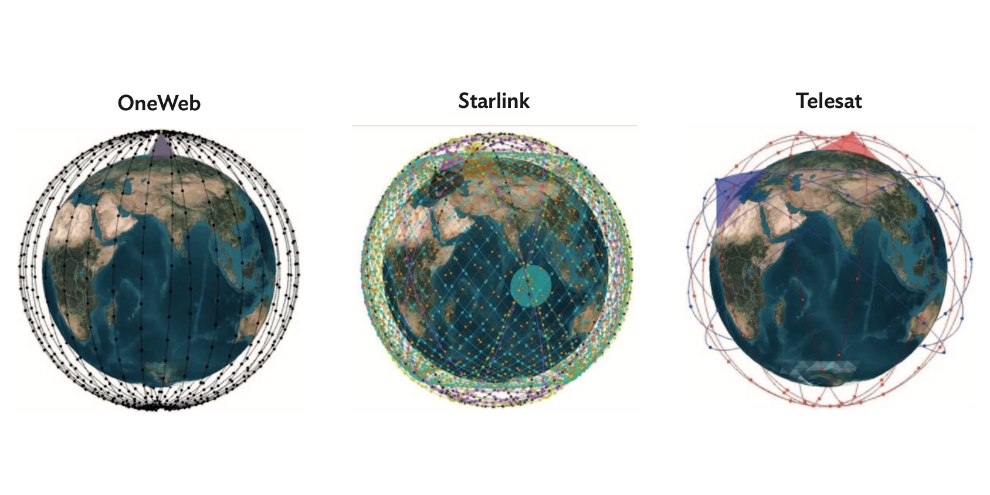
LEO constellations, like SpaceX's Starlink, place thousands of smaller satellites at a much lower altitude (around 550 km). This drastically reduces latency, offering internet performance comparable to terrestrial fiber optics.
Given your computer engineering background, you can think of this in terms of network architecture: GEO is like a remote, slow-to-access data archive, whereas LEO is like a distributed, low-latency edge computing network.

While several companies are building LEO networks, SpaceX's Starlink is by far the largest and most influential, creating a de facto near-monopoly on high-performance satellite internet.
2. Impact on Modern Warfare: A Trial by Fire in Ukraine
The Russia-Ukraine war has been the first major conflict where a commercial LEO constellation has played a decisive role. When Russia's initial invasion and subsequent attacks crippled Ukraine's terrestrial communication infrastructure, Starlink provided a critical lifeline.
Its impact extends far beyond simple internet access for civilians. It has been integrated directly into Ukraine's military operations, fundamentally changing how they fight.
The Starlink Shutdown - Russian Military Communications, Corruption & Satellites in Ukraine
To understand the profound military impact of Starlink, we'll turn to an in-depth analysis by the YouTube channel Perun, which is highly regarded for its detailed, data-driven examinations of modern warfare.
Please watch the video from the beginning until 26:10. Part 1 (00:00 - 20:37): Focus on why modern warfare requires robust communications and why Russia's own military systems failed, creating a dependency on civilian tech for both sides. Part 2 (20:37 - 26:10): Pay close attention to how Starlink was used by both Ukrainian and Russian forces, particularly its role in enabling drone warfare.
As the video explains, Starlink became the backbone of Ukraine's decentralized command and control. It allows small, mobile units to coordinate, enables drone operators to stream real-time video for reconnaissance and targeting, and connects artillery units to front-line spotters. This creates a highly agile and resilient "kill chain."
This seamless integration of a commercial system into military operations is detailed in the following analysis.
Starlink Militarization: Challenges and Responses to Space Intelligence and Information Security
This translated article from a Chinese security journal, hosted by CSIS, provides a structured look at Starlink's militarization and its role in Ukraine.
Please read section 2.3, 'Starlink’s Operational Applications.' This section succinctly describes how Starlink was integrated into the Ukrainian military's command system, forming an intelligence chain from NATO platforms down to frontline action.
The key takeaway is that Starlink provided Ukraine with a command, control, and intelligence capability that is resilient, mobile, high-bandwidth, and difficult for Russia to counter through traditional electronic warfare.
3. Impact on Sovereignty and Information Access
Starlink's influence extends beyond the battlefield, directly challenging the ability of states to control the flow of information within their borders—a concept known as digital sovereignty.
The Case of Iran: Bypassing State Control
In late 2025/early 2026, when the Iranian government shut down the internet to quell widespread protests, Starlink terminals smuggled into the country allowed protestors to bypass the blackout, coordinate, and stream evidence of the crackdown to the outside world.
Starlink and the unravelling of digital sovereignty
This article from SpaceNews provides a concise analysis of this event and its broader implications for digital sovereignty.
Read the first three sections of the article. Focus on how Starlink was used in Iran, why the state couldn't completely block it, and how this has made other countries cautious about licensing the service.
This case demonstrates a powerful new dynamic: a private, foreign company can effectively nullify a state's sovereign decision to control its domestic information space. This gives immense power to both the company and its host government (the United States), which can encourage such interventions.
The Response: The Drive for Technological Sovereignty
The dependence on a US-based company for such critical infrastructure has not gone unnoticed by other global powers. In response, we are seeing a push to develop sovereign LEO constellations to avoid being reliant on another nation's technology.
The European Union's IRIS² project is a prime example of this trend.
IRIS²: Connecting Europe, Connecting the World. Securely.
This short promotional video from the EU's space program clearly articulates the geopolitical motivation behind their own constellation.
Watch this short video (less than 2 minutes). Listen for the explicit statement that 'Europe will no longer depend on others for satellite connectivity.' This is the principle of technological sovereignty in action.
China is also aggressively developing its own LEO constellations (Guowang and G60 Starlink) for the same strategic reasons: to ensure its own secure connectivity and to offer an alternative to the US-dominated system as part of its Digital Silk Road.
4. The Geopolitics of Control: A Switch in the Sky
The Ukraine war has also revealed the immense geopolitical leverage that comes with controlling this technology. Because Starlink is a private service, its owner—Elon Musk—has the ability to grant or deny access.
The Starlink Shutdown - Russian Military Communications, Corruption & Satellites in Ukraine
Let's return to the Perun analysis to see how this control was exercised and the impact it had.
Please watch the video from 26:10 to 49:39. The Shutdown (26:10 - 34:34): This section explains the 'whitelist' solution that SpaceX and Ukraine implemented to disable Russian-used terminals and the immediate impact it had on Russian operations. Russia's Alternatives & The Geopolitical Lesson (34:34 - 49:39): Focus on the limitations of Russia's alternatives and the broader lesson about the geopolitical value that comes from owning a system like this, which is driving the push for 'tech sovereignty'.
This episode highlights several critical points:
- A Single Point of Control: A decision made by a company in California had an immediate tactical effect on a battlefield thousands of miles away.
- The Power of the 'Off Switch': The ability to deny service to an adversary while ensuring it for an ally is a powerful tool of coercion and support.
- The Dual-Use Dilemma: Starlink is simultaneously a commercial product, a tool for humanitarian aid, a lifeline for protestors, and a weapon of war. This blurs the lines between civilian and military technology.
- A New Form of Leverage: For a country like your home, Nepal, deciding whether to license a service like Starlink involves a complex geopolitical calculation. It offers unprecedented connectivity but also introduces a dependency on a foreign private actor and their government, who could potentially use that dependency as leverage in a crisis.
Conclusion
Today we've seen how LEO constellations represent a revolutionary leap in information infrastructure, with profound geopolitical consequences. They are not merely a new way to get online; they are a new domain of power competition.
Key Takeaways:
- A New Military Reality: LEO constellations like Starlink have proven to be a decisive factor in modern warfare, providing resilient, high-bandwidth communications that can resist traditional electronic warfare.
- Sovereignty Challenged: These systems can bypass state-controlled internet infrastructure, challenging a government's ability to control information flow and empowering protest movements.
- A Race for Sovereignty: The dominance of US-based Starlink has spurred other powers, notably the EU and China, to invest billions in their own sovereign constellations to avoid strategic dependency.
- The Power of Control: The ability to grant or deny access to these networks constitutes a new and powerful form of geopolitical leverage, placing immense influence in the hands of the private companies that own them and, by extension, their home governments.
Preview of the Next Lesson:
Having examined the physical infrastructure of the internet—both wired (cables) and wireless (satellites)—we will now focus on the malicious activity that this infrastructure enables. In our next lesson, we will analyze a case study of state-sponsored cyber espionage and its geopolitical consequences (e.g., OPM hack). We will explore how nations exploit global connectivity to steal vast amounts of data for strategic advantage.