Hello! Welcome to your next lesson on the geopolitics of energy.
In our last few lessons, we've explored the geopolitics of the 20th century's dominant energy sources: oil and natural gas. We saw how controlling physical resources and their transport routes—from tanker chokepoints in the Persian Gulf to gas pipelines in Europe—defined power. The Russia-Europe energy crisis was a stark example of how this "weaponized interdependence" functions.
Today, we pivot from the old energy landscape to the new. The global push to transition away from fossil fuels is not ending geopolitical competition; it's transforming it. The contest is shifting from who controls the oil well or the gas field to who controls the building blocks of the green economy.
This lesson addresses a core question for the 21st century: how is the energy transition creating a new arena for geopolitical competition? We will focus specifically on the scramble for critical minerals and control over the renewable technology supply chains. For you, with your background in computer engineering, the logic will be familiar. Just as a smartphone depends on a complex global supply chain of silicon chips, rare metals, and software, a green economy depends on a fiercely contested supply chain of minerals, manufacturing, and technology.
1. The Building Blocks of a Green Future: Critical Minerals
The energy transition is fundamentally a mineral transition. Technologies like electric vehicles (EVs), wind turbines, and solar panels are not powered by burning fuel, but they are built from a specific set of minerals. These are often called "critical minerals" because their supply is essential for the economy and national security, and vulnerable to disruption.
This infographic provides a great overview of which minerals are needed for which technologies.
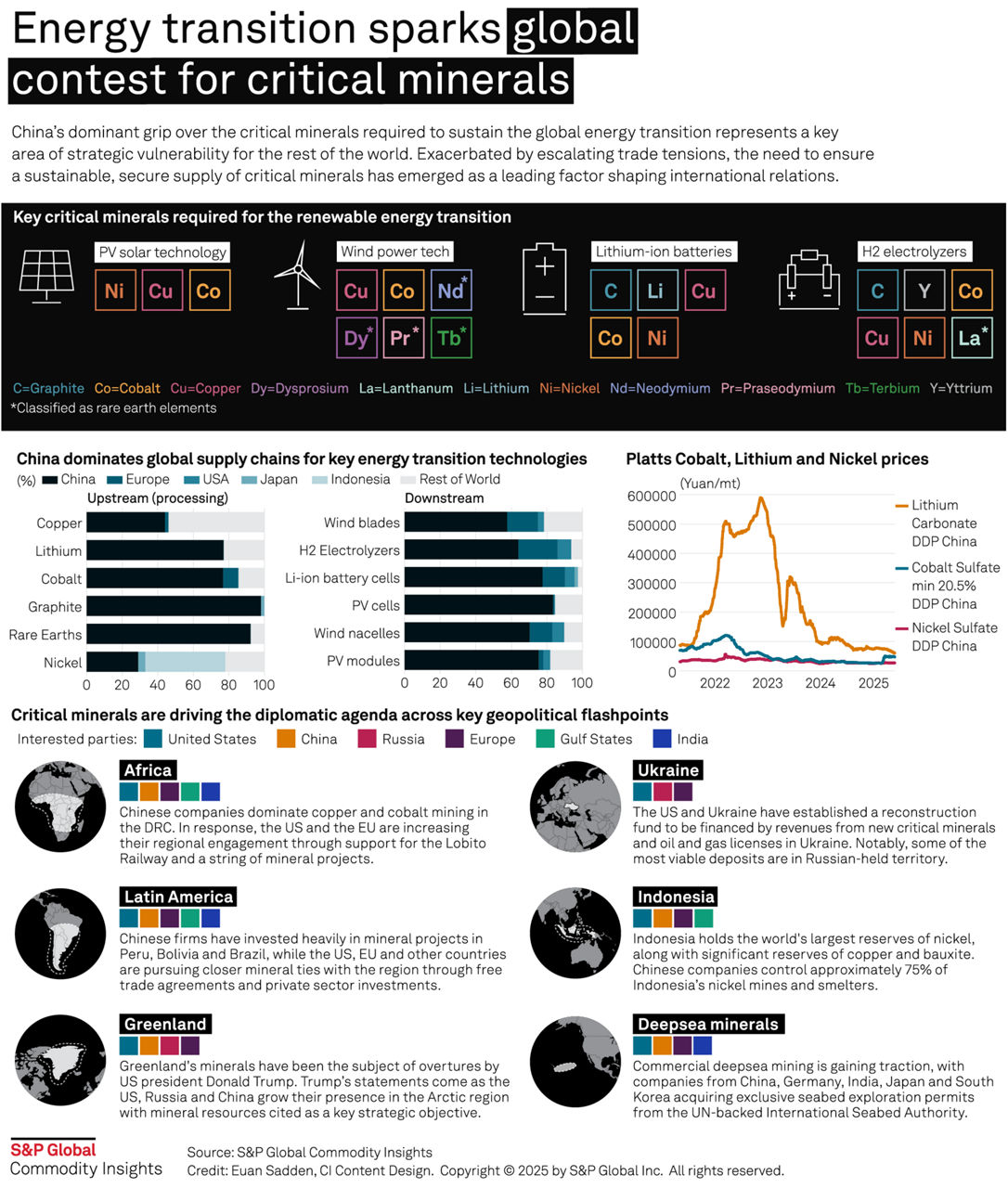
As you can see, the list includes:
- Lithium, Cobalt, Nickel, Graphite: Core components of EV batteries.
- Rare Earth Elements (REEs): Essential for the powerful permanent magnets in wind turbines and EV motors.
- Copper: The workhorse of electrification, needed in vast quantities for everything from wiring and grid infrastructure to all renewable technologies.
- Silicon, Gallium, Germanium: Key materials for solar photovoltaics (PV).
The term "critical" is itself a political designation. To understand this, let's turn to a short video that introduces the topic.
RARE/EARTH: The Geopolitics of Critical Minerals and the AI Supply Chain
This clip from a panel discussion at the Institute for Advanced Study, titled 'RARE/EARTH', introduces the core theme of our lesson: the intersection of technology, critical minerals, and geopolitics.
Please watch the introduction by Alondra Nelson from 00:06 to 03:37. As you watch, pay close attention to her explanation of why the definition of 'critical minerals' is flexible and dependent on geopolitical calculations.
As the video explains, what is "critical" changes based on a country's technological needs, supply vulnerabilities, and strategic goals. This definitional flexibility is where geopolitics begins.
2. The New Geography of Power: Extraction vs. Processing
In the age of oil, power was concentrated in countries with large reserves. The new geography of power is more complex. It's not just about who mines the minerals, but who processes them into usable materials. This distinction is crucial.
Take a look at this image, which breaks down the top producers and processors for key minerals.
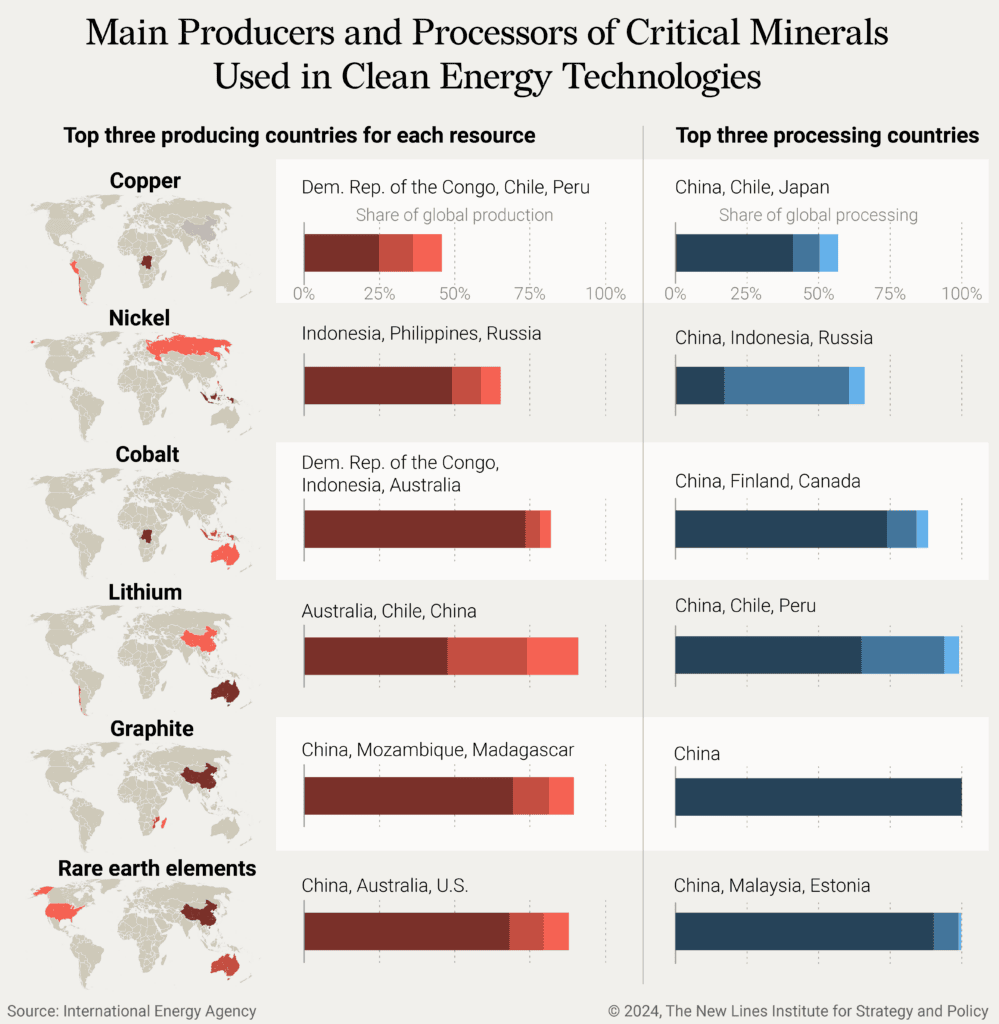
What should immediately jump out at you is a clear pattern:
- Extraction is geographically dispersed: The Democratic Republic of Congo (DRC) dominates cobalt mining, Chile and Australia lead in lithium, Indonesia in nickel.
- Processing is geographically concentrated: China holds a near-monopoly on the refining and processing of almost all these minerals. For example, while the DRC produces over 70% of the world's cobalt, China refines around 70% of it.
This didn't happen by accident. It is the result of a deliberate, long-term industrial strategy by Beijing.
The Geopolitics of Critical Minerals Supply Chains
To understand the geopolitical landscape, we first need to grasp China's central role. This report from the Center for Strategic & International Studies (CSIS) provides an excellent overview.
Please read Section 2, 'The Chinese Dominance of the Global Critical Minerals Supply Chains' (pages 4-6). Focus on the methods China used to build its dominance, such as state-sponsored R&D, investment policies, and acquiring mining projects abroad.
China's strategy involved not only securing raw materials from abroad but also heavily investing in the midstream (processing) and downstream (manufacturing) stages of the value chain. They were also willing to bear the significant environmental costs of refining, particularly for rare earth elements, which other nations were happy to outsource. This gave them a commanding position over the entire supply chain.
3. The Geopolitics of Supply Chains: Weaponized Interdependence 2.0
China's dominance creates a new form of "weaponized interdependence." Just as Russia used its control over gas pipelines to pressure Europe, China can use its control over critical mineral processing to exert leverage.
Beijing has already demonstrated this by restricting exports of gallium and germanium in 2023 in response to US controls on semiconductor technology. This move sent a clear signal: disruptions in one high-tech supply chain can be met with retaliation in another.
Faced with this vulnerability, other major powers are scrambling to build more resilient supply chains. This has sparked a new "great game" of diplomatic and economic maneuvering. Let's examine India's strategy as a case study, which is particularly relevant given your interest in South Asian dynamics.
India's critical minerals strategy
This briefing paper from the Finnish Institute of International Affairs details India's strategy to navigate the complex geopolitics of critical minerals, driven by its rivalry with China and its own energy goals.
Please read the following sections of the PDF: The introduction on page 2 ('India’s critical minerals strategy is emerging...'). 'CRITICAL MINERALS AND GEOPOLITICAL ENTANGLEMENTS' on page 4. 'INDIA’S CRITICAL MINERALS STRATEGY: DOMESTIC IMPERATIVES' on pages 4-5. 'INDIA’S CRITICAL MINERALS STRATEGY: INTERNATIONAL COOPERATION' on page 5. As you read, identify the two main pillars of India's strategy and how they directly respond to the challenge posed by China.
As the paper outlines, India is pursuing a two-pronged approach:
- Bolstering Domestic Capacity: Ramping up domestic exploration and mining, highlighted by the recent discovery of lithium reserves in Jammu and Kashmir.
- Forging International Partnerships: Cooperating with like-minded countries to diversify supply chains. This includes joining the US-led Minerals Security Partnership (MSP) and making direct deals with resource-rich nations like Australia and Argentina.
India's strategy is a textbook example of how middle powers are attempting to navigate the new landscape of great power competition, seeking to reduce their dependence on a single dominant player.
4. The "Extractive Appendage": AI, Green Tech, and the Human Cost
The global race for critical minerals is not just about geopolitics; it's also about a massive intensification of mining with profound environmental and social consequences. This creates a challenging paradox: the "green" transition relies on some of the world's "dirtiest" industrial processes.
Furthermore, the demand for these minerals isn't just coming from renewable energy. It's also being driven by the explosion in artificial intelligence, which requires vast data centers, powerful semiconductors, and enormous amounts of energy—often stabilized by large battery storage systems.
RARE/EARTH: The Geopolitics of Critical Minerals and the AI Supply Chain
Let's return to the 'RARE/EARTH' discussion, where the panelists explore this darker side of the transition. They introduce the concept of the 'extractive appendage'—where green energy and AI are competing for the same finite resources.
Please watch two clips from the discussion: 11:39 to 13:30: Listen to the explanation of the 'extractive appendage' and how the material demands of AI and EVs are creating a 'super cycle' of mineral demand. 24:31 to 30:00: This segment vividly describes the on-the-ground reality of lithium extraction in Chile's Atacama Desert, highlighting the tension between an 'extractive frontier' and a fragile ecosystem that is home to indigenous communities. Focus on the tension between the clean, abstract promise of technology and the messy, material reality of its production.
The speakers powerfully argue that the current model of extraction often replicates colonial patterns. The Global South provides the raw materials and bears the environmental and social costs, while the high-value technology and profits remain concentrated in the Global North. Your work on AI chatbots and your interest in geopolitics places you at the intersection of these forces—the seemingly immaterial world of code is physically dependent on these extractive realities.
Conclusion
The shift to renewable energy is redrawing the map of global power. While it promises a cleaner future, it simultaneously fuels a new and intense geopolitical competition with significant ethical challenges.
Key Takeaways:
- The energy transition is shifting geopolitical focus from fossil fuels to critical minerals and their complex supply chains.
- Power is defined not just by extraction (mining) but, more importantly, by processing (refining), a stage that China has strategically come to dominate.
- This dominance creates new vulnerabilities and a new form of weaponized interdependence, prompting powers like the US, EU, and India to pursue strategies of diversification and "friend-shoring."
- The soaring demand from both green energy and AI is creating an "extractive appendage," intensifying mining activities that often have severe environmental and social consequences, echoing historical patterns of exploitation.
Preview of the Next Lesson:
Today, we've seen how interdependence in the physical supply chains for minerals can be "weaponized." In our next lesson, we will broaden this concept to another domain that, like technology, appears abstract but is deeply embedded in global power structures: finance. We will explain the concept of 'weaponized interdependence' and how global financial networks become tools of coercion.