Hello! Welcome to your next lesson in our Geopolitics course.
In our last session, we formally defined "weaponized interdependence," exploring how the United States has leveraged its central position in the global financial system—specifically the dominance of the US dollar and the SWIFT network—as a tool of coercion. We concluded by noting that this weaponization has triggered a strategic backlash: a growing effort by other nations to reduce their vulnerability to this form of power.
Today, we will explore that backlash in detail. We will examine the motivations, methods, and challenges of "de-dollarization," focusing on the efforts led by the BRICS economic bloc. This topic is a direct bridge from our last discussion and is highly relevant to your interest in the shifting dynamics of great power competition. The concepts of alternative networks and protocols you are familiar with from computer engineering will provide a useful lens for understanding the creation of parallel financial systems like China's CIPS.
Our learning outcome is to assess the geopolitical implications of de-dollarization efforts by economic blocs (e.g., BRICS).
1. The De-dollarization Momentum: What and Why?
De-dollarization refers to the process of reducing the dominance of the US dollar in the global economy. This involves countries shifting away from using the dollar for international trade, as a reserve currency held by central banks, and for pricing key commodities.
To get a quick visual overview of this trend, its timeline, and the key actors involved, take a look at these two infographics.

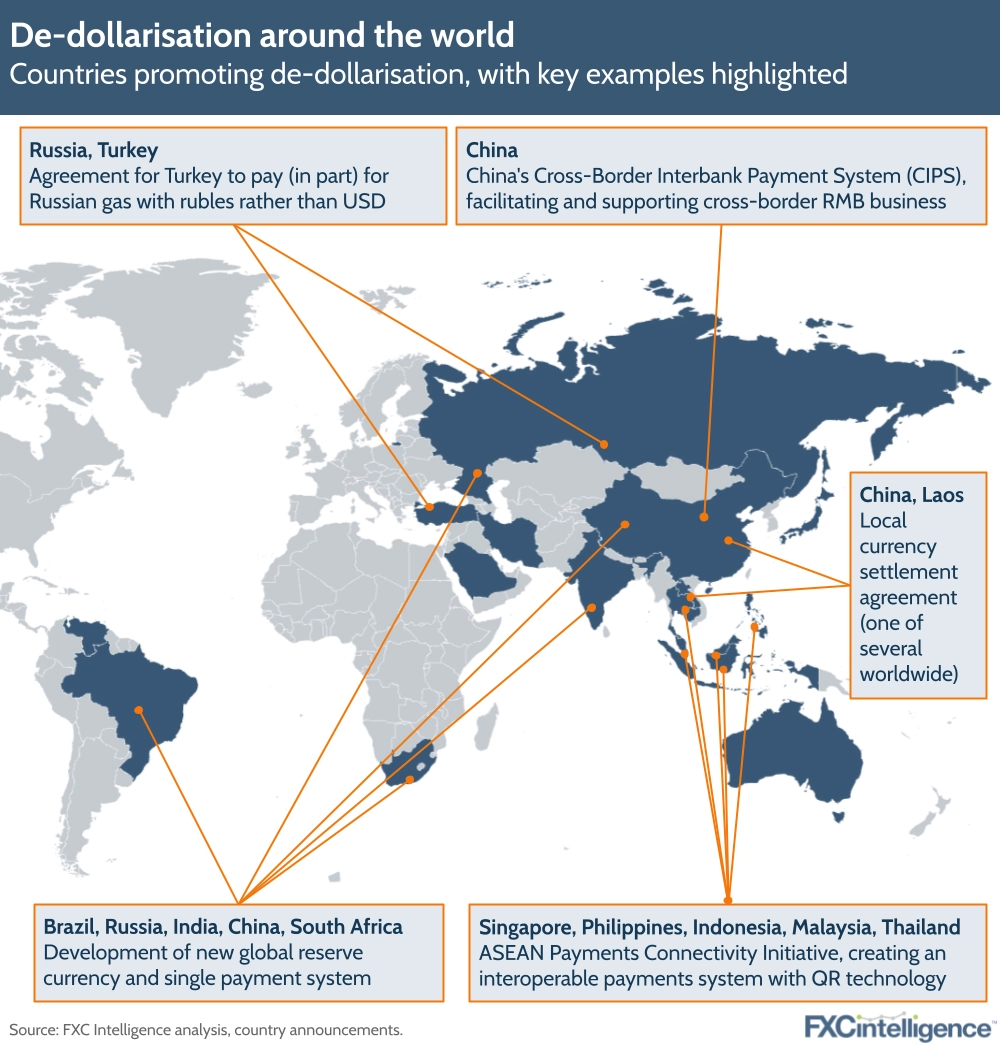
As the graphics suggest, this is not a purely theoretical debate. It is a strategic trend driven by two powerful motivators:
- Geopolitical Imperative (The "Push"): This is a direct consequence of the "weaponized interdependence" we discussed. The US's willingness to use sanctions and disconnect countries from the dollar-based financial system (the "chokepoint effect") has created a strong incentive for nations to build alternatives. Freezing Russia's foreign currency reserves in 2022 was a major catalyst, serving as a "wake-up call" to many countries in the Global South.
- Economic Rationale (The "Pull"): Reliance on the dollar also exposes countries to US monetary policy. When the US Federal Reserve raises interest rates, it can cause capital to flow out of emerging markets and make their dollar-denominated debt more expensive to service. Trading in local currencies can mitigate these risks and strengthen economic sovereignty.
To understand these drivers more deeply, please watch the following video.
Dedollarization speeds up: Countries drop dollar assets, as gold rises
This video from Geopolitical Economy Report clearly explains the primary catalysts behind the acceleration of de-dollarization, linking it directly to US foreign policy and past financial crises.
Please watch two clips: 01:28 - 02:46: This section explains how the use of sanctions as a 'weapon' has accelerated de-dollarization. 18:56 - 22:35: This part traces the trend back to the 2008 financial crisis and explains why the freezing of Russia's reserves was a pivotal moment for the Global South.
2. The BRICS De-dollarization Playbook
The BRICS bloc—now expanded to include major energy producers and regional powers—is at the forefront of the de-dollarization movement. Their efforts are not aimed at a single, dramatic overthrow of the dollar but rather a gradual construction of a parallel, multipolar financial system.
Their strategy consists of several key components:
a) Increasing Bilateral Trade in Local Currencies
This is the most practical and immediate step. Instead of using the US dollar as an intermediary, BRICS members are increasingly settling trade directly in their own currencies. Notable examples include:
- Russia and China conducting the vast majority of their trade in yuan and rubles.
- China and Brazil signing agreements to trade in yuan and reais.
- India and the UAE settling oil trades in rupees and dirhams.
b) Shifting Reserves Away from the Dollar
Central banks are diversifying their foreign exchange reserves. This involves reducing their holdings of US Treasury bonds and increasing their holdings of two key assets:
- Gold: A neutral reserve asset that cannot be printed by any single country and is harder to sanction or freeze when held domestically.
- Other currencies: Primarily the Chinese yuan, as its international role grows.
Dedollarization speeds up: Countries drop dollar assets, as gold rises
Let's return to the Geopolitical Economy Report video to see the data behind this shift in reserves.
Please watch these two clips: 02:46 - 04:02: This segment shows the clear trend of the dollar's declining share in global central bank reserves. 09:48 - 13:58: This crucial section highlights the historic shift of gold overtaking US Treasuries as the primary reserve asset held by central banks. Note the clarification that this is not a return to the 'gold standard'.
c) Building Alternative Financial Infrastructure
This is where your background in technology is most relevant. To escape a network you perceive as hostile, you must build your own. The BRICS nations are doing just that.
The BRICS+ Power Shift: Geopolitical Risks and de-dollarization Impact with Dominic Bowen
This video from Global Risk Community provides a good summary of the BRICS' financial ambitions and the systems they are developing.
Watch the segment from 10:13 - 13:51. Focus on the discussion of de-dollarization as a geopolitical tool, the development of BRICS Pay as an alternative to SWIFT, and the (early stage) talk of a new BRICS currency.
As the video mentioned, key initiatives include:
- The New Development Bank (NDB): Positioned as an alternative to the Western-led IMF and World Bank, providing financing for infrastructure projects, often in local currencies.
- Alternative Payment Systems:
- China's Cross-Border Interbank Payment System (CIPS): Designed as an alternative to SWIFT for settling international claims in yuan. Think of it as a parallel financial messaging protocol.
- BRICS Pay: A planned system to integrate the retail payment systems of member countries, facilitating transactions between ordinary citizens and businesses.
- A Common BRICS Currency: This is the most ambitious and challenging goal. While it is discussed at summits, it remains a long-term aspiration due to immense political and economic hurdles.
3. A Reality Check: Headwinds and Implications
While the de-dollarization trend is real, the dollar's displacement is far from imminent. The efforts by BRICS and other nations face significant obstacles. To understand these challenges and the true geopolitical implications, we need a more detailed, balanced analysis.
The Difficult Realities of the BRICS' Dedollarization Efforts
This excellent analysis from the Carnegie Endowment for International Peace, 'The Difficult Realities of the BRICS' Dedollarization Efforts,' provides a sober look at the challenges involved. It details both the motivations for de-dollarization and the structural reasons for the dollar's continued dominance.
Please read two sections carefully: 'The Dollar’s Role in Emerging Markets': Focus on the self-reinforcing nature of dollar dominance and the structural issues (like liquidity and lack of PvP arrangements) that make it hard for other currencies to compete. 'Conclusion': This section provides a masterful summary of the limitations facing BRICS currencies (especially the renminbi's convertibility issues), the internal divisions within the bloc, and the geopolitical factors that could limit these efforts.
As the Carnegie paper makes clear, the path to a post-dollar world is fraught with challenges. Let's synthesize the key takeaways and assess the geopolitical implications.
Challenges:
- The Dollar's Inertia: The dollar's dominance is a result of deep, liquid financial markets, trust in US institutions (relatively speaking), and powerful network effects. It is the default currency for most of the world, and changing this is incredibly difficult and costly.
- Lack of a Viable Alternative:
- The Euro has its own structural problems and the Eurozone lacks full political union.
- The Chinese Yuan (Renminbi) is the strongest contender, but it is not freely convertible, and China maintains strict capital controls. This limits its appeal as a true global reserve currency.
- Internal BRICS Divisions: The BRICS bloc is not a monolithic alliance. The deep-seated geopolitical rivalry between India and China, for example, makes agreement on a common currency or a yuan-centric system highly problematic.
Geopolitical Implications:
- Erosion of US Coercive Power: While the dollar will remain dominant for the foreseeable future, the growth of alternative financial channels will gradually blunt the effectiveness of US sanctions. The "chokepoint" is becoming leakier.
- Emergence of a Fragmented, Multipolar Financial Order: The most likely outcome is not the replacement of the dollar with the yuan, but rather the rise of a more fragmented system. We may see a dollar bloc, a yuan bloc, and other regional currency arrangements. This makes the world more complex and potentially less stable.
- New Arenas of Great Power Competition: The battle for currency dominance opens up new fronts in the US-China rivalry, including competition over setting technical standards for digital currencies and controlling the infrastructure of global finance.
- Strategic Choices for Smaller States: For a country like Nepal, this fragmentation presents both opportunities and risks. It could mean access to alternative sources of financing (e.g., from the NDB) that come with different conditions than those from the IMF/World Bank. However, it also increases the pressure to navigate carefully between competing economic and political blocs, a classic challenge for smaller states located between giants.
Conclusion
Today, we've assessed the growing trend of de-dollarization, situating it as a strategic response to the weaponization of the dollar-based financial system.
Key Takeaways:
- De-dollarization is driven by both geopolitical motives (fear of sanctions) and economic concerns (exposure to US monetary policy).
- The BRICS bloc is leading these efforts through a multi-pronged strategy: promoting local currency trade, shifting reserves to gold and other currencies, and building alternative financial infrastructure like CIPS and the NDB.
- Significant headwinds remain, including the dollar's deep-rooted network effects, the lack of a fully viable single alternative (due to issues like the yuan's lack of convertibility), and internal BRICS rivalries.
- The primary geopolitical implication is not the imminent collapse of the dollar, but the gradual fragmentation of the global financial system into a more multipolar order, reducing US coercive leverage and creating a more complex strategic environment for all nations.
Preview of the Next Lesson:
We have now examined how finance and global networks are used as tools of economic statecraft. In our next module, we pivot to another critical domain where technology and geopolitics intersect: the physical hardware that powers the digital world. Our next lesson will be: "Explain why semiconductors are a critical strategic resource in great power competition." We will move from the "software" of global power to its "hardware."