Hello! Welcome to the first lesson of our new module, "Technology as a Geopolitical Arena."
In our last lesson, we concluded our discussion on economic statecraft by examining the de-dollarization efforts led by the BRICS bloc. We framed this as an attempt to build a parallel "software" for global finance to counteract the weaponization of the dollar-based system.
Today, we shift from the "software" of global power to the "hardware" that underpins the entire digital economy and modern military capabilities. We will be focusing on semiconductors, the tiny chips that have become a colossal factor in great power competition. Given your background in computer engineering and your project on computational optimization, you have a direct appreciation for how processing power enables complex systems, and this lesson will connect that technical reality to the highest levels of global strategy.
Our learning outcome for this lesson is to explain why semiconductors are a critical strategic resource in great power competition. We will explore their foundational economic role, their function as a strategic multiplier for AI and military power, and the unique vulnerabilities of their global supply chain.
1. The New Oil: Why Semiconductors are Foundational
Semiconductors, or "chips," are the brains of modern electronics. They are in nearly every device with an on/off switch, from smartphones and cars to the vast data centers that run the cloud services you've worked with. Their ubiquity makes them as fundamental to the 21st-century economy as oil was to the 20th.
The race for semiconductor supremacy | FT Film
To begin, let's watch a brief clip from the Financial Times documentary 'The race for semiconductor supremacy' that effectively illustrates this pervasiveness.
Watch the segment from 00:52 to 01:31. Note the wide range of sectors mentioned that depend entirely on semiconductors.
This universal dependence means that any disruption to the semiconductor supply can have immediate and severe economic consequences. As we saw during the COVID-19 pandemic, a shortage of relatively simple automotive chips forced major car manufacturers to halt production lines, leading to billions in lost revenue. This event was a stark reminder to governments worldwide that a stable supply of chips is not just a commercial issue, but a matter of economic security.
The academic paper "Semiconductors are a New Weapon of Geopolitics" puts this into perspective by quoting author Chris Miller: "Last year, the chip industry produced more transistors than the combined quantity of all goods produced by all other companies, in all other industries, in all human history." This highlights the sheer scale and foundational nature of the industry.
2. The Strategic Multiplier: AI, Data, and Military Power
While their role in the general economy is crucial, the strategic importance of semiconductors explodes when we consider their function in cutting-edge technologies, particularly Artificial Intelligence.
As you know from your technical work, advancements in AI, especially in models like the ones you've used from the Gemini family, are driven by what researchers call "scaling laws." In essence, better AI systems require bigger models trained on more data, which in turn demands exponentially more computing power. This computing power is supplied by highly specialized semiconductors.
Chris Miller, author of Chip War, provides a clear explanation of this dynamic.
Chip War 2.0: The Global Battle for Semiconductor Supremacy│Chris Miller (The Author of “Chip War")
In this talk, Chris Miller explains the direct link between AI progress, the demand for computing power, and the specific chips that enable it.
Please watch two key segments: 00:00 - 02:08: Focus on the explanation of 'scaling laws' and how the need for more computing power to train AI systems drives the demand for better semiconductors. 07:17 - 09:25: This part identifies Graphics Processing Units (GPUs), particularly from Nvidia, as the 'currency of the AI era' and the most critical hardware for training advanced AI.
This direct link between advanced chips and AI capability is why both Washington and Beijing view semiconductor access not just as an economic race, but as a national security imperative. They are betting that leadership in AI will translate directly into military and intelligence superiority.
Chip War 2.0: The Global Battle for Semiconductor Supremacy│Chris Miller (The Author of “Chip War")
Let's return to Chris Miller's talk to see how this translates into military and national power.
Watch the segment from 29:02 - 33:04. Pay close attention to how AI is already being integrated into military systems (autonomous drones, like those in the Ukraine war) and intelligence analysis (sifting through satellite data).
As Miller argues, when governments think about AI, they aren't just thinking about chatbots. They are thinking about autonomous weapons, AI-driven intelligence analysis, and cyber warfare. The country that controls the supply of the most advanced chips has a significant head start in developing and deploying these next-generation capabilities.
3. The Achilles' Heel: A Fragile Global Supply Chain
If advanced semiconductors are a strategic necessity, their supply chain is a strategic vulnerability. No single country is self-sufficient. The production of a single advanced chip is an incredibly complex process involving intellectual property, specialized software, unique materials, and mind-bogglingly sophisticated machinery from dozens of companies across multiple continents.
This geographic and corporate specialization has created a number of "chokepoints," where one company or country has a near-monopoly on a critical step in the process.
Let's visualize this complexity.

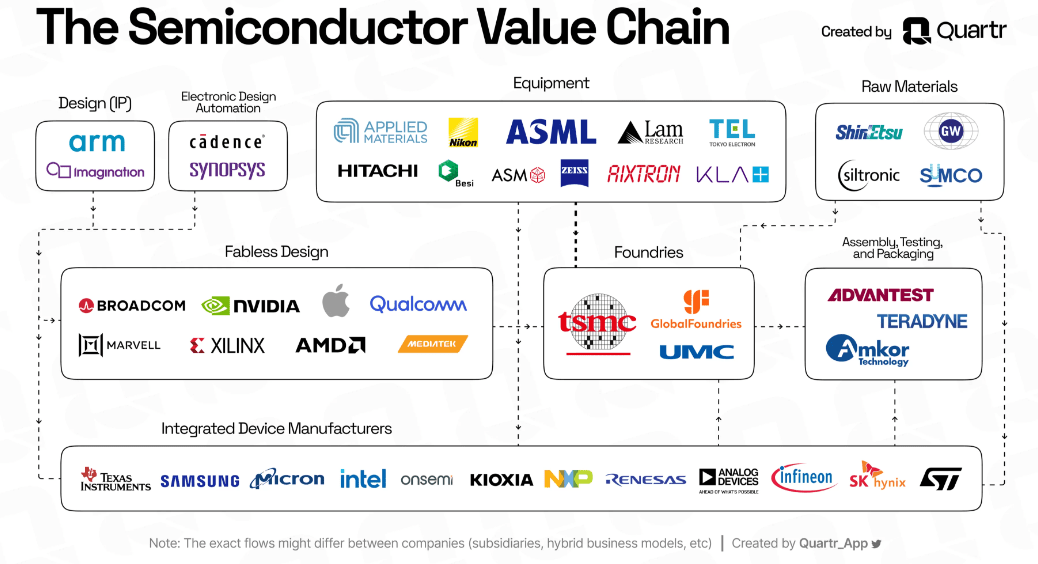
These diagrams reveal a critical geopolitical reality: the world, including both the US and China, is profoundly dependent on a few key players in a few key locations.
Chip War 2.0: The Global Battle for Semiconductor Supremacy│Chris Miller (The Author of “Chip War")
Chris Miller provides an excellent breakdown of this complex supply chain, identifying the key players and the most critical chokepoints.
Watch the segment from 12:40 - 27:32. This is the core of the lesson, so please focus on these key points: Unparalleled Complexity: Why manufacturing advanced chips is so difficult. Global Distribution: How the supply chain stretches across the US, Europe, and Asia, making every chip an international product. China's Dependence: Note the striking fact that China spends more on importing chips than on importing oil. The Ultimate Chokepoint: The role of the Dutch company ASML and its Extreme Ultraviolet (EUV) lithography machines, which are essential for producing the most advanced chips.
The most acute chokepoint is the one you see in the images and the video: the concentration of advanced manufacturing in Taiwan, dominated by a single company, Taiwan Semiconductor Manufacturing Company (TSMC).
The race for semiconductor supremacy | FT Film
The FT Film further emphasizes the geopolitical risk associated with this concentration.
Watch from 13:54 - 15:40. This section explains TSMC's near-monopoly on advanced processors and explicitly frames the 'incredible vulnerability' this creates, especially given the geopolitical tensions surrounding Taiwan.
This intense concentration of a critical resource in a geopolitical flashpoint is the crux of the issue. A blockade or conflict over Taiwan could instantly sever the world's access to over 90% of its most advanced chips, triggering a global economic and technological crisis far exceeding that of any oil shock. This makes the semiconductor supply chain a primary arena for great power competition.
Conclusion
In this lesson, we have dissected why a tiny piece of silicon has become a resource of immense strategic importance.
Key Takeaways:
- Ubiquity and Economic Centrality: Semiconductors are foundational to the modern global economy. Their disruption has immediate, widespread economic consequences, making supply chain stability a matter of economic security.
- The AI-Military Nexus: Leadership in Artificial Intelligence and next-generation military systems is directly dependent on access to the most powerful and advanced semiconductors (like GPUs). This makes chips a critical strategic multiplier for national power.
- A Vulnerable, Concentrated Supply Chain: The production of advanced chips is a globally fragmented process with critical chokepoints. Key vulnerabilities include the reliance on Dutch EUV machines (ASML) and, most importantly, the concentration of advanced manufacturing in Taiwan (TSMC).
- Weaponized Interdependence: This structure allows states controlling chokepoints to exert influence, a classic example of "weaponized interdependence." The fear of being cut off from this critical resource drives nations like the US and China to pursue strategies of self-sufficiency (or "friend-shoring") and technology denial.
Preview of the Next Lesson:
Now that we understand why semiconductors are so critical, our next lesson will focus on how this competition is playing out. We will delve into the specific strategies being used, focusing on the learning outcome: "Analyze the US strategy of technology denial toward China through export controls, entity lists, and allied coordination." We will explore the "small yard, high fence" policy and assess its effectiveness and consequences.