Welcome to the next step in your research journey. In our last lesson, we focused on identifying research gaps, which are the very justification for undertaking a new study. We saw that these gaps represent the unanswered questions and unsolved problems in your field.
Today, we'll address the logical follow-up question: Once you've found a gap, how do you decide on the fundamental nature of the research you'll conduct to fill it? This lesson will equip you to distinguish between exploratory, descriptive, and explanatory research approaches in engineering. Understanding this distinction is crucial because the type of research gap you've identified often dictates the most appropriate and powerful way to frame your investigation. This choice will shape your research question, your methodology, and the kind of contribution you ultimately make.
From "What?" to "Why?": A Hierarchy of Inquiry
Research approaches can be seen as operating at different levels of depth. At the most fundamental level, we explore a new phenomenon. Then, we might seek to describe it in detail. Finally, we aim to explain why it behaves the way it does.
The two short videos below provide an excellent, high-level overview of this hierarchy. They both use the simple but powerful "What/How/Why" framework to differentiate the three approaches.
Research Design | Part 5 - Purpose - Exploratory vs. Descriptive vs. Explanatory Research
This video from DrJ Thesising 101, "Exploratory vs. Descriptive vs. Explanatory Research," uses a great analogy of "Dora the Explorer" to introduce the topic.
Please watch these segments in order: The general introduction to the three types from the beginning. The explanation of exploratory research from this section. The discussion of descriptive research from this part. Finally, the segment on explanatory research from here.
1.3 Exploratory, Descriptive and Explanatory Nature Of Research
This video from MeanThat, "Exploratory, Descriptive and Explanatory Nature Of Research," offers another clear perspective and connects each research type to the kind of question it answers.
Pay close attention to how the presenter links the research purpose to the question you would ask: Exploratory: Watch from this section to understand its role in investigating new topics. Descriptive: The segment from here explains how this approach builds on exploratory findings. Explanatory: Watch from this part to see how it moves beyond correlation to causality. Finally, the key takeaway is summarized from this concluding segment, which links "what", "how", and "why" questions to each type.
These videos establish a clear progression. You can think of these research types as building upon one another, each providing a deeper level of understanding than the last.

The Three Approaches in an Engineering Context
Let's now ground these abstract definitions with examples directly relevant to your interests in mechanism design and system dynamics.
1. Exploratory Research: Charting New Territory
Exploratory research is undertaken when a problem is not clearly defined or has been sparsely studied. It's the first step into an unknown area, akin to a reconnaissance mission. The goal is not to provide conclusive answers but to gain familiarity, identify key variables, generate initial ideas, and formulate hypotheses for future investigation.
- Driving Question: "What is going on here?"
- Typical Research Gap: A knowledge gap where a topic is novel or a new technology emerges.
- Engineering Example: Imagine a new class of soft robotic actuators has been invented using electroactive polymers. An exploratory study might ask: "What are the primary factors influencing the dynamic response of these new actuators?" Your research would involve reviewing the limited existing literature, conducting initial experiments to observe their behavior under various inputs, and perhaps interviewing the inventors to identify important parameters like material composition, electrode geometry, and voltage frequency. You wouldn't aim to create a perfect predictive model yet, but to map out the important variables that such a model would need to include.
2. Descriptive Research: Painting a Detailed Picture
Descriptive research aims to provide an accurate and systematic description of a phenomenon or the characteristics of a population. It can describe relationships between variables, but it does not attempt to explain them. It answers questions of "what," "where," "when," and "how," but stops short of "why."
- Driving Question: "How are these variables related?" or "What are the characteristics of this system?"
- Typical Research Gap: An empirical gap, where data is missing for a known phenomenon under specific conditions.
- Engineering Example: Building on the previous exploratory work, a descriptive study might ask: "How does the actuation frequency affect the displacement and force output of a specific electroactive polymer actuator?" This would involve carefully controlled experiments where you systematically vary the frequency and measure the outputs. The result would be a set of graphs and data tables that accurately characterize the actuator's performance across a range of frequencies, perhaps revealing a non-linear relationship or a resonant peak.
3. Explanatory Research: Uncovering Causal Mechanisms
This is often considered the ultimate goal of scientific and engineering research. Explanatory (or causal) research moves beyond description to determine cause-and-effect relationships. It is designed to test a specific hypothesis about why a phenomenon occurs. Your background in dynamics, where you use principles like Newton's laws or Lagrange's equations to explain why a system moves in a certain way, is a perfect parallel to this mindset.
- Driving Question: "Why does this happen?"
- Typical Research Gap: A theoretical or methodological gap where existing models fail to explain observed behavior, or where conflicting results need to be resolved.
- Engineering Example: Having described the actuator's behavior, an explanatory study would ask: "Why does the actuator's displacement peak at a specific resonant frequency?" To answer this, you would develop a mathematical model of the actuator, perhaps treating it as a damped mass-spring system governed by a second-order differential equation. You would use principles of viscoelasticity and electromagnetism to derive the model's parameters. Your hypothesis would be that the model's predicted natural frequency matches the experimentally observed resonant peak. Confirming this would explain the cause of the peak behavior.
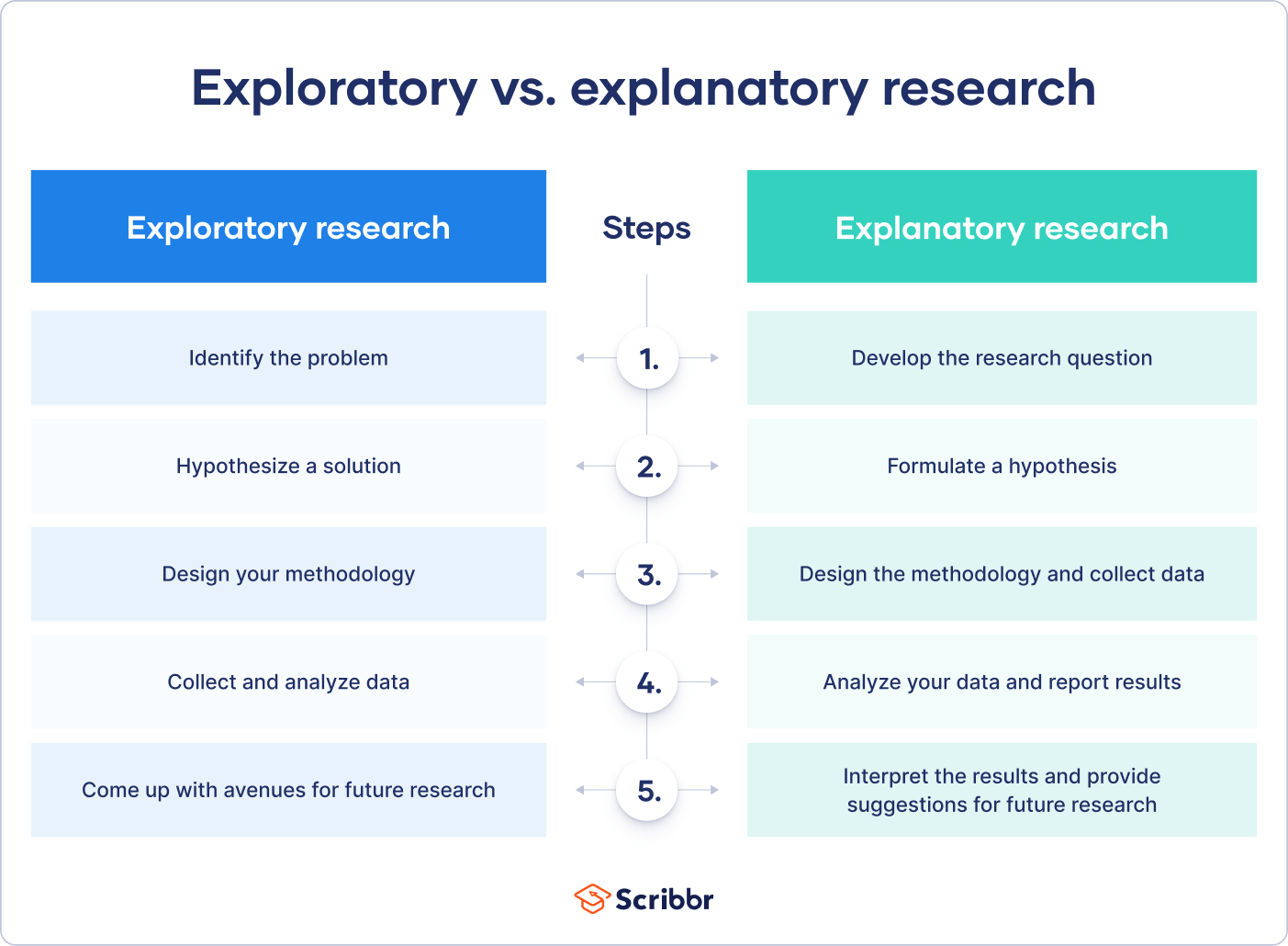
The following flowchart provides a clear visual contrast between the steps involved in an exploratory versus an explanatory research project.
From Approach to Strategy: Inductive vs. Deductive Reasoning
The choice between these research types is deeply connected to your fundamental reasoning strategy.
- Exploratory research is inherently inductive. You start with specific observations (data) and work your way up to broader generalizations and theories. You observe the new actuator's behavior and try to induce a general model or identify key principles.
- Explanatory research is primarily deductive. You start with a general theory or principle (e.g., the laws of mechanics) and use it to formulate a specific, testable hypothesis. You deduce what should happen and then design an experiment to see if reality matches your prediction.
The article below provides concise definitions and a useful summary table comparing these approaches.
Types of Research - Explained with Examples | DiscoverPhDs
This article from DiscoverPhDs offers clear, practical definitions of the research types we've discussed.
Focus on the section "Types of research by depth of scope." Note the engineering-specific example for explanatory research, which closely aligns with the kind of work you might do.
A Framework for Choosing Your Path
As you prepare for your Master's research, you'll need to make a conscious decision about which approach is most suitable for your project. This decision isn't arbitrary; it's a strategic choice based on your research goals and the current state of knowledge in your chosen area.
The following guide provides a comprehensive framework for thinking through this decision. It covers the underlying research philosophies and provides a practical checklist for making a choice.
[PDF] Research Types and Key Characteristics for Engineering and ...
This guide from Colorado State University is designed to help graduate students select the right research methodology. The final section synthesizes many of these ideas into a practical decision-making tool.
Please read the section titled "Practical Decision-Making Framework" (starting on page 21). Pay special attention to the flowchart and the practical checklist. This will be an invaluable tool as you begin to plan your own research.
The framework in this guide helps formalize the decision process. By clarifying your goals—whether you aim to explore, test a theory, or develop a new one—and assessing the context and available resources, you can confidently select and justify your chosen research approach.
Conclusion
In this lesson, we have differentiated the three primary research approaches that form the foundation of an academic study. You are now equipped to recognize them in the literature and, more importantly, to select the right one for your own work.
Here are the essential takeaways:
- Exploratory research asks "What?", ventures into new or poorly understood topics, and is primarily inductive, aiming to generate hypotheses.
- Descriptive research asks "How?", provides detailed accounts of phenomena, and establishes correlations without claiming causality.
- Explanatory research asks "Why?", tests hypotheses derived from theory, and is primarily deductive, aiming to establish cause-and-effect relationships.
- The choice of approach depends on your research question, the nature of your identified research gap, and the maturity of the research area.
In our next lesson, we will build directly on this foundation. Having chosen a research approach, your next task is to formulate a well-defined research problem with clear objectives and scope. This is where you translate your broad research idea into a focused, manageable, and answerable question that will guide your entire project.