Hello! In our previous lesson, we developed a high-level blueprint for a literature review, using the inverted pyramid model to structure your narrative from a broad overview down to a specific research gap. We focused on organizing your sources into thematic sections.
Today, we will zoom in from that architectural view to the level of individual components. The goal of this lesson is to master the skill of writing a synthesis paragraph that compares and contrasts the findings of two to three selected papers on a single topic. This is a fundamental building block of a graduate-level literature review. Instead of just describing what others have done, you will learn to construct a new understanding by weaving together different strands of research.
What is Synthesis? Creating a Conversation Between Sources
At its core, synthesis is the act of integrating multiple sources to create a new, more comprehensive whole. It moves beyond summarizing individual papers one by one. A summary reports what a single source says; a synthesis creates a conversation between sources, highlighting where they agree, disagree, or build upon one another's work.
This Venn diagram provides a useful mental model for synthesis.
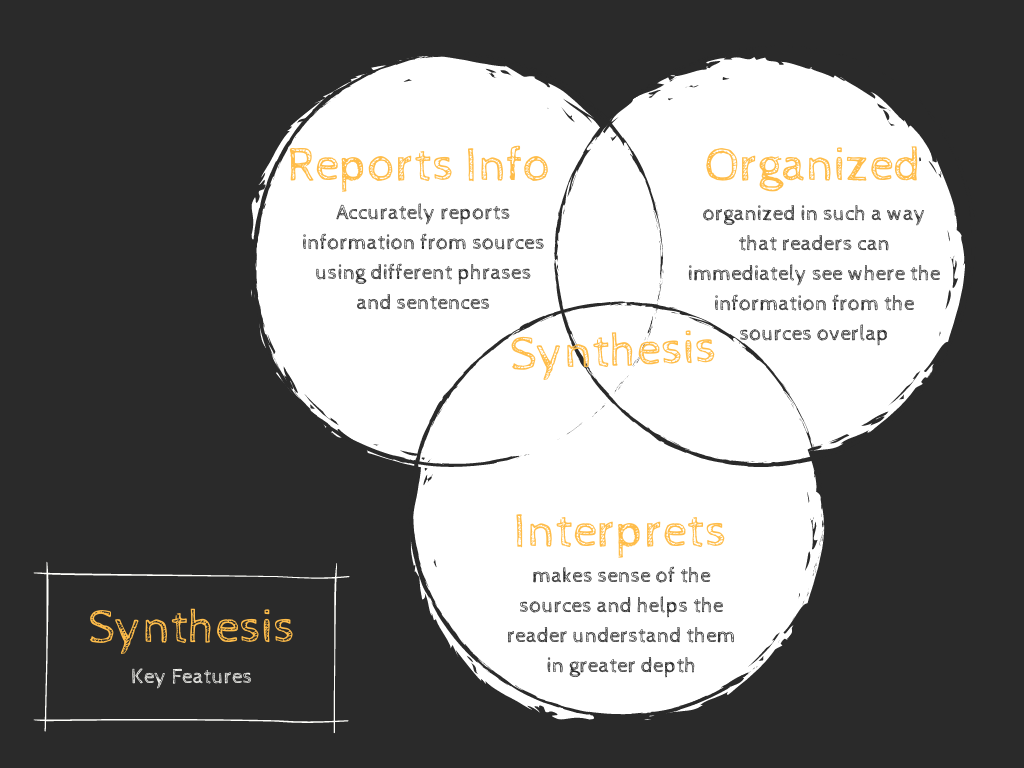
As an engineer, you can think of this process analytically. You deconstruct each paper into its fundamental components (its methodology, assumptions, results) and then reconstruct those components from multiple papers into a new, more insightful structure—your synthesis paragraph. Graduate-level work, especially in a technical field like mechanical engineering, demands this level of analytical integration.
This guide from the University of Ottawa library outlines exactly what is expected in a graduate-level literature review in engineering. It clearly distinguishes between simple description and the synthesis you are expected to produce.
Read the section "What do your professors want in a literature review?" Pay close attention to the three expectations listed, particularly the emphasis on identifying "major trends, methods, approaches, and differences" and communicating "your own perspective."
A Systematic Tool for Synthesis: The Matrix
To manage the complex information from multiple papers, we need a structured tool. A "synthesis matrix" (or synthesis table) is an excellent way to organize your findings for comparison. The structure is simple and logical: list your sources in the columns and the key points of comparison, or themes, in the rows.
This allows you to see, at a glance, how different papers address the same specific issue.
Synthesis table for literature reviews
The video "Synthesis table for literature reviews" from the CSUMB Library provides a clear, practical demonstration of how to build and populate such a table.
First, watch the introduction to understand the concept of the synthesis table. Then, follow the detailed walkthrough from this section, where the presenter takes findings from individual articles and organizes them into rows. Finally, see how these rows are analyzed to create overarching themes. This process of populating the table and then defining the themes for each row is the core of the analytical work.
Identifying the Points of Comparison
Your synthesis matrix is only as useful as its rows—the themes or points of comparison. So, how do you decide what to compare? You should be looking for common threads across the papers you've grouped thematically. A highly effective method is to ask a set of standard questions about the literature you're reviewing.
Literature Synthesis 101: How to Synthesise In Your Literature Review - 5 Key Questions (+Examples )
The video "Literature Synthesis 101" from Grad Coach offers an excellent framework based on five key questions. These questions provide a systematic way to probe the literature for points of agreement, disagreement, and other critical patterns.
Watch the segments explaining each of the five key questions. These will form the basis for the rows in your synthesis matrix: Points of agreement: What findings or assumptions are broadly settled? Points of disagreement: Where are there mixed findings or conflicting results? Key theories: What foundational models or equations are being used or challenged? (e.g., comparing works that use linear vs. nonlinear models for a dynamic system). Contexts covered: What specific systems or conditions have been studied? (e.g., control strategies for rigid-link vs. flexible-link robots). Methodologies used: What research approaches were taken? (e.g., comparing results from a finite element analysis, a simplified analytical model, and an experimental validation).
By using these five questions as a guide, you can systematically extract the crucial points of comparison and populate your synthesis matrix with high-quality, relevant information.
From Matrix to Paragraph: Writing the Synthesis
Once your synthesis matrix is populated, the structure of your synthesis paragraph becomes clear. Instead of writing about one source at a time, you will write about one theme (one row from your matrix) at a time, weaving together the contributions from the different sources in that row.
The basic structure of a synthesis paragraph is as follows:
- Topic Sentence: Introduce the single theme or point of comparison for the paragraph. This sentence signals to the reader what this "conversation" will be about.
- Evidence and Analysis: Present the findings from your sources related to this theme.
- Start with the first source's contribution to the point.
- Use transition words to connect the next source, explicitly stating the relationship (e.g., "Similarly, Author B found...", "In contrast, Author C's experiments showed...", "Building on Author A's model, Author B incorporated...").
- Explain how the sources are similar or different. Don't just state that they are.
- Concluding Sentence: Provide a concluding thought that summarizes the collective insight gained from comparing these sources. What is the net result of this conversation? What does this agreement or disagreement imply?
Now, let's look at how this is done in practice.
Writing A Literature Review and Using a Synthesis Matrix
This document from Florida International University's writing center provides a perfect, concrete example of a synthesis paragraph written from a matrix.
First, re-read the distinction between a summary and synthesis in the section "No, a literature review is not a summary." Then, carefully study the example paragraph provided under the heading "WRITING YOUR REVIEW." Notice how the writer uses phrases like "not all these changes were welcomed" to set up a point of contrast, and "according to" to introduce evidence, weaving together findings from Bruley and Cornelsen to support a single, unified idea about discrimination.
The example, though from a different field, demonstrates the technique perfectly. The paragraph is organized around the theme of hardship, not around the individual authors. This is the hallmark of effective synthesis.
Conclusion
In this lesson, we have moved from the macro-structure of a literature review to the micro-skill of crafting a synthesis paragraph. This skill is essential for demonstrating a high level of understanding and for building the argument that will eventually lead to your own research contribution.
Here are the key takeaways:
- Synthesis vs. Summary: Your goal is to create a conversation between sources, organized by theme, not to list summaries of individual papers.
- The Synthesis Matrix: Use this structured tool to analytically break down papers and organize your findings for comparison.
- The Five Guiding Questions: Use the framework of agreement, disagreement, theories, contexts, and methodologies to identify the most important points to compare.
- Thematic Paragraph Structure: Build your paragraphs around a single theme (a row in your matrix), using a topic sentence, evidence woven with transitions, and a concluding thought.
In our next lesson, we will leverage this new skill to identify research gaps and open questions from a body of related literature. The disagreements, unexplored contexts, and methodological limitations you uncover during synthesis are the very seeds from which research gaps grow.