Hello! Welcome to this new module on Amazon Ads.
In the last part of the course, you created a powerful personal checklist to guide you through publishing new books from start to finish. That checklist is your strategic roadmap. Now, we're going to zoom in on one of the most important parts of your post-launch strategy: using paid advertising to accelerate your success.
You've already learned how to optimize your book for organic discovery through keywords and categories. Ads are the next step, allowing you to proactively place your book in front of shoppers and supercharge your sales and visibility.
In this lesson, you will learn to explain how Amazon Sponsored Product ads work for KDP books. We'll demystify the system by breaking down what ads are, why they are so crucial for growth, and the basic mechanics behind how they function.
1. Why Use Amazon Ads? The Flywheel Effect
At its simplest, an Amazon ad is a way to pay for your book to appear in prominent spots where customers are shopping. However, their true power goes beyond just the immediate sales they generate. Effective advertising creates a positive feedback loop, often called a "flywheel," that boosts your book's overall performance.
To understand this crucial concept, watch the first part of the following video.
Amazon KDP Ads For Beginners | Full Step-By-Step Guide (2025)
This video from the Samazonkdp channel provides an excellent overview of why ads are so important, especially for a new book.
Watch from the beginning until 03:27. Focus on how ad-driven sales influence Amazon's algorithm to improve your book's organic (unpaid) ranking over time.
As the video explained, the key benefits are:
- Increased Visibility: Your book gets seen by more potential buyers. Without ads, a new book can be buried deep in the search results.
- Targeted Reach: You can place your book directly in front of customers who are searching for books just like yours.
- Boosted Organic Sales: This is the most important long-term benefit. When your ads lead to sales, Amazon's A9 algorithm sees that your book is relevant and desirable. In response, it starts showing your book more often in organic search results, leading to even more sales. This creates a powerful, self-reinforcing cycle of growth.
2. Where Do Ads Appear?
When you run an ad campaign, you are bidding for your book to be shown in specific "sponsored" placements. The two most common places you'll see these ads are:
1. In Shopping Search Results: Your book can appear at the top, middle, or bottom of the page when a customer searches for a relevant term. These are valuable spots that get a lot of attention.
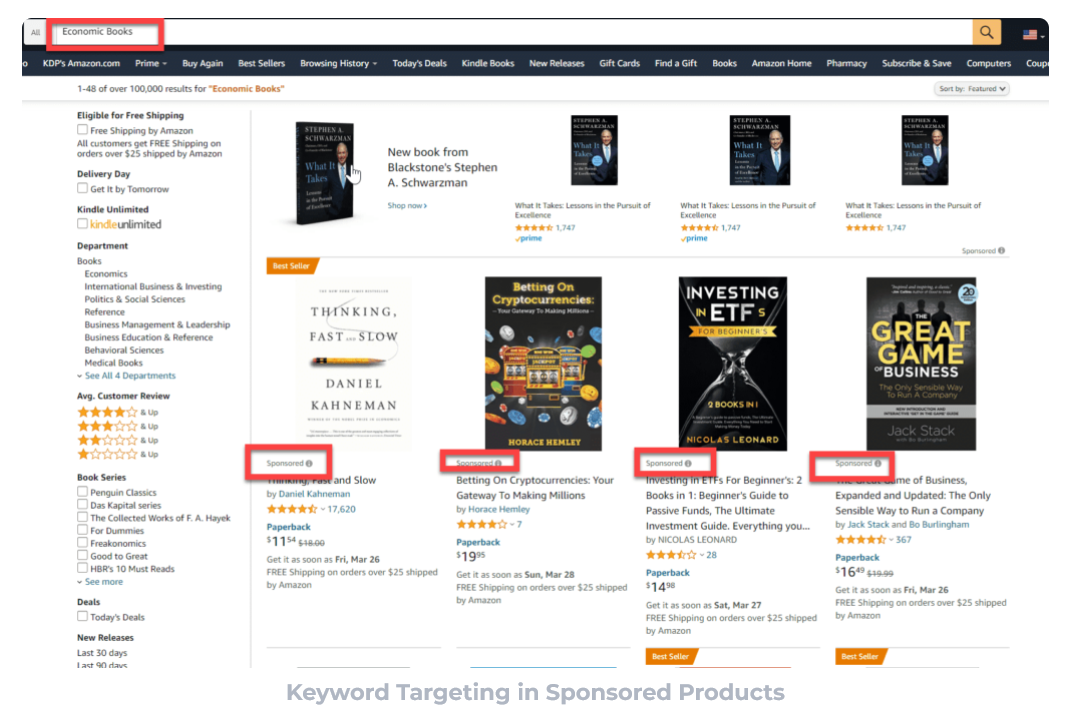
2. On Product Detail Pages: Your book can appear in a "Sponsored products" carousel on the page of another book. This is a great way to attract customers who are looking at a competitor's book.

3. How Do Ads Work? The Auction and PPC Model
Now that you know why you should use ads and where they appear, let's look at the mechanics of how the system works.
The Pay-Per-Click (PPC) Model
Amazon Ads operate on a Pay-Per-Click (PPC) model. This means:
- You do not pay when someone simply sees your ad (this is called an "impression").
- You only pay when a customer actually clicks on your ad to view your book's product page.
This makes it a cost-effective way to advertise, as you're only paying for shoppers who show genuine interest.
The Ad Auction
Every time a customer searches on Amazon, a lightning-fast auction happens in the background to decide which ads get shown. You don't just win by bidding the most money. Amazon's goal is to show ads that are most likely to lead to a sale.
The video below explains the key ingredients that help you win these ad auctions.
My SIMPLE & Profitable Amazon Ads Strategy | Beginner Amazon Ads Tutorial for KDP Authors
Ken Fornari provides a clear, concise explanation of the factors that determine who wins an ad placement.
Watch from 01:28 to 02:31. Pay attention to the combination of factors that Amazon's algorithm considers: your bid, your book's relevance, and its performance history.
To summarize, your ability to win an ad spot is determined by a mix of:
- Your Bid: The maximum amount you are willing to pay for a single click.
- Relevance: How closely your book and keywords match the customer's search. A "dinosaur coloring book" ad is highly relevant for the search "dinosaur coloring book for kids."
- Performance: Your book's history of being clicked on (Click-Through Rate or CTR) and purchased when shown for similar searches.
A highly relevant book with a strong sales history can often win an ad spot even with a lower bid than a less relevant competitor.
4. How Do You Target Ads? Automatic vs. Manual Campaigns
The final piece of the puzzle is understanding how you tell Amazon who to show your ads to. This is called targeting. There are two main ways to do this, which correspond to two different campaign types.
The next video segment breaks this down perfectly.
Amazon KDP Ads For Beginners | Full Step-By-Step Guide (2025)
Let's return to the Samazonkdp video to understand the fundamental difference between letting Amazon do the work versus doing it yourself.
Watch from 03:27 to 06:52. Focus on understanding the core difference between Automatic and Manual targeting.
As the video explained, the two main campaign types are:
-
Automatic Campaigns: You choose your book, set a budget, and Amazon's algorithm "reads" your book's title, keywords, and description to automatically show your ad for search terms and on product pages it deems relevant.
- Best for: Beginners, and for conducting research to discover which search terms customers are using to find and buy your book.
-
Manual Campaigns: You have full control. You provide Amazon with a specific list of keywords or products (known as ASINs) that you want to target.
- Best for: Scaling up your advertising by focusing your budget on proven, profitable keywords that you discovered through your automatic campaigns.
For beginners, the journey always starts with an Automatic campaign. It's the simplest way to get started and the best way to gather data on what works before investing more heavily.
Conclusion
You now have a foundational understanding of how Amazon's advertising platform works for KDP authors. This can feel like a complex topic, but it boils down to a few core principles.
Key Takeaways:
- Amazon Ads are a Pay-Per-Click (PPC) system designed to increase your book's visibility and sales.
- They create a positive feedback loop: ad sales lead to better organic ranking, which leads to more sales.
- Your ads appear in search results and on competitors' product pages.
- Ad placements are won through an auction that balances your bid with your book's relevance and performance.
- Automatic campaigns are the ideal starting point for beginners, letting Amazon find relevant customers for you.
In our next lesson, we'll discuss a critical step you must take before you spend a single dollar on ads: verifying your book's listing is fully optimized for conversion. After all, driving traffic to a product page that isn't ready to sell is like pouring water into a leaky bucket.