Hello! Welcome back. In our last lesson, you did the essential "detective work" of building a large list of potential keywords. You now have a spreadsheet filled with 50-100 search terms that real customers might use.
This lesson is about turning that raw data into actionable intelligence. A long list is a great start, but many of those keywords are likely duds—either too competitive or not searched for enough. Our goal today is to analyze your keywords for relevance, search volume, and competitive viability. This is how you'll find the "golden" keywords that can get your book in front of the right buyers.
By the end of this lesson, you will have a filtered, annotated list that clearly shows which keywords are your strongest contenders.
The Three Pillars of Keyword Analysis
Before we dive into the "how," let's understand the "what." Every keyword you consider should be filtered through three critical criteria: Relevance, Search Volume, and Competition.

-
Relevance: Is the keyword an accurate and honest description of your book? This is the most important filter. If a customer searches for "dinosaur coloring book" and finds your "flower coloring book," they won't buy it. This tells Amazon's algorithm that your book is not a good result for that search, which will hurt your ranking over time.
-
Search Volume (Demand): Are people actually searching for this term? A perfectly relevant keyword is useless if no one ever types it into the search bar. We want to target terms that have a measurable audience.
-
Competition (Viability): How many other books are already targeting this keyword? Trying to rank for a term like "coloring books" (with millions of results) is nearly impossible for a new book. We need to find keywords where you have a fighting chance to appear on the first few pages of the search results.
This article provides a great framework for thinking about these three filters.
Mastering Amazon KDP Keywords for More Sales
To start, please read the section 'The Three-Point Scoring System' from the ManuscriptReport blog. It does an excellent job of explaining how to think about and evaluate each keyword against these three crucial criteria.
Focus on the section titled 'The Three-Point Scoring System'. You don't need to do any complex scoring, but absorb the logic behind evaluating relevance, traffic (search volume), and competition.
Gauging the Numbers: Tools and Metrics
While some advanced sellers use paid tools to get precise data, the principles of analysis are the same whether you do it manually or with software. Paid tools simply provide estimates for our three pillars:
- Search Volume: An estimated number of monthly searches.
- Competition Score: A number (e.g., 1-100) indicating how difficult it is to rank.
- Opportunity Score: A metric that combines search volume and competition to highlight "sweet spots."
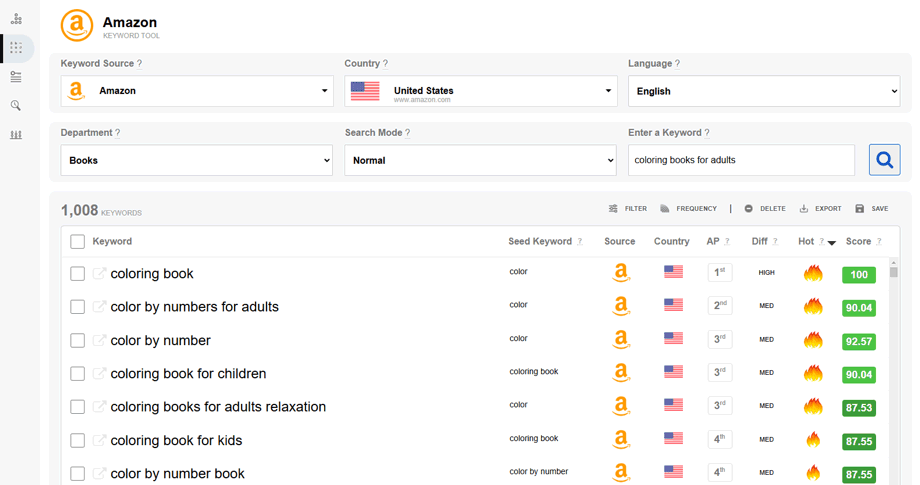
The following video uses a paid tool, but it's an excellent way to understand the thought process behind the analysis.
Amazon KDP Keyword Research Tutorial (Full 2025 Guide)
Watch this clip from the Samazonkdp channel. The presenter explains what makes a good keyword by looking at demand (search volume) and competition. Pay close attention to how he defines a good opportunity.
Watch from 05:15 to 08:04. Focus on how he balances 'high demand' with 'low competition' and how the 'Opportunity Score' in his tool represents this balance.
Long-Tail Keywords: Your Secret Weapon
As you analyze your list, you'll notice some keywords are short and broad (e.g., "coloring book") while others are long and specific (e.g., "easy mandala coloring book for seniors"). These specific phrases are called long-tail keywords.
- Short-Tail Keywords: High search volume, but extremely high competition.
- Long-Tail Keywords: Lower search volume, but much lower competition and higher buyer intent. Someone searching for "easy mandala coloring book for seniors" knows exactly what they want and is more likely to buy if your book is a perfect match.
For a new book with no sales history, long-tail keywords are your path to getting seen.
This next clip explains the strategic difference between the two.
Amazon KDP Keyword Research Tutorial (Full 2025 Guide)
Let's continue with the same video. This section clearly breaks down the difference between short-tail and long-tail keywords and why you need a mix of both in your overall strategy.
Watch from 08:12 to 10:14. Understand why long-tail keywords are great for ranking for a specific phrase, while short-tail keywords help broaden your book's overall reach.
A Live Analysis Example
Now, let's see how these concepts are applied in a real-world scenario. In this final video segment, the presenter analyzes keywords for a new coloring book. Even though he uses a tool, focus on his logic.
Amazon KDP Keyword Research Tutorial (Full 2025 Guide)
This is a longer but incredibly valuable clip showing the analysis process in action. The presenter decides on keywords for his title and subtitle by carefully weighing relevance, search volume, and competition.
Watch from 14:12 to 22:37. Notice how he: Starts with a core, relevant keyword ('dementia coloring book'). Evaluates its search volume and opportunity score. Looks for other long-tail keywords for the subtitle, like 'bold and easy coloring book for seniors,' and checks their viability. Justifies his choices based on the data, aiming for that sweet spot of good demand and low competition.
Your Action Plan: Analyze Your Keyword List
It's time to apply this process to the spreadsheet you created in the last lesson.
-
Add New Columns: In your spreadsheet, next to your "Keywords" column, add two new columns: "Search Results" and "Viability."
-
Step 1: The Relevance Filter. Read through every keyword on your list. Is it a 100% accurate description of your coloring book? If not, delete the row. Be ruthless. This is the most important step.
-
Step 2: The Competition Filter. For every remaining keyword, perform the following manual analysis:
- Go to
amazon.com(use a private/incognito window and ensure the search department is "All"). - Copy and paste the keyword into the search bar and hit Enter.
- Look at the top-left of the results page. It will say "1-48 of over X results for..." Record that "X" number in your "Search Results" column.
- Now, assess the first page of results. In your "Viability" column, write "High," "Medium," or "Low" competition based on this:
- High: Over 10,000 results. The first-page books all have professional covers and hundreds or thousands of reviews.
- Medium: 1,000 - 10,000 results. A mix of books, some with high reviews, but some with fewer than 100.
- Low: Under 1,000 results. The covers might be of mixed quality, and several books on the first page have few or no reviews. These are your prime targets.
- Go to
-
Step 3: The Search Volume & Intent Filter. Look at your list, especially the keywords you marked as "Low" or "Medium" viability.
- Identify which are long-tail keywords. These are your best starting point.
- Even if a long-tail keyword has a low search result count (which is good!), the fact that it appeared in Amazon's autocomplete in the first place confirms that people are searching for it.
Your goal is to identify 10-20 keywords that fall into the "Goldilocks zone": they are highly relevant, have manageable competition ("Low" or "Medium"), and are specific enough to attract buyers (long-tail).
Conclusion
You've now moved from a simple list of words to a strategic analysis of market opportunities. This process is the core of effective keyword research and is fundamental to getting your book discovered.
Key Takeaways:
- A strong keyword must be relevant, have sufficient search volume, and face manageable competition.
- Long-tail keywords are your secret weapon as a new publisher, offering lower competition and higher buyer intent.
- You can manually gauge competition by looking at the number of search results and the quality of the top-ranking books for a given keyword.
- The goal is to find the "sweet spot" where you can realistically compete and attract the right customers.
Preview of the Next Lesson:
Now that you've analyzed your big list, the next step is to make some final decisions. In the next lesson, we'll discuss strategies for using broad vs. long-tail keywords and how to audit your existing book's keywords before finally compiling your new, optimized list of 7 backend keywords.