Introduction
In our previous lesson, we built your digital fortress, developing a data compartmentalization strategy to create firewalls between your different online personas. This was an essential inward-facing defense. Now, with your own identity secured, we will shift our focus outward. The digital world isn't just about protecting your own information; it's also about understanding who you are interacting with.
This lesson directly addresses the learning outcome: Use tools like reverse image search and profile analysis to verify the authenticity of online profiles. We will move from passive defense to active verification. For you, this skill is critical. Whether you're engaging with potential partners in lifestyle communities, vetting a photographer for your lingerie brand, or simply interacting with new followers, the ability to discern genuine profiles from deceptive ones is a cornerstone of digital safety and operational security.
Think of this process through the lens of your statistics background. When you encounter a new profile, you can form a null hypothesis, : "This profile is authentic." Your task is to gather data and look for evidence that would lead you to reject that hypothesis. Today, we'll equip you with the tools and analytical framework to do just that.
The Anatomy of Deception: Catfishing and Fake Personas
Before we dive into the tools, it's important to understand what we're looking for. One of the most common forms of identity deception is "catfishing," where an individual creates a fake online persona to engage in a relationship with someone, often for emotional, financial, or malicious reasons.

In your world, this could manifest as someone using stolen photos of an attractive person to get closer to you, feigning interest in your lifestyle or design work to build trust before making manipulative requests. Your first line of defense is to question the visual "evidence" they present.
Core Skill: Mastering Reverse Image Search
The single most powerful tool for puncturing a fake identity is the reverse image search. Instead of searching for images with words, you search with an image to find where else it has appeared online.
The investigative journalism collective Bellingcat has produced one of the best guides on this technique. We will use it as our primary reference.
Guide To Using Reverse Image Search For Investigations - bellingcat
This guide from Bellingcat will teach you the fundamental tools and advanced strategies for effective reverse image search. It's an essential read for any serious digital investigator.
Start by reading the introduction, which mentions the Catfish TV show. Then, focus on the section "Beyond Google," which explains why Yandex is the superior tool and how to use it. Also, read the brief sections on Bing and Google to understand their capabilities and limitations. Next, jump to the section "Creative Searching." This is where you'll learn the advanced techniques that separate amateurs from experts. Pay close attention to the example of pixelating or blurring a person to identify a background location. Finally, review the summary tips at the end.
The Investigator's Toolbox: Yandex, Bing, and Google
As you just read, relying solely on Google for reverse image searches is a common mistake. Here’s a quick summary of your primary tools:
- Yandex: Your go-to tool, especially for faces. Its facial recognition algorithm is powerful enough to find other photos of the same person, not just exact duplicates of the image you searched. This is invaluable for discovering the true source of a catfish's photos.
- Bing: Has a useful "Visual Search" feature that allows you to crop a part of an image within the search tool itself, helping you focus on a specific object or person.
- Google Images: Best for identifying widely-used images, famous landmarks, or popular stock photos. It's a good starting point but often fails on more obscure or modified images.
- TinEye: Specializes in finding exact duplicates, which is useful for tracking the spread of a specific meme or image, or finding the original, un-cropped version of a photo.
Practical Application: The "Interested Follower" Scenario
Imagine a new follower DMs you. Their profile picture shows a handsome man, and their messages are flattering, referencing both your polyamorous advocacy and your lingerie designs. They suggest they're also in the lifestyle and would love to connect.
Your is "This is a real person who is genuinely interested." Now, you test it.
- Action: Download their profile picture.
- Tool: Go to Yandex Images.
- Search: Upload the picture.
Potential Outcomes:
- Rejection: Yandex returns multiple hits showing the same person on stock photo websites or on the profile of a minor influencer with a different name. You have strong evidence to reject . This profile is likely fake.
- Corroboration: Yandex finds other photos of the same person across different, seemingly personal social media accounts, all with the same name. This strengthens your confidence in , but does not prove it.
- Inconclusive: The search returns no results. This means the image is not widely indexed. It could be a private, original photo, or it could be a photo stolen from a private account. Your analysis is not over; you simply lack evidence to reject based on this test alone. We need more data.
This leads us to the next stage: holistic profile analysis.
Holistic Profile Analysis: A Multi-Factor Approach
A single data point is not enough. You must analyze the entire profile as a system, looking for patterns and anomalies. Your background in experimental design is relevant here; you are essentially looking for confounding variables and indicators that don't align with the profile's claims.
How to Identify Fake Followers & Bot Audiences |... - InfluenceFlow
This guide, though focused on influencer marketing, provides an excellent checklist for spotting inauthentic accounts. The principles for detecting fake followers are directly applicable to identifying a fake individual profile.
Read the sections "Red Flags to Spot Fake Followers" and "Comment and Like Quality Assessment." These provide a fantastic checklist. Also, review the section on using free tools like Social Blade. Finally, in the FAQ at the end, note the specific answer to spotting AI-generated pictures using reverse image search.
The Profile Verification Checklist
Using the insights from the reading, here is a systematic checklist to apply to a profile of interest:
-
Profile Completeness:
- What to look for: A sparse bio, no link, a generic username (e.g., "dave1988765"), or a brand new account creation date.
- Why it matters: Real people, especially those wanting to connect within a niche community, usually put some effort into their profile to signal their identity and interests.
-
Follower-to-Engagement Ratio:
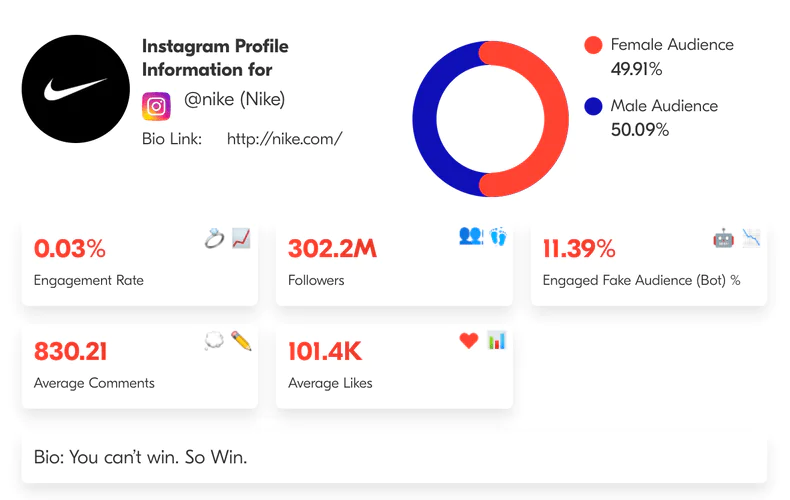
- What to look for: A high follower count with suspiciously low engagement (likes/comments). An account with 10,000 followers but only 15 likes per photo is a major red flag.
- Why it matters: This suggests the followers were purchased and are not a real, engaged audience. This is a quantitative indicator of inauthenticity.
-
Follower Quality:
- What to look for: Click on their list of followers. Do you see a large number of profiles with zero posts, no profile picture, and random usernames?
- Why it matters: This is another sign of purchased followers, indicating the account owner is trying to artificially inflate their social proof.
-
Content and Comment Quality:
- What to look for: Are their posts low-quality, stolen, or repetitive? Read the comments on their posts. Are they all generic ("Wow," "Nice," "🔥🔥🔥") or are they specific and conversational?
- Why it matters: Generic comments are often left by bots. A real person's posts will typically attract genuine, context-specific comments from friends and real followers.
-
Historical Consistency:
- What to look for: Use a free tool like Social Blade to look up their username. Does their follower graph show a sudden, massive spike on a single day?
- Why it matters: Organic growth is gradual. A vertical leap in followers almost always indicates they were bought.
Advanced Techniques: Open-Source Intelligence (OSINT)
For situations requiring deeper vetting—such as a serious business collaboration or a potential romantic partner you met online—you can employ more advanced OSINT techniques. These methods use publicly available information to build a more complete picture of a person's digital footprint.
How To Find Anyone Online Using OSINT...
This video provides a great introduction to OSINT tools. We'll focus on the section demonstrating username search tools.
Watch the segment on Sherloq and Maigret. These tools take a username and scan hundreds of websites to see where else that person has an account. This is a powerful way to uncover a person's broader online presence.
Another powerful set of techniques involves using specialized search queries, often called "Google Dorking," and facial recognition.
SOCIAL MEDIA OSINT (private accounts)
This video on "SOCIAL MEDIA OSINT" demonstrates several practical investigative methods.
First, watch the segment on using Google search operators to find a user's public comments or tags on a platform like Instagram. Then, watch the section on using facial recognition tools like FaceCheck.ID and PimEyes, which are a step beyond a simple reverse image search.
Key OSINT Strategies:
- Username Search: If someone's username is "LingerieLover88" on Instagram, tools like Maigret can check if that same username exists on Reddit, Twitter, FetLife, or hundreds of other sites. Finding their posts on other forums can quickly verify or contradict the story they are telling you.
- Google Dorking: Use queries like
site:twitter.com "LingerieLover88"to find all mentions of that username on Twitter. This can uncover conversations they've had, people they associate with, and interests they've expressed publicly. - Facial Recognition: For very high-stakes verification, paid tools like PimEyes can scan the web for other photos of a person's face, even if they are in group shots or have been altered. This can uncover hidden social media profiles or professional websites they haven't disclosed.
Conclusion
In this lesson, you've transitioned from a defensive to a proactive security posture. You are no longer just protecting your own data; you are now equipped to critically evaluate the identities of those who enter your digital space.
Here are your key takeaways:
- Adopt a Verification Mindset: Treat online profiles with professional skepticism. Start with the hypothesis that a profile is authentic and actively look for evidence to the contrary.
- Master Reverse Image Search: This is your primary tool for debunking fake photo identities. Always go beyond Google and use Yandex for its superior facial recognition capabilities.
- Conduct Holistic Profile Analysis: A single clue is not enough. Assess the entire profile—engagement ratios, follower quality, comment patterns, and account history—to build a comprehensive case for or against authenticity.
- Leverage OSINT for Deeper Vetting: For high-stakes interactions, use username checkers and advanced search techniques to map a person's full digital footprint.
You now have the skills to audit your existing followers and vet new ones. But what happens when your investigation uncovers something more sinister than a simple catfish—like a potential stalker or someone planning to dox you? Our next lesson will address this, as we will learn to create a personal protocol for handling suspected stalking or doxing attempts.