Introduction
In our last lesson, we built a robust protocol for handling overt digital threats like doxing and stalking, focusing on protecting your personal data and physical safety. Now, we shift our focus from external security to internal certainty. We begin our module on "Covert Emotional Control and Psychological Manipulation" by examining one of the most disorienting tactics you'll encounter online: gaslighting.
This lesson is designed to address the learning outcome: Define gaslighting and identify reality-distortion techniques in online comments and private messages. Unlike a doxing attempt, which is a clear and obvious attack, gaslighting is a subtle poison. It doesn't steal your information; it attempts to corrupt your perception of reality itself. By the end of this lesson, you will have a precise definition of this tactic and a practical toolkit for identifying its various forms in the specific contexts of your public-facing work.
What Gaslighting Is (and Isn't)
The term "gaslighting" is frequently misused online to describe any form of disagreement or deception. However, it refers to a very specific and insidious form of manipulation. At its core, gaslighting isn't just about lying; it's a sustained effort to make you question your own memory, perception, and sanity, ultimately making you dependent on the manipulator for your "truth."
To establish a clear definition and distinguish it from other toxic behaviors, we'll start with a reading that breaks this down. The example scenario—an argument over posting a picture online—should be particularly relevant to your work as a designer who models your own creations.
Can we talk about what gaslighting actually is, AND what it isn't?
This Reddit post provides an excellent, clear-headed analysis of gaslighting. It offers a formal definition and, most importantly, contrasts what constitutes gaslighting with what does not.
First, read the initial section to understand the formal definition and the origin of the term. Then, pay close attention to the section titled "Examples." Notice how it clearly separates behaviors like guilt-tripping and being controlling from the specific act of gaslighting, which involves directly challenging your memory and sanity.
As you can see from the reading, telling you that your photo makes someone feel insecure is guilt-tripping. Demanding you take it down is controlling. But telling you, "We never had a conversation about that photo, you must be imagining things. Honestly, I'm worried about your memory,"—that is gaslighting.
The Mechanism: How Gaslighting Engineers Instability
Gaslighting is powerful because it exploits a fundamental human need to have a stable sense of reality. The tactic is designed to provoke an emotional reaction from you and then use that very reaction as evidence of your supposed instability. This is a crucial dynamic to understand, especially in the charged environment of public comment sections or community disputes.
Dr. Ramani Durvasula, a clinical psychologist, explains this process with exceptional clarity. She outlines a sequence that you may find uncomfortably familiar:
- The Provocation: The manipulator makes a false accusation, denies a promise, or twists your words.
- The Reaction: You, rightly, become upset, confused, or agitated. You defend yourself, perhaps with strong emotion, because your reality is being challenged.
- The Pivot: The manipulator becomes calm, cool, and collected. They pivot the conversation away from the original issue and focus on your reaction. They will say things like, "You need to calm down," or "You're being so dramatic."
In that moment, to an outside observer or even to yourself, you may appear to be the "unstable" one, while the manipulator looks like the calm, rational party. This is not an accident; it is the intended outcome.
When being gaslighted makes YOU seem unstable
In this video, Dr. Ramani breaks down how gaslighters deliberately make their victims appear unhinged.
Watch the following segments: First, watch from the beginning of the sequence to understand the provocation-reaction-pivot dynamic. Next, observe how the manipulator frames you as unhinged to both you and outside observers. Finally, understand the long-term consequences, where the victim begins to internalize the false narrative and the ultimate goal of achieving mental control.
Imagine this in your context:
- As a designer: Someone leaves a comment on your bikini photo: "You said you stood for body positivity, but you only post when you look perfect. It's hypocritical." You reply, explaining that your brand celebrates confidence in many forms. They respond publicly, "Wow, I was just asking a question. Why are you so defensive and angry? You really need to learn to take feedback." They provoked you with a loaded accusation and then used your defense to paint you as hostile and unstable.
- In your community: During a discussion about relationship structures, someone misrepresents a point you made in a previous conversation. When you correct them with the facts, they say to the group, "Okay, let's all take a breath. I see this is a very emotional topic for you." They have successfully shifted the focus from their dishonesty to your "emotionality."
A Field Guide to Reality-Distortion Techniques
Now that you understand the definition and the psychological engine of gaslighting, let's arm you with a field guide to its specific manifestations. Recognizing these phrases and tactics in the wild is the first step toward neutralizing them.
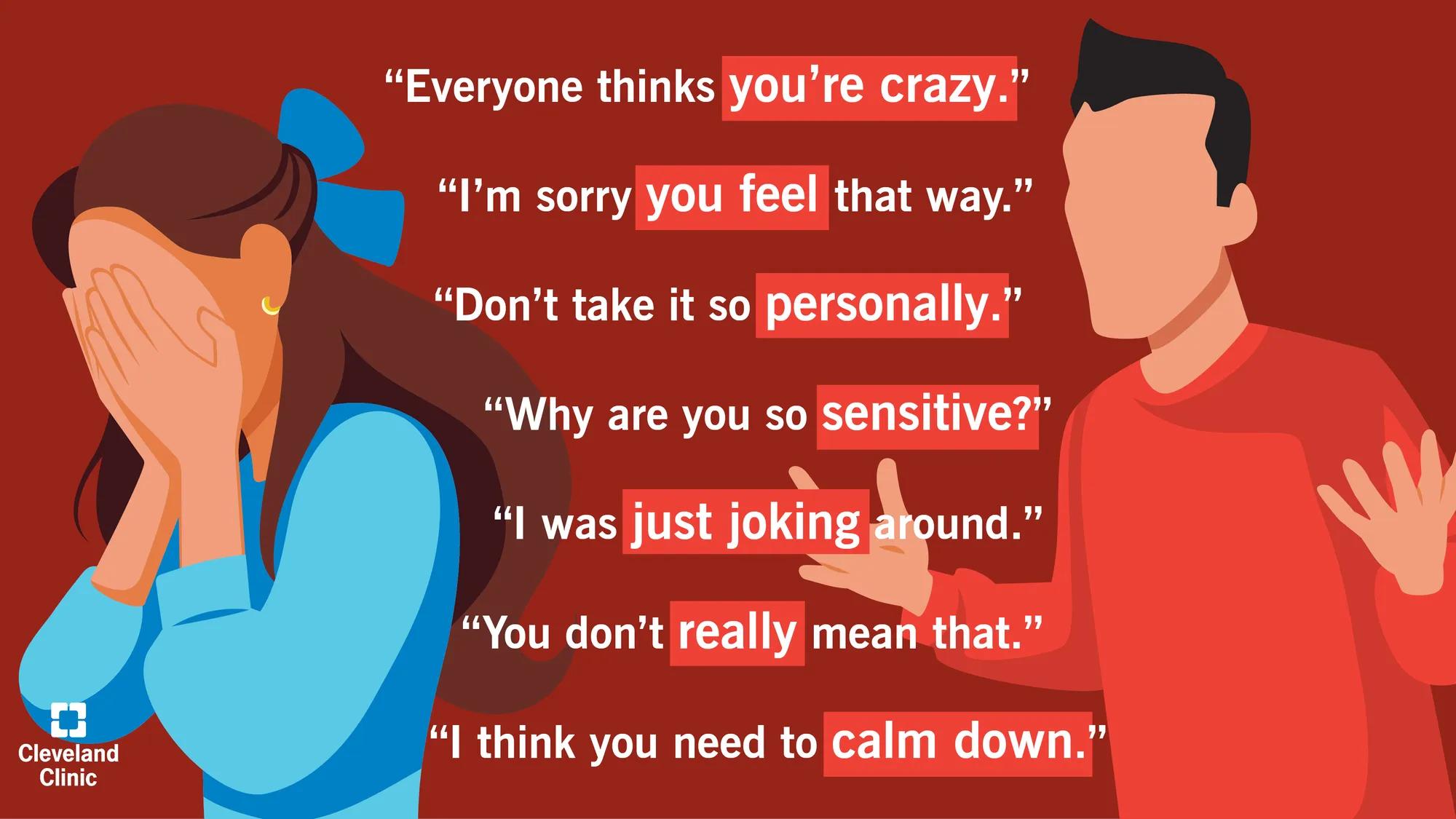
The article below provides a comprehensive list of these verbal tools. As you read, think of them as flags that should immediately alert you to a potential gaslighting attempt.
35 Common Gaslighting Phrases and What They Mean, According ...
This article from Good Housekeeping offers a detailed inventory of common gaslighting phrases, explaining the manipulative intent behind each one.
First, read the introductory section, "What is gaslighting, exactly?" to reinforce the definition. Then, skim the main list of phrases under the heading "Here are some gaslighting phrases...". You don't need to memorize all 35, but focus on identifying the patterns. Pay special attention to phrases that are common online, such as: "I really think you need to calm down." (Trivializing your valid emotions) "You're too emotional." (Dismissing your perspective by attacking your temperament) "So and so thinks you're crazy, too." (Creating an "invisible army" to make you feel isolated) "It didn't happen that way." (Directly denying a shared reality)
In the digital world, these verbal tactics are often combined with platform-specific techniques that make gaslighting even more effective.

Let's break down these digital variations:
- Deleted Messages: This is a classic. Someone sends a hostile or abusive message, and when you confront them, they delete it and claim it never existed. "I have no idea what you're talking about. Look, my message history is clean. You must have imagined it."
- Contradictory Screenshots: A manipulator can easily edit screenshots or take them out of context to "prove" a false narrative. In a community conflict, someone might share a screenshot of a single, emotional sentence you wrote, stripped of the preceding conversation that provoked it, to paint you as unhinged.
- Gaslighting in Group Chats: This is the digital version of "everyone thinks you're crazy." The gaslighter will make a false claim and then appeal to the silence or complicity of others in the group ("See? No one else has a problem with this") to make you feel isolated and question your own judgment. This is particularly potent in niche communities where social cohesion is highly valued.
Finally, it's worth noting the distinction made in the Good Housekeeping article between "malicious gaslighting" (done for control, often by narcissists) and "self-protecting gaslighting" (done to avoid consequences). While both are harmful, understanding the manipulator's likely intent can inform your response. The rival creator trying to sabotage your brand is acting maliciously. The follower who denies making a promise out of social anxiety is acting defensively. The effect on you is similar, but the underlying motivation differs.
Conclusion
This lesson has moved our focus from the explicit threats of data exposure to the covert threat of psychological manipulation. We have established a precise framework for understanding and identifying gaslighting in your unique online environment.
Here are the key takeaways:
- Gaslighting is the specific act of manipulating someone into doubting their own reality. It is not simply lying or disagreeing; its goal is to erode your confidence in your memory, perception, and sanity.
- It operates through a predictable psychological sequence: A manipulator provokes an emotional reaction and then uses that reaction as "proof" of your instability.
- You can identify gaslighting by its signature phrases: Statements like "You're overreacting," "I was just joking," or "That never happened" are red flags.
- Digital platforms offer unique tools for gaslighters: Deleting messages, using out-of-context screenshots, and leveraging group dynamics are common tactics to watch for.
In our next lesson, we will continue our exploration of covert control by examining two related tactics that often accompany gaslighting: stonewalling and the silent treatment. We will learn how manipulators use the withdrawal of communication as a powerful tool for punishment and control.