Introduction
In our last module, you meticulously designed and planned the pilot test for your diagnostic instrument. By focusing on reliability metrics like Cronbach's Alpha and the Intra-class Correlation Coefficient, you've ensured your questionnaire is not just relevant but also consistent. You now possess a powerful tool for gathering quantitative data. The pivotal question becomes: how do you bring this data to life in a way that respects the client's unique story?
This lesson addresses the learning outcome: Structure a diagnostic session to synthesize intake data with client narrative. We will move from instrument design to session design. The goal is to create a structured, efficient, and empathetic process for your first major working session with a client.
Given your background in statistics and operations research, you'll find it useful to frame this process as a form of hypothesis-driven problem-solving. Your client's completed questionnaire provides the initial data and allows you to form a preliminary "hypothesis" about their challenges, strengths, and goals. The diagnostic session is where you collaboratively test, refine, and enrich this hypothesis with the qualitative depth of their personal narrative. By the end of this lesson, you will have a complete architectural plan for conducting this crucial session and a framework for documenting its synthesized output.
1. A Framework for Synthesis: Hypothesis-Driven Diagnosis
In many fields, particularly academia, one gathers all possible data before attempting to draw a conclusion. In consulting and efficient problem-solving, a more effective approach is often used: forming an initial hypothesis to guide the investigation. This focuses your data collection and analysis, preventing you from getting lost in irrelevant details.
We will adapt this powerful concept for your diagnostic session. The data from your validated intake instrument serves as the foundation for your "Day One Hypothesis" about the client's situation. The session itself is an iterative process of testing and refining this hypothesis through conversation.
HOW TO SOLVE PROBLEMS - How do consulting firms work (hypothesis-based problem solving explained)
This video from Firm Learning explains the principles of hypothesis-based problem-solving in a business consulting context. The logic is directly transferable to your work. It provides a robust mental model for structuring your thinking before and during a client session.
Watch these key segments to grasp the core ideas: What is this approach? Notice how it's described as a way to define scope and focus data collection. The core idea: Pay close attention to the contrast between the academic "look at everything" approach and the business approach of closing information gaps with a "hypothesized solution." The project roadmap: This is the most critical part. Observe the process: Management Objectives -> Project Objectives -> Key Drivers -> Hypotheses -> Key Questions & Analyses.
Let's translate this consulting framework into your coaching practice:
| Consulting Framework Step | Your Coaching Application | Example |
|---|---|---|
| Management Objective | Client's Desired Outcome | "We want to feel more connected and stop fighting about logistics." |
| Project Objectives | Coaching Engagement Scope | To improve emotional integration and streamline lifestyle management. |
| Key Drivers | Subscales of Your Intake Instrument | Emotional Integration, Logistical Management, Communication Patterns, Relationship Security. |
| Hypotheses | Inferences from Intake Data | "The low scores on the 'Logistical Management' scale suggest this is the primary source of conflict, more so than jealousy, which scored moderately." |
| Key Questions/Analyses | Probing Questions for the Session | "I noticed that managing schedules came up as a major stressor in the questionnaire. Can you walk me through a recent instance where this caused a conflict?" |
This approach transforms the diagnostic session from a vague "getting to know you" chat into a focused, analytical, yet deeply personal investigation. You enter the room not with a blank slate, but with a structured inquiry plan based on the data the client has already provided.
2. The Architecture of a Diagnostic Session
A well-structured session respects both your time and the client's. It creates a predictable, safe container for deep exploration. We will build a 60-minute session architecture that blends the empathetic flow of a therapeutic conversation with the crisp efficiency of a coaching template.
How To Structure A Mental Health Intake Assessment
The Mental Health Toolbox channel provides an excellent overview of how a clinical intake is structured. While your role is a coach, not a clinician, the fundamental principles of setting the stage and allowing the client's narrative to unfold are identical.
Please watch these segments to understand the session flow: The Clinical Loop: This introduces the critical connection between Assessment, Treatment Plan, and Progress Notes, which is the exact cycle you are building. Informed Consent and Framing: Observe how the presenter demystifies the process for the client to reduce anxiety. Following the Client: This highlights the importance of not being rigidly bound to a list of questions, but rather following the client's "free association" and circling back to your key topics.
Here is a minute-by-minute template for your 60-minute diagnostic session:
Phase 1: Opening & Framing (0-10 minutes)
This phase is about creating safety, clarifying the purpose, and managing expectations.
Skills of Assessment and Diagnosis
This chapter excerpt provides excellent scripts and rationale for the opening moments of a first session. It covers everything from the initial greeting to handling confidentiality and ground rules.
Read the sections titled The Greeting and The Opening for how to physically start the session. Then, review the section Taking Care of Ground Rules to understand how to clearly and confidently cover the necessary administrative and ethical points (confidentiality, scheduling, etc.).
Your Action Steps:
- Greeting & Rapport (2 min): Greet the client, make them comfortable, and transition from the waiting area to your office.
- Framing the Session (3 min): Explicitly state the purpose.
- Example Dialogue: "Thanks for taking the time to fill out the questionnaire so thoroughly. It’s given me a fantastic starting point. The goal for our session today is to dive deeper into some of the themes that came up and make sure I have a full picture of your world. We'll connect the dots between the data and your direct experiences. How does that sound?"
- Ground Rules & Consent (5 min): Briefly cover your coaching agreement essentials: confidentiality and its limits, session logistics, and cancellation policy. This reinforces professionalism and boundaries.
Phase 2: Synthesis & Exploration (10-50 minutes)
This is the core of the session where you test your hypotheses and weave together data and narrative.
Skills of Assessment and Diagnosis
This resource shows how to transition from formalities to the heart of the matter. It also provides a brilliant example of a therapist synthesizing information in real-time.
First, read the section Exploring the Presenting Complaint. Notice the emphasis on listening and reflection to build a bond. Also, read the section on a common mistake: Failing to Collect Relevant Information. This reinforces the value of a hypothesis-driven approach. Finally, carefully study the extended dialogue in the Skills in Action section. Observe how the therapist masterfully connects a simple observation ("You appeared a bit frustrated as you were filling out the paperwork") to the client's deep-seated grief and hopelessness. This is synthesis in action.
Your Action Steps:
-
Lead with the Data (10 min): Start by referencing the questionnaire. This validates the client's effort and grounds the conversation in concrete information.
- Example Dialogue: "In reviewing your responses, one pattern that stood out was the contrast between your high scores in 'Mutual Trust' and the challenges you noted in 'Weekly Logistical Planning.' It suggests the foundation is strong, but the day-to-day execution is a major friction point. Does that resonate?"
-
Explore Key Domains (25 min): Use your "Key Drivers" (subscales) as a map to guide the exploration. For each domain, ask open-ended questions to elicit stories, feelings, and specific examples.
- Presenting Complaint: "You said the main reason you're here is to 'stop feeling like project managers.' Tell me what that phrase means to you."
- Strengths (Protective Factors): "Let's start with what's working. What parts of this lifestyle bring you the most joy and connection?"
- Challenges (Perpetuating/Precipitating Factors): "Now let's talk about the friction. Can you walk me through the last time you had a significant disagreement? What was it about, and how did it unfold?"
- History & Context (Predisposing Factors): "How did you two decide to explore this lifestyle initially? What were your expectations versus the reality?"
-
Listen and Synthesize (Throughout): Use active listening skills—reflecting content and feeling—to show you understand and to check your interpretations. Let the client's narrative flow, but gently guide it back to your framework to ensure all key areas are covered.
Phase 3: Closing & Next Steps (50-60 minutes)
A clean closing solidifies what was accomplished and sets a clear path forward.
Skills of Assessment and Diagnosis
The section on "Closure" provides an excellent template for ending the session professionally.
Read the section on Closure. Note the 5-minute warning, the summary of goals, and the confirmation of the next appointment.
Your Action Steps:
- Give a Time Warning (1 min): "We have about 10 minutes left..."
- Summarize Key Insights (5 min): Verbally present your synthesized assessment back to the client. This is a check for understanding.
- Example Dialogue: "So, to summarize what I've heard today: you have a deep, trusting bond, but it's being eroded by chronic stress from mismanaged schedules and unspoken expectations. This leads to arguments that aren't really about the issue at hand, but about feeling unheard and unappreciated. The key challenge, then, seems to be building a more robust and explicit system for communication and planning. Have I captured that correctly?"
- Bridge to the Next Session (2 min): Frame the next step, which is goal setting.
- Example Dialogue: "This has been an incredibly productive session. Now that we have this shared understanding, our next meeting will be focused on translating these insights into concrete, measurable goals for our work together."
- Confirm Logistics (2 min): Schedule the next session. End on a positive and encouraging note.
3. The Output: The Diagnostic Summary (DAP Note)
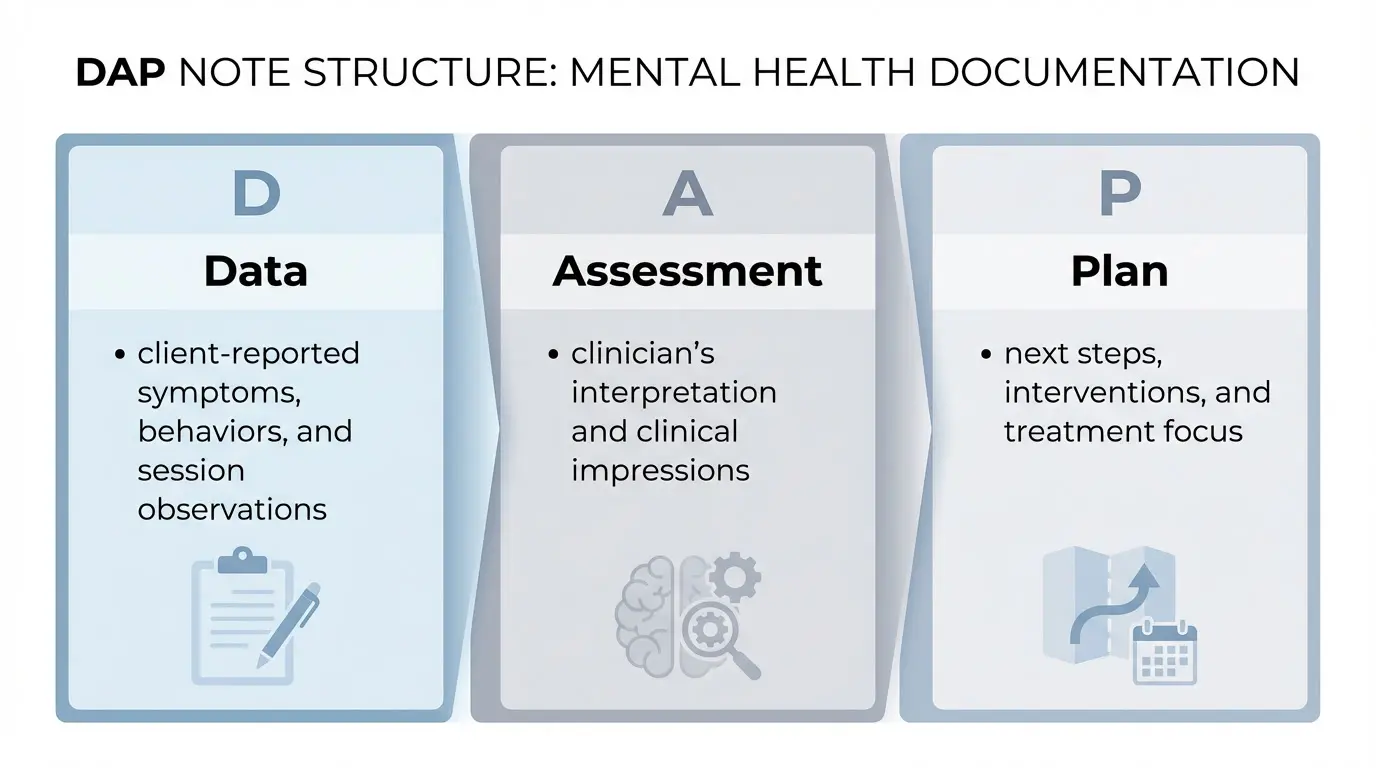
After the client leaves, your final task is to formalize your synthesis in writing. This is not just administrative work; it is a critical thinking exercise that cements your understanding and forms the foundation for the entire engagement plan. A simple, powerful format for this is the DAP Note.
To make your "Assessment" section truly robust, you can use a structured mental model called the "Five P's of Formulation," which is a standard in clinical practice for synthesizing a case.
How To Structure A Mental Health Intake Assessment
This video introduces the "Five P's" as a way to create a clinical snapshot. It is the perfect analytical tool for you to structure the 'A' section of your DAP note.
Watch the following segments to learn each component of the formulation: The Five P's introduction: Get an overview of the model. Presentation: This covers your objective observations. Predisposing & Precipitating Factors: This distinguishes long-term vulnerabilities from recent triggers ("Why now?"). Perpetuating & Positive Factors: This looks at what keeps the problem going and what strengths can be leveraged. Identified Needs & Target Behaviors: This translates the assessment into actionable areas.
Here’s how you would structure your DAP note for a hypothetical couple:
-
D (Data):
- Quantitative: Key scores from intake (e.g., Logistical Management: 3/10; Emotional Security: 8/10).
- Qualitative (Client Quotes): "We feel like business partners managing a chaotic project." "The core love is there, but we're exhausted."
- Observations: Client A appeared tense when discussing schedules, while Client B was more withdrawn. Both became animated and warm when discussing their early relationship.
-
A (Assessment - Using the Five P's):
- Presenting Problem: Couple experiences high conflict and emotional distance stemming from inefficient management of their non-traditional lifestyle logistics.
- Predisposing Factors: Both partners come from highly structured family backgrounds, leading to an implicit expectation that things "should" run smoothly without explicit systems.
- Precipitating Factors: A recent increase in Client A's work travel has broken their previous informal system, triggering the current crisis ("Why now?").
- Perpetuating Factors: The couple avoids structured planning conversations because they reliably lead to conflict, creating a vicious cycle. Lack of a shared calendar/system.
- Protective (Positive) Factors: High mutual trust and respect. Strong shared commitment to the lifestyle. Both are motivated and resourceful.
-
P (Plan):
- Focus next session on co-creating SMART goals related to communication protocols and a shared logistical system.
- Assign "homework" for them to each independently list the top 3 logistical friction points from the past month.
- Begin engagement by focusing on building a "Relationship Dashboard" (shared calendar, weekly check-in).
Conclusion
In this lesson, you have constructed a complete blueprint for the diagnostic session, the critical juncture where data meets narrative. By adopting a hypothesis-driven mindset, you can approach this session with focus and purpose, ensuring that you synthesize information efficiently and effectively.
Key Takeaways:
- Hypothesis-Driven Diagnosis: Use intake data to form initial hypotheses, and use the session to test, refine, and deepen them with the client's story.
- Structured Session Architecture: A three-phase model (Opening, Exploration, Closing) with clear time allocations creates a safe and productive container for the client.
- Synthesis is Key: The primary task is to weave together quantitative data points (from your instrument) with the qualitative narrative (from the client's mouth) into a coherent picture.
- Documenting for Clarity: Using a DAP note format, powered by the "Five P's" framework for the assessment, creates a concise, powerful, and actionable summary of the diagnostic session.
This session lays the entire foundation for your engagement. You have moved from a presenting problem to a synthesized diagnosis. In our next lesson, we will zoom in on the "Exploration" phase and master the techniques for doing it well. You'll learn to apply active listening and probing questions to distinguish presenting problems from their underlying motivations, adding another layer of depth to your diagnostic skill set.