Introduction
In our previous lesson, we designed the complete architecture for a 60-minute diagnostic session, establishing a framework to synthesize your intake data with the client's narrative. You learned to structure this crucial meeting using a hypothesis-driven approach, transforming it from a simple chat into a focused, analytical investigation.
This lesson builds directly on that foundation, zooming into the heart of the session—the "Synthesis & Exploration" phase. Our focus is to fulfill the learning outcome: Apply active listening and probing questions to distinguish presenting problems from underlying motivations.
Clients often describe their issues in terms of symptoms—the "presenting problem." For instance, they might say, "We fight about scheduling." Your task, as an expert consultant, is to look beyond this surface-level issue to uncover the root cause—the deeper, often unspoken, emotional need or fear. This process is analogous to root cause analysis in operations research; instead of a faulty machine, you are diagnosing the intricate workings of a relationship. By mastering the techniques in this lesson, you will learn to ask questions that peel back the layers of a problem, moving from the "what" to the fundamental "why."
1. The Landscape of Need: Presenting Problems vs. Underlying Motivations
In your work, distinguishing between a symptom and its source is paramount.
- A presenting problem is the tangible issue the client brings to you. It's the conflict, the logistical snag, or the communication breakdown. It's often phrased as a complaint about a situation or a behavior. Example: "My partner never initiates planning our dates."
- An underlying motivation or need is the core emotional driver of the presenting problem. It is often connected to universal human needs for security, control, attention, status, or intimacy. Example: "I feel undesired and unimportant because I'm always the one managing our connection."
Tackling the presenting problem alone—for example, by creating a shared calendar—is merely a patch. Addressing the underlying need for feeling desired creates lasting change.
A powerful framework for understanding these deeper needs comes from the field of psychology, which identifies a set of "primal human needs" that we all share. When these needs are unmet, they manifest as emotional distress or conflict.
10 Therapy Questions to Get to the Root of the Problem
This video by therapist Mark Tyrrell provides an excellent overview of these primal human needs and how they drive behavior. It explains why we must assess these fundamentals before jumping to complex diagnoses.
Please watch the following segments: Overlooking the obvious: Pay close attention to the list of emotional needs, such as attention, community, intimacy, control, status, and security. Yielding big discoveries: Note the approach of integrating questions naturally into conversation to assess how these needs are being met. Practical questions: The video provides ten simple but powerful questions linked directly to specific needs. Think about how you could adapt these for your clientele.
By mapping these primal needs to your specific coaching niche, you can develop a powerful diagnostic lens. For example:
- Need for Security: "Do I trust that our relationship is solid, even when we introduce new people or dynamics?"
- Need for Control/Autonomy: "Do I have a real voice in the decisions we make about our lifestyle, or am I just going along with it?"
- Need for Status/Attention: "Do I feel valued, desired, and prioritized by my partner within this dynamic?"
- Need for Intimacy: "Are we maintaining a deep emotional connection, or are we just 'managing the project' of our lifestyle?"
The presenting problem is your entry point. Your goal is to navigate from there to the underlying, unmet need. The tools for this navigation are active listening and strategic probing.
2. Active Listening: A Tool for High-Fidelity Data Collection
Before you can probe, you must listen. Active listening is not a passive or "soft" skill; it's a rigorous data collection method. It creates an environment of psychological safety where clients are more likely to share truthful, nuanced information—high-fidelity qualitative data.
The Art of Active Listening | The Harvard Business Review Guide
This video from Harvard Business Review frames active listening as a dynamic, two-way interaction. It distinguishes between passive absorption and active engagement that elevates the conversation.
Watch these key parts to refine your approach: Active vs. passive listening: Grasp the "sponge vs. trampoline" analogy. Your role is not just to absorb but to help the client explore their own thoughts more deeply. Listen without an agenda: This is crucial. In statistical terms, this is how you minimize your own confirmation bias, ensuring you don't just search for data that confirms your initial hypothesis. Asking good questions: Pay close attention to the example about the employee's presentation. The ineffective response dismisses the concern and shifts the focus. The effective response validates the feeling and probes for more information ("What's worrying you?"). This is the essence of moving from a presenting problem to the underlying issue.
Active listening sets the stage. It tells the client that you have not only heard their words but are also trying to understand the meaning behind their words. This builds the trust necessary for effective probing.
3. A Systematic Framework for Probing: Cognitive Interviewing Techniques
Your background in statistics and experimental design gives you a unique advantage in understanding a powerful technique called Cognitive Interviewing. This is a formal methodology used in survey research to understand the cognitive processes respondents go through when answering a question. It provides a systematic way to understand why a client's initial answer might be incomplete or misleading.
The core idea, based on Tourangeau's model, is that answering a question involves four steps:
- Comprehension: Understanding the question.
- Retrieval: Recalling relevant information from memory.
- Judgment/Decision: Deciding what information to share, which can be influenced by factors like social desirability or perceived sensitivity.
- Response: Mapping the internal judgment onto a verbal answer.
A breakdown can occur at any step. A client might not fully understand what you're asking, struggle to recall specific events, feel hesitant to share something embarrassing (social desirability bias), or struggle to articulate a complex feeling. Your job is to use probing to identify and resolve these breakdowns.
This guide provides a structured overview of cognitive interviewing techniques. While its focus is on improving survey questions, the verbal probing methods are directly applicable to your diagnostic sessions. It will provide you with a toolkit of question types to systematically explore a client's statements.
First, read the introduction to Tourangeau's model to understand the theoretical basis. Next, focus on the section The use of Verbal Probing techniques. Pay special attention to the table that lists different types of probes. This is your practical toolkit. Finally, review Examples 1 through 6. For each example, notice how the initial question led to a problem (in comprehension, recall, or decision-making) and how a specific probe revealed that problem.
Here is a table adapting the verbal probes from the guide into your coaching toolkit:
| Probe Type | Purpose | Example in Your Context |
|---|---|---|
| Paraphrasing | To check your understanding and invite clarification. | "So, if I'm hearing you correctly, when he goes out you feel less 'excited' and more 'anxious.' Is that right?" |
| Comprehension | To understand what a client's specific words mean to them. | "You used the word 'disrespectful.' What does disrespect look like in that situation?" |
| Recall | To ground a general feeling in a specific event. | "Can you walk me through the last time you felt that way? What happened right before?" |
| Confidence | To gently challenge an assumption. | "How certain are you that he is thinking about X when that happens?" |
| Specific | To break down a vague statement into concrete parts. | "You said the night was 'a disaster.' What part of it was most difficult?" |
| General | To open up space for unguided elaboration. | "Tell me more about that." or "I noticed you hesitated there. What was on your mind?" |
By consciously using these different types of probes, you can guide the conversation from the general to the specific, from the symptom to the cause, in a structured and non-confrontational way.
4. Application: From Technique to Dialogue
Let's put these concepts into practice using common scenarios. The goal is to create a conversational flow that systematically uncovers deeper layers of meaning.
The "Five Whys" Heuristic
A simple yet profoundly effective model for drilling down to a root cause is the "Five Whys," a technique popularized in manufacturing and quality improvement. You simply ask "Why?" in succession to move past surface-level symptoms.

Here is a hypothetical coaching dialogue using this structure:
- Client: "We're fighting all the time about managing her dates." (Presenting Problem)
- Coach (Why 1): "Why do you think the fights are happening?"
- Client: "Because things keep getting confused. I thought she was free on Friday, but she had already made plans." (Sub-cause 1)
- Coach (Why 2): "Why was there confusion about her availability?"
- Client: "Because we don't have a reliable system. It feels like I'm trying to piece it together from texts and passing comments." (Sub-cause 2)
- Coach (Why 3): "Why do you think you haven't put a more reliable system in place?"
- Client: "Honestly, because talking about it feels like a business meeting. It kills the mood." (Sub-cause 3)
- Coach (Why 4): "Why is it so important to avoid it feeling like a business meeting?"
- Client: "Because this whole lifestyle was meant to bring passion and excitement back into our lives. Now it just feels like another source of stress to manage." (Sub-cause 4)
- Coach (Why 5): "And why does that feel like such a threat?"
- Client: "Because I'm terrified that if we lose the excitement, we'll lose our connection. I'm afraid this 'project' is actually pushing us apart instead of bringing us together." (Root Cause: Fear of losing connection)
Notice how the conversation started with a logistical problem (scheduling) and ended with a core emotional fear (losing connection). You can now address the real issue.
Using Probes to Handle Objections
The provided resources offer excellent examples of how to handle initial resistance—a common presenting problem.
The 'Cuckold Consultant' Will Take Your Money and Unleash Your ...
This article, while journalistic, contains valuable snippets of dialogue and strategy that illustrate the principles of probing and reframing in your specific niche.
Read the section where the consultant, Dr. 36, discusses handling objections. It starts around the paragraph If she says. Note the strategy of agreeing first to lower resistance. Then, read the section that describes mirroring empathy. This is a direct example of a paraphrasing probe used to encourage elaboration.
Let's break down the "mirroring" technique from the article.
- Client's Presenting Statement: "That's so wrong and I'd never do that." (This is a judgment, not an explanation).
- Coach's Probing Response (Mirroring): "It's wrong, and you'd never do it?"
This response is effective because it's non-judgmental. It doesn't argue or defend. It simply reflects the client's words back to them as a question, which implicitly invites them to explain why it's wrong, leading you closer to the underlying fear or value that is being violated.
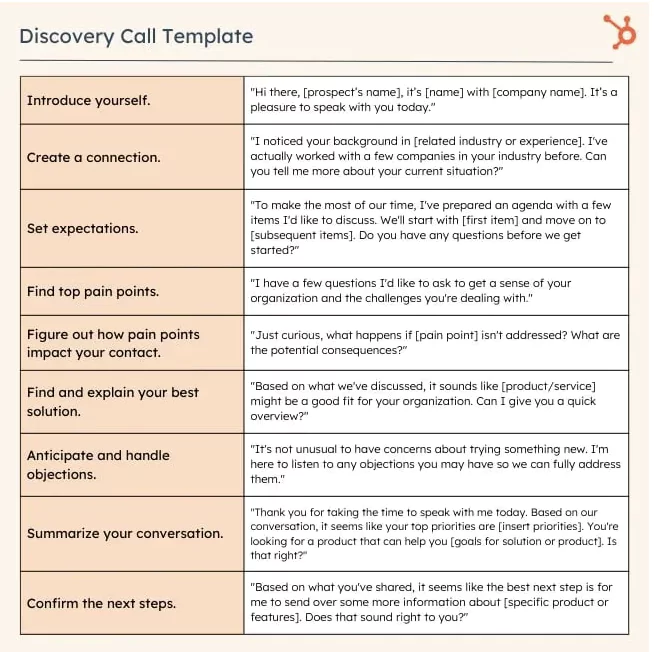
This process is visible in many professional frameworks. Even a simple sales script reveals this structure.
Conclusion
In this lesson, you have moved from the broad structure of the diagnostic session to the fine art of its execution. You've learned to see beyond the surface-level "presenting problem" to identify the deeper emotional drivers and unmet needs that are the true source of a client's challenges.
Key Takeaways:
- Presenting problems are symptoms; underlying motivations are root causes. Your primary diagnostic task is to trace the path from one to the other, often by identifying unmet primal needs for things like security, control, and intimacy.
- Active listening is a data collection technique. By creating a non-judgmental space and listening without an agenda, you increase the likelihood of receiving truthful, high-fidelity information from your client.
- Verbal probing is your systematic tool for exploration. By borrowing techniques from cognitive interviewing, you can use a variety of targeted questions (paraphrasing, recall, specific probes) to deconstruct a client's statements and uncover their foundational meaning.
- The "Five Whys" is a powerful, simple heuristic. It provides a clear path to drill down from a logistical issue or behavioral complaint to a core emotional fear or need.
You now have the tools to not only hear what your clients are saying but to understand what they truly mean. The next step is to use this deep understanding to create a concrete plan of action. In our next lesson, we will focus on translating the client's narrative and your synthesized diagnosis into a set of measurable, co-created objectives using a goal-setting framework like SMART.