Introduction
In our last lesson, we established the open-explore-close framework as the fundamental architecture for every coaching session, providing you with a reliable blueprint to ensure each meeting is purposeful and productive. You now have the 'what' and 'when' of a structured session. Today, we turn to the 'how'.
This lesson focuses on a set of core communication skills known as the OARS model. Standing for Open questions, Affirmations, Reflections, and Summaries, these are the micro-tools you will use, primarily within the 'Explore' phase of your session, to expertly navigate the client's inner world. The learning outcome is to apply this model to navigate client ambivalence. Ambivalence—the state of having simultaneous, conflicting feelings about change—is not a sign of resistance to be overcome, but a natural human state to be explored. Mastering OARS is the key to systematically guiding clients to resolve their own ambivalence and move from contemplation to committed action.
The Mindset: The Spirit of Motivational Interviewing
Before we deconstruct the OARS toolkit, it's essential to understand the philosophy that guides its use. These skills originate from a methodology called Motivational Interviewing (MI), which is fundamentally a "style of being with people." The effectiveness of OARS is magnified when applied with the underlying "spirit" of MI.
This short video from YaleCourses introduces the core challenge of ambivalence and outlines the five guiding principles of MI. As you watch, consider how these principles—especially developing discrepancy and dancing with discord—provide a strategic-level alternative to the common but ineffective impulse to argue for change.
How do you have patient-centered conversations? Motivational Interviewing Basics
This video introduces the foundational principles of Motivational Interviewing (MI), which create the collaborative and non-confrontational environment necessary for OARS to be effective.
Please watch the segment explaining the five main principles. Pay close attention to how they collectively create a partnership where the client, not the coach, becomes the primary voice for change.
These principles create a collaborative partnership. Your role is not to push the client toward a solution but to create a space where they can articulate their own motivations for change.

With this mindset, the OARS skills become more than just conversational techniques; they become strategic instruments applied within a structured process. The document "The 4 Processes of MI" frames this beautifully. It shows that you will use OARS skills purposefully across four phases of a change conversation: Engaging, Focusing, Evoking, and Planning. This aligns perfectly with your goal of creating a systematic workflow.
This document provides the strategic context for OARS, showing how the skills are applied differently across the lifecycle of a change-focused conversation.
Please read the entire document, focusing on how the function of OARS shifts within each of the four processes. Pay particular attention to the Evoking process, as this is where you directly address ambivalence by eliciting 'Change Talk' and managing 'Sustain Talk'.
Deconstructing the OARS Toolkit
Now, let's break down each component of OARS. Think of these as a set of precision instruments in your consulting toolkit, each with a specific function.
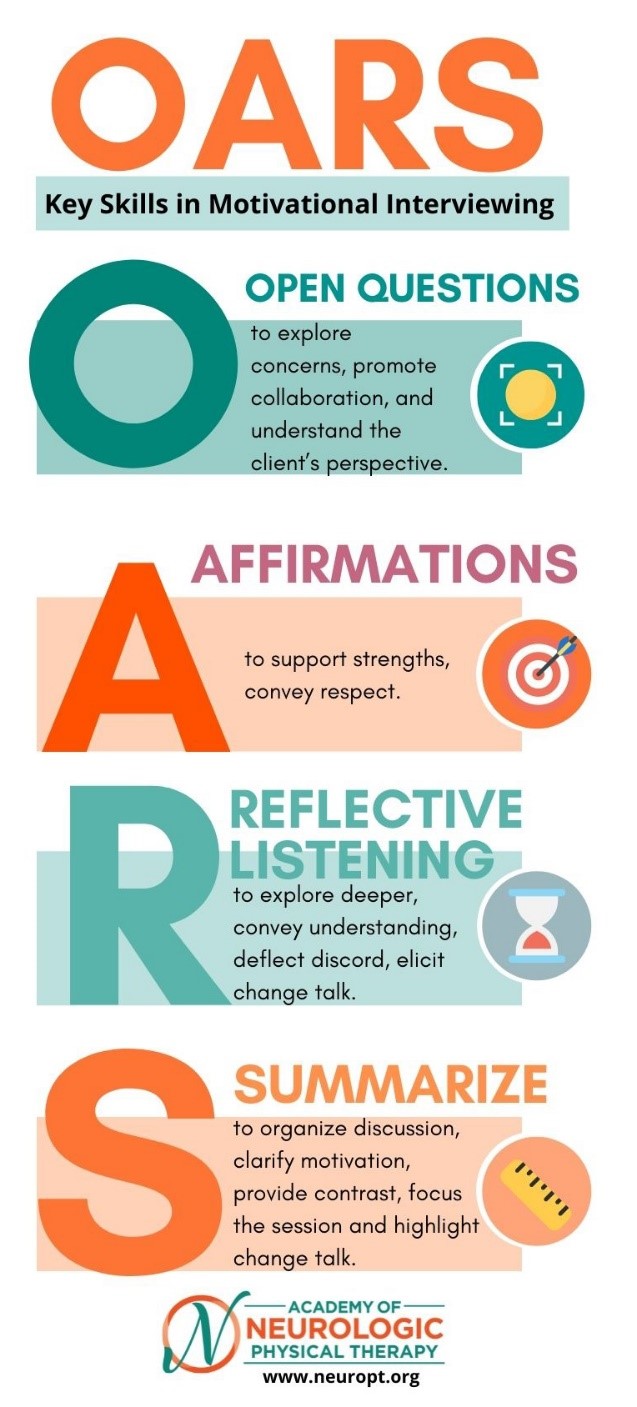
O: Open Questions
Open-ended questions are the starting point for exploration. They are questions that cannot be answered with a simple "yes" or "no," compelling the client to provide a more detailed narrative. Their strategic purpose is to evoke "change talk"—the client's own arguments for change.
The following video offers an excellent overview of how to formulate open questions that specifically target the client's desire, ability, reasons, and need for change. It also introduces the "change ruler," a simple scaling technique that can provide a quantitative anchor in a qualitative conversation.
5.Motivational Interviewing: Core clinician skills -- Introducing OARS
This video from the Heart Foundation delves into the practical application of OARS, starting with a detailed look at crafting effective open questions.
Watch the segment on open questions. Focus on the specific examples provided for eliciting different types of change talk (Desire, Ability, Reason, Need) and the use of the "change ruler" technique.
To see this in practice, let's look at a hands-on exercise. The "Motivational Interviewing Coaches' Workbook" provides a clear-cut activity for transforming closed questions into open ones.
[PDF] mOTIVATIONAL INTERVIEWING COACHES' WORKBOOK
This workbook provides practical, hands-on exercises for each OARS skill.
Please review Activity 2.1. You don't need to complete the worksheet yourself, but study the list of closed-ended questions and then compare them to the example open-ended answers. Notice how the open questions invite a story rather than a simple confirmation or denial.
A: Affirmations
Affirmations are not generic praise; they are direct, factual statements that recognize a client's specific strengths, efforts, or positive intentions. The strategic function of an affirmation is to build the client's self-efficacy—their belief in their own ability to succeed—and to strengthen the consulting relationship.
For a concise explanation and examples, we return to the YaleCourses video.
How do you have patient-centered conversations? Motivational Interviewing Basics
This video provides a clear and concise definition of affirmations within the MI context.
Watch the short segment on affirmation. Note the emphasis on sincerity and recognizing specific strengths and actions.
To make this practical, the MI workbook shows how to reframe common praise into powerful, specific affirmations.
[PDF] mOTIVATIONAL INTERVIEWING COACHES' WORKBOOK
This workbook exercise demonstrates how to convert vague praise into specific, efficacy-building affirmations.
Review the exercise in Activity 2.3. Focus on how each example of praise (e.g., "Good job finishing...") is transformed into a factual affirmation followed by an open-ended question (e.g., "You really paid attention to the details... Tell me about...").
R: Reflections
Reflections are the most powerful and nuanced skill in the OARS model. A reflection is a statement, not a question, that makes a guess about what the client is thinking or feeling. As one expert puts it, if MI were a car, reflections would be the engine. They demonstrate deep listening and give the client an opportunity to hear their own thoughts, often leading to new insights.
This concept may resonate with your background in Bayesian methods. A reflection is akin to formulating a hypothesis about the client's internal state based on the data they've provided (their words and tone). You state your hypothesis ("It sounds like you're feeling..."). The client's response—either confirming ("Yes, exactly!") or correcting ("No, it's more like...")—is new evidence that allows you to update your understanding and refine your next hypothesis. This iterative process is what drives the conversation deeper.
5.Motivational Interviewing: Core clinician skills -- Introducing OARS
This segment of the video highlights the central importance of reflections, distinguishing between simple and complex forms.
Please watch the section explaining why reflections are the 'engine' of motivational interviewing. This part illustrates how reflections, more than questions, drive the process of self-discovery.
The MI workbook offers concrete practice in formulating these statements.
[PDF] mOTIVATIONAL INTERVIEWING COACHES' WORKBOOK
This activity provides client statements and example reflections, moving from simple restatements to more complex interpretations of meaning.
Review Activity 2.5 and its example answers. Notice how a simple statement like "I don't have a drug problem" can be reflected in a way that acknowledges the client's perspective while opening the door for further exploration ("You don't feel your life has been impacted at all... How would your life be different if...").
S: Summaries
Summaries are essentially a collection of reflections strung together. Their function is to consolidate what has been said, reinforce change talk, highlight the client's ambivalence, and serve as a transition to a new topic or the next step. A well-timed summary can be a powerful intervention.
[PDF] mOTIVATIONAL INTERVIEWING COACHES' WORKBOOK
This section of the workbook provides a structured approach to creating strategic summaries.
Read Handout 2.3 on developing transitional summaries, paying attention to the "I CAN" strategy (Indicate, Change talk, Ambivalence, Next step). Then, review the three scenarios and their sample summary responses to see how this structure is applied.
Application: A Niche-Specific Example
Let's synthesize these skills with a scenario from your consulting practice.
Client: A husband in a hotwife relationship.
Situation: The wife has recently started seeing a new, recurring partner. The husband is experiencing ambivalence.
Client says: "I'm so incredibly happy for her. Seeing her this vibrant and fulfilled is everything I wanted. It's a huge turn-on. But... I can't shake this feeling in the pit of my stomach. I find myself checking my phone constantly when she's out. I feel... less essential."
Here is how you could apply OARS:
- Open Question: "Tell me more about the moments when you feel most connected to her happiness, and then about the moments when that feeling in your stomach is strongest."
- Affirmation: "The fact that you can hold both your profound joy for her and your own discomfort at the same time shows a remarkable level of self-awareness and commitment to this dynamic."
- Reflection (of feeling/meaning): "So on one hand, her fulfillment is a core part of your own satisfaction. But on the other, this new development is triggering a fear about your own importance and place in her life."
- Summary (transitional): "Let me see if I'm tracking with you. You're fully on board with this evolution in your relationship and are genuinely excited by her new experiences. At the same time, it's brought up some unexpected feelings of insecurity that you want to address, not to limit her, but to find your own solid footing within this new reality. Where do you think we should go from here with that?"
This sequence validates the client's entire experience, organizes their conflicting thoughts, reinforces their positive intentions (change talk), and transitions them toward problem-solving, all without you giving a single piece of advice.
Conclusion
In this lesson, we have moved from the architectural framework of a session to the fine-grained tools of facilitation. You've learned that the OARS model is not just a set of techniques but a strategic toolkit for navigating the complex terrain of human ambivalence.
Key Takeaways:
- OARS as a System: The OARS skills—Open Questions, Affirmations, Reflections, and Summaries—are the core components of a systematic method for facilitating client-led change.
- The Power of the 'Spirit': These skills are most effective when used within the collaborative, empathetic spirit of Motivational Interviewing, with the goal of evoking the client's own motivation.
- Reflections as the Engine: While all skills are important, reflective listening is the primary driver of insight, helping clients hear their own thoughts and resolve internal conflicts.
- Strategic Application: The purpose of OARS is to selectively listen for and amplify "change talk," guiding the client to build their own case for change.
You now have a powerful model for the 'Explore' phase of your sessions. In our next lesson, we will add another sophisticated tool to your repertoire: reframing techniques. While OARS helps you deeply understand and validate a client's current view of a problem, reframing will allow you to help them shift their perspective entirely, opening up new avenues for solutions and growth.