Introduction
In our last session, we focused on reframing—a technique for collaboratively offering a new, more resourceful perspective to your clients. This skill allows you to help shift a client's viewpoint when they feel stuck. Today, we advance to a related but distinctively empowering technique: Socratic questioning.
This lesson directly addresses the learning outcome of applying Socratic questioning to guide clients toward discovering their own solutions and motivations. While reframing involves you providing a new frame, Socratic questioning is the art of asking questions that guide the client to challenge their own assumptions and construct a new perspective themselves. For your goal of building a rigorous, evidence-based practice, this method is indispensable. It shifts the dynamic from you as the expert with answers to you as the facilitator of the client's own insight, which makes the resulting change more profound and lasting.
We will explore what Socratic questioning is, why it's effective, a practical framework for applying it in sessions, and how to adapt it specifically for the challenges your clients face.
The Philosophy and Proof of Socratic Questioning
At its heart, Socratic questioning is a disciplined, collaborative dialogue that uses focused questions to stimulate critical thinking and illuminate ideas. It is the opposite of a didactic, or teaching, style. Instead of providing answers, you help the client examine the very foundations of their beliefs.
From a statistical standpoint, you can think of this process as "collaborative empiricism." The client presents a strong, often negative, conclusion (e.g., "This lifestyle is making me a bad partner"). This conclusion is their 'hypothesis.' Your role is not to immediately disprove it, but to act as a co-investigator, using questions to systematically examine the 'data'—the evidence, assumptions, and logic—that support or contradict this hypothesis.
This isn't just a philosophical preference; it's an empirically supported technique. A study on Cognitive Therapy (CT) for depression found a direct link between the therapist's use of Socratic questioning and the client's symptom improvement from one session to the next.
Therapist Use of Socratic Questioning Predicts Session-to ... - PMC
This research article provides empirical validation for the effectiveness of Socratic questioning. It will ground your use of the technique in evidence.
First, read the introductory section to understand the formal definition and purpose. Focus on the paragraph that begins Socratic questioning involves therapists. Note the emphasis on avoiding a didactic style and fostering active engagement. Then, jump to the "Discussion" section. Read the first paragraph, This study provides, to see the core finding that validates this method's impact on client outcomes.
The key takeaway is that by guiding clients to think critically for themselves, you are not just solving a single problem; you are building their capacity for self-reflection and resilience. The goal is not to win an argument, but to arrive at a more robust, evidence-based understanding together.
A Four-Step Framework for Socratic Questioning
To apply this method systematically, we need a reliable framework. Trying to use Socratic questioning without a clear structure can easily devolve into aimless questioning or, worse, a disguised lecture. A common pitfall is what's called "provided discovery," where the coach asks leading questions to steer the client toward a predetermined answer. This defeats the entire purpose.
The following framework, adapted from clinical CBT training, reverses this pitfall. Instead of trying to get the client to see things from your perspective, you first work to see it from theirs and then expand that perspective collaboratively.
Rethinking How We Teach Socratic Questioning
This article from the Society for the Advancement of Psychotherapy provides an excellent, actionable framework for implementing Socratic questioning.
First, read the section on Common Pitfalls to understand what to avoid. Then, carefully study the four steps of the proposed framework: Step 1: Focusing: Identifying the most critical thought or belief to work on. Step 2: Phenomenological Understanding: Understanding and validating how the client came to their belief. Step 3: Collaborative Curiosity: Co-exploring blind spots and what information might be missing. Step 4: Summary and Synthesis: Helping the client form a new, more balanced, and believable thought.
This four-step process—Focus, Understand, Explore, Synthesize—provides the structure you need to guide a productive and empowering conversation.
Observing Socratic Questioning in Action
Let's watch a demonstration of a therapist using this method to help a client with a negative automatic thought. As you watch, try to map the therapist's questions to the four-step framework we just discussed.
This video from Qualia Counselling Services provides a clear and concise demonstration of Socratic questioning in a therapeutic context.
Watch the following segments, paying close attention to the type of questions the therapist asks: Focusing & Unpacking Assumptions (01:18-02:27): The therapist identifies the target thought ("they don't like me") and immediately begins to probe the underlying assumptions (e.g., "acknowledgment means liking," "they saw me"). This combines Steps 1 and 2. Collaborative Curiosity (02:34-04:40): Notice how the therapist asks for proof, but when the client provides it, he gently guides him to consider other possible conclusions ("could have been distracted," "busy"). He isn't arguing; he's opening up the field of possibilities. Synthesis & Emotional Impact (04:44-06:46): Here, the therapist helps the client compare the emotional result of the original thought ("depression") with the feeling of considering alternatives ("intrigued," "surprised"). This solidifies the shift and corresponds to Step 4.
Applying the Framework to Your Niche
Now, let's translate this into your consulting practice. Here are two common scenarios your clients face, along with a scripted Socratic dialogue using the four-step framework.
Scenario 1: The "Jealousy is Failure" Belief
A husband feels intense jealousy when his wife is on a date. He comes to you with the belief: "If I were secure enough, I wouldn't feel this jealousy. It means I'm failing at this lifestyle."
-
Step 1: Focus
- You: "It sounds like that feeling of jealousy is really hitting you hard, and you're interpreting it as a personal failure. Let's focus on that thought: 'This jealousy means I'm failing.'"
-
Step 2: Phenomenological Understanding
- You: "That's a heavy conclusion to carry. Help me understand, where does the equation 'jealousy = failure' come from for you? What’s the story you tell yourself about what a 'successful' person in this lifestyle should feel?"
- You: "It makes complete sense that you'd feel that way, given that most of society tells us jealousy is a sign something is wrong in a relationship. Your response is very human."
-
Step 3: Collaborative Curiosity
- You: "I'm curious, what's the function of this jealousy? If we look at it not as a moral failing but as a data point, what is it telling you? Is it signaling an unmet need for reassurance? A fear of loss? Something else?"
- You: "What's an alternative hypothesis to 'I'm failing'? For example, could the hypothesis be 'I am navigating a complex emotional landscape and jealousy is a predictable signal'? What evidence would support that view?"
- You: "Have there been times you've felt secure and a little jealous? Are they always mutually exclusive?"
-
Step 4: Summary and Synthesis
- You: "So, on the one hand, there's this powerful belief that jealousy is a sign of failure. On the other hand, we've explored the idea that jealousy could be a normal, even useful, signal in a novel situation. What's a new thought that feels more balanced and believable? Perhaps something like, 'Feeling jealousy doesn't mean I'm failing; it's a signal for me to check in with my wife and ask for the reassurance I need.'"
- You: "How might you put that new thought into practice this week?"
Scenario 2: The "Logistical Overwhelm" Belief
A couple is struggling to manage their calendars, leading to stress. The wife says: "This is just too complicated. A normal relationship isn't this hard. It's not worth the effort."
-
Step 1: Focus
- You: "It sounds like you're feeling completely overwhelmed by the logistics, and that's leading you to question the entire lifestyle. Let's examine that core belief: 'The complexity makes it not worth the effort.'"
-
Step 2: Phenomenological Understanding
- You: "I can hear the exhaustion in your voice. What does 'too complicated' look like in practice? Can you walk me through a specific example from last week?"
- You: "Of course that feels overwhelming. You're essentially running a project management system for your intimate lives on top of everything else, without a dedicated tool or process."
-
Step 3: Collaborative Curiosity
- You: "You mentioned 'a normal relationship isn't this hard.' What assumptions are we making about what 'normal' relationships entail? Do they have zero logistical challenges?"
- You: "Let's re-examine the second part of that thought: '...it's not worth the effort.' What was the original 'why' for you both? What were the benefits you were seeking? Let's list them out."
- You: "Now let's look at the 'effort' side. We're framing it as one big, complicated problem. From your background in operations research, you know that complex systems can often be broken down. What's one piece of the scheduling problem that, if we solved it, would reduce 50% of the stress?"
-
Step 4: Summary and Synthesis
- You: "So, we've established that the logistical side is genuinely difficult and causing stress. We've also reconnected with the significant benefits you both get from this. The original thought was 'It's too complex, so it's not worth it.' What's a more accurate, actionable thought now? Maybe: 'The logistics are currently overwhelming, so we need to design a better system to make the benefits accessible with less stress.'"
- You: "What's the first experiment we could run this week to design that better system?"
Your Socratic Questioning Toolkit
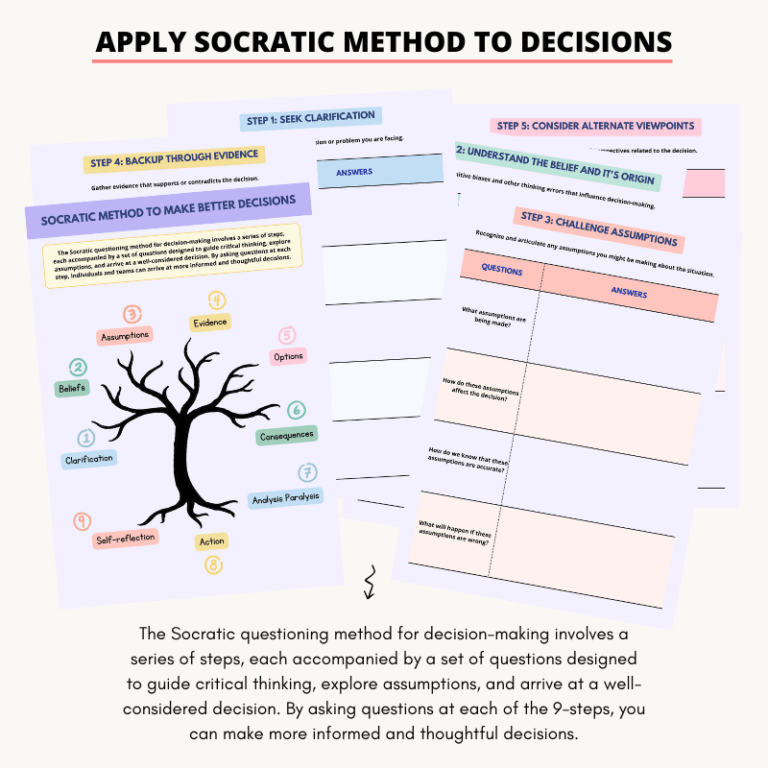
To help you structure this in your sessions, you can use a simple worksheet. This ensures you are systematically guiding the client through their own thought process.

The core process of Clarification, examining Beliefs, challenging Assumptions, and gathering Evidence is a powerful algorithm for decision-making and problem-solving, both for you and your clients.
Conclusion
Today, we've added one of the most powerful tools of cognitive coaching to your repertoire. Socratic questioning moves you beyond providing answers and into the role of a facilitator who empowers clients to find their own.
Key Takeaways:
- It's Guided Discovery, Not Interrogation: The tone is one of collaborative curiosity, not cross-examination. Your goal is shared understanding.
- Structure is Your Ally: The Focus -> Understand -> Explore -> Synthesize framework provides a reliable pathway for any Socratic conversation.
- It's Empirically Grounded: Research shows this method works. By using it, you are aligning your practice with evidence-based principles.
- Empowerment is the Goal: By helping clients deconstruct their own limiting beliefs, you equip them with a lifelong skill, which is the ultimate goal of effective coaching.
In our last few lessons, we've focused on facilitating dialogue—using OARS to listen, reframing to offer perspective, and Socratic questioning to guide discovery. However, conversations about sensitive topics can sometimes become heated. In our next lesson, we will address this directly by learning to use de-escalation techniques to manage emotionally charged conversations, ensuring your sessions remain a safe and productive space for transformation.