Introduction
Welcome to the first lesson of Module 7. In our previous module, you masterfully designed the entire engagement architecture, culminating in the creation and collaborative finalization of the engagement plan. With a signed agreement and a shared set of KPIs, you have successfully moved your client from prospect to partner. The strategic foundation is set; now, we begin the core work of facilitation.
This lesson addresses a crucial element of systemizing your practice: facilitating coaching sessions using a consistent open-explore-close framework. Moving away from purely informal conversations, this structure provides a reliable protocol for every session. Think of it as the core algorithm for your client interactions—a process that ensures each meeting is purposeful, productive, and consistently drives progress toward the engagement's macro-level goals. It builds trust through predictability and provides a safe, structured space for your clients to do their transformative work.
The Open-Explore-Close Framework: Your Session Blueprint
Every coaching session, regardless of the specific topic, should have a clear beginning, middle, and end. This structure isn't a rigid script but a flexible blueprint that ensures you cover essential ground. The three primary phases are:
- Open: Establishing the foundation for the session. This includes reconnecting, reviewing progress and commitments from the previous session, and collaboratively setting a clear, specific goal for the current session.
- Explore: The heart of the session. This is where you facilitate the client's discovery process through powerful questioning, active listening, and other techniques. The client leads the content, while you guide the process.
- Close: Consolidating the session's value. This phase involves summarizing key insights, defining concrete action steps, establishing accountability, and ending the session on a positive, forward-looking note.
This flow ensures that every session starts with a clear purpose and ends with a clear plan, maximizing the value of the time spent.
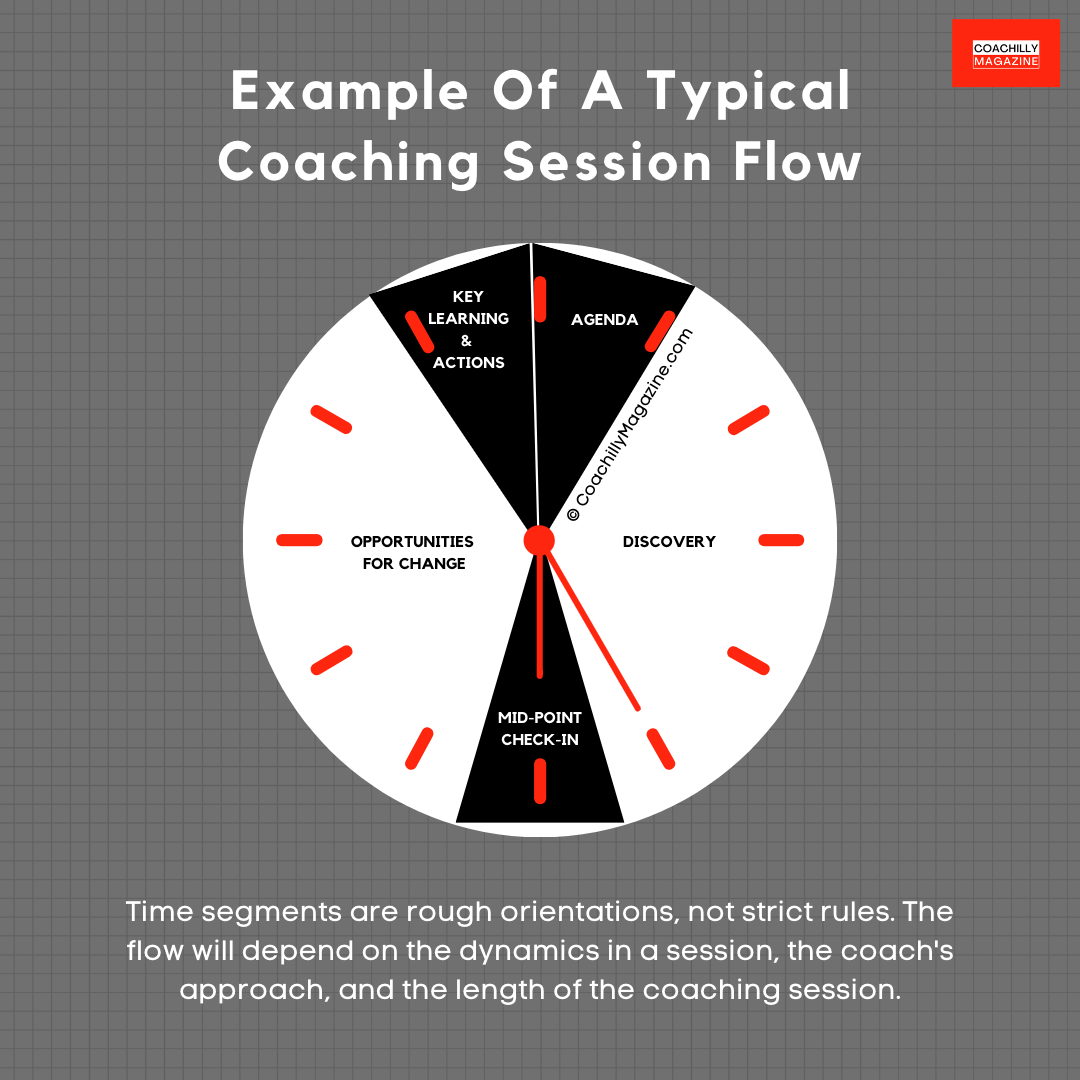
For a more detailed breakdown, we can look at a practical model that allocates time within a standard 60-minute session.
Coaching Conversation Script, Samples and Template
This article from Life Coach Hub provides an excellent four-step structure that maps directly onto our framework, offering a practical timeline and rationale for each phase of the conversation.
Please read the section titled "What a sample coaching conversation looks like." Focus on the four steps presented: Familiarization (our 'Open' phase) Discovery (the first part of 'Explore') Goal setting (the latter part of 'Explore') Takeaways & Tactics (our 'Close' phase) Pay close attention to the suggested time allocations and the specific objectives for each stage. This provides a tangible structure for a 60-minute session.
Now, let's equip you with specific, actionable protocols for executing each of these phases.
Phase 1: The 'Open' Stage — Establishing the Agreement
The opening of a session does more than just break the ice; it sets the trajectory for the entire conversation. Its primary function is to move from general check-in to a specific, agreed-upon outcome for the session. A robust opening protocol prevents sessions from becoming unfocused "chats" and immediately signals your role as a professional facilitator.
The following video presents a highly effective "Six C's" model. We will focus on the first three "C's" which constitute a powerful protocol for the 'Open' stage.
How to Structure Coaching Sessions That Clients Love
This video from IGC Coaching School provides a detailed, step-by-step structure for a coaching call. We'll use its opening sequence as our primary protocol.
Please watch from the first 'C', Connection. This is the initial rapport-building and energy check. Next, watch the segment on the second 'C', Review of Commitments. This is the crucial step of linking the current session to past actions and the overall engagement plan (your "glow plan" or "project plan"). Finally, and most importantly, study the third 'C', the Coaching Request. This is the core of the 'Open' phase. The presenter provides five specific questions to elicit a clear, measurable goal for the session. Internalize these questions; they are a cornerstone of a structured session.
To summarize this powerful opening protocol:
- Connection (~5 mins): Build rapport, check in on their energy and significant events, but maintain control to guide the session forward.
- Commitments Review (~5-10 mins): Review action items from the last session. This creates continuity and accountability. Connect this review to both the short-term tasks and the long-term goals outlined in your formal engagement plan.
- Coaching Request (~5 mins): This is non-negotiable. Use this sequence of five questions to establish a contract for the session:
- "How would you like to use our time today?"
- "What do you want to walk away with from our session?"
- "How will you know you got what you needed from our time today?"
- "What larger issue does this request address?" or "What's this really about?"
- "How does this support our long-term plan of [insert the primary goal from the engagement plan]?"
Executing this protocol ensures you and your client are perfectly aligned on the session's objective before you dive into exploration. Another useful model for this phase is the TOMS model (Topic, Outcome, Meaning, Success Measure), described in the "Executive Coaching Session Walkthrough" video, which serves the same purpose of creating a clear agreement.
Phase 2: The 'Explore' Stage — Facilitating Client Insight
With a clear agreement in place, you transition into the 'Explore' phase. This is the longest part of the session (~30-35 minutes) and corresponds to the "Coaching in Action" step from the video. Here, your role shifts from agenda-setting to deep listening and inquiry. The goal is not to provide solutions, but to create the conditions for the client to generate their own insights.
Your primary tools in this phase are active listening and powerful, open-ended questions.
How to Design Effective Coaching Sessions - ACE Fitness
This article from ACE Fitness offers excellent professional advice on facilitating the exploratory part of a session.
First, read the section under "Tips From the Pros" that begins with Erin Litton's advice on developing a loose script. This emphasizes being present and listening rather than worrying about what to ask next. Next, focus on the five "go-to" open-ended questions from motivational interviewing. These are high-caliber questions perfect for the 'Explore' phase. Then, read Meg Root's advice on opening the conversation with a positive frame and checking in on goals. Notice her crucial distinction: focus on the energy and importance of change, not just the micro-details. This is where you listen for "change talk." Finally, read the section "Be Aware of Potential Traps." Pay special attention to the advice on using silence and avoiding doing more work than the client.
Key Protocols for the 'Explore' Phase:
- Practice the 90/10 Rule: 90% listening, 10% talking. Your talking should consist almost entirely of asking powerful questions.
- Use Proven "Pocket Questions": The five questions from Miller and Rollnick are a superb starting point for your toolkit:
- Why would you want to make this change?
- How might you go about it in order to succeed?
- What are the three best reasons for you to do it?
- How important is it for you to make this change, and why?
- (After summarizing their answers) So, what do you think you'll do?
- Embrace Silence: After asking a powerful question, be comfortable with a 5-10 second pause. This is when the client is thinking. Rushing to fill the silence robs them of the opportunity for insight.
This phase is an artful dance, but it is guided by the clear objective you established in the 'Open' stage. You are constantly, gently guiding the exploration back towards that desired outcome.
Phase 3: The 'Close' Stage — Defining Action and Ensuring Accountability
In the final 10-15 minutes, you transition from exploration to consolidation. A weak closing can leave a client feeling adrift, even after a great exploration phase. A strong closing cements the value of the session, creates momentum, and reinforces your role as a partner in their progress.
We will return to the "Six C's" framework to establish a clear protocol for this final stage.
How to Structure Coaching Sessions That Clients Love
This final segment of the "How to Structure Coaching Sessions" video details the last two 'C's, providing a template for a structured and empowering session conclusion.
Please watch the final part of the video, from review of commitments to the end. This covers the Review of Commitments (the new ones created during this session) and the Closing and Completion, which includes specific questions to ask.
Key Protocols for the 'Close' Phase:
- Review New Commitments: Ask the client first: "Based on our conversation, what are your key action steps before our next session?" Compare their list to your notes. Ensure each commitment is a clear, specific, and measurable goal (e.g., "Draft the opening message to a potential partner by Thursday" is better than "Think about online dating").
- Ask Closing Questions: Use a consistent set of questions to help the client reflect and to gather feedback.
- "What was your biggest breakthrough or major insight from our session today?"
- "Was there anything missing or incomplete from our call that we should capture for next time?"
- "What would you like to be acknowledged for today?"
- Reframe Accountability: As the ACE Fitness article wisely suggests, the word "accountability" can feel judgmental. Frame it positively: "How do you plan to follow through with the action plan you established today?" or "What support will you need to make this happen?" This places the client in a position of power and proactive planning.
- Schedule the Next Session: End by confirming the date and time for your next meeting. This maintains momentum and reinforces the ongoing nature of your partnership.
Conclusion
In this lesson, you have learned the fundamental open-explore-close framework that will serve as the blueprint for every client session. This structure is the key to transforming your coaching from an informal art into a systematic, repeatable, and highly effective professional service.
Key Takeaways:
- Structure Creates Safety: A consistent session framework (Open, Explore, Close) provides predictability and trust, allowing clients to engage more deeply.
- The 'Open' Stage Sets the Contract: Use the "Coaching Request" protocol (the 5 questions) to establish a clear, co-created goal for every session. This is the single most important step for ensuring a productive meeting.
- The 'Explore' Stage is for Client Discovery: Your role is to facilitate insight through active listening and powerful, open-ended questions, not to provide answers. Use silence as a tool.
- The 'Close' Stage Cements Value: A strong closing protocol involves reviewing commitments, helping the client summarize their own takeaways, and framing accountability in a positive, empowering way.
This framework is the 'what' and 'when' of a coaching session. You now have a reliable structure. In our next lesson, we will focus on the 'how'. We will delve into the OARS model (Open questions, Affirmations, Reflections, Summaries), a set of micro-skills that will dramatically enhance your ability to navigate the crucial 'Explore' phase with finesse and impact.