Introduction
In our last lesson, we transformed the idea of client "homework" into a structured data collection method called Ecological Momentary Intervention (EMI). You learned how to design between-session tasks that not only reinforce learning but also generate valuable in-the-moment data on your clients' experiences. Today, we take the crucial next step by learning how to use that data to rigorously test the effectiveness of your interventions.
This lesson directly addresses the learning outcome: design single-case experimental designs (SCEDs) like A-B-A to test the effectiveness of specific interventions for a client. This is where your background in experimental design and causal analysis becomes a powerful asset in your consulting practice. We will move beyond simple observation and into the realm of structured, personalized experimentation, allowing you to demonstrate a clear, causal link between your coaching strategies and client outcomes.
To begin, let's look at a high-level framework for this data-driven approach. The entire process, from initial design to final decision, can be visualized as a four-step cycle.
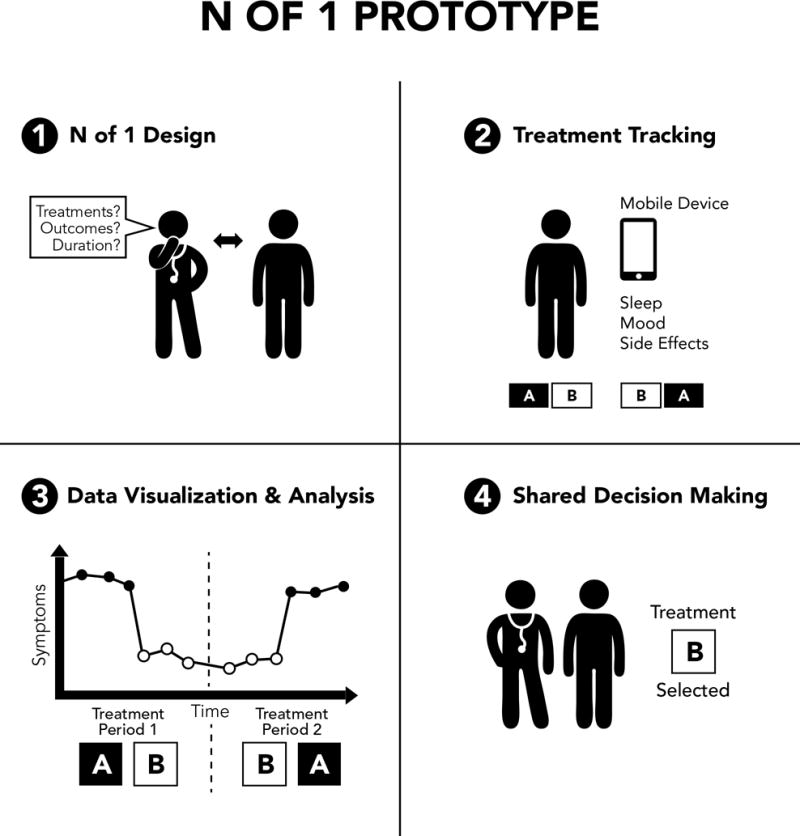
This "N of 1 Prototype" illustrates the full cycle of a data-driven coaching engagement. Today, we are focusing on Step 1: N of 1 Design, which forms the scientific foundation for the tracking, analysis, and decision-making that follow.
The Logic of Single-Case Experiments
Your statistical training likely focused on group-based designs, such as Randomized Controlled Trials (RCTs), which determine the average effect of an intervention across a large population. While powerful, they don't necessarily tell you if an intervention will work for a specific individual. Single-Case Experimental Designs (SCEDs) answer this very question by treating each client as their own experiment.
The following video provides an excellent overview of the core principles of experimental design in this context, contrasting the group designs you're familiar with against the single-subject approach we'll be using.
Experimental Design Part 1 - EVERYTHING you NEED to know 😎
This video from the channel "Understanding Behavior" clearly articulates the difference between group and single-subject methodologies.
Please watch the segment that compares group versus single-subject designs. Pay close attention to the distinction made: group designs measure the average effect for a population, while single-subject designs evaluate the effectiveness of an intervention for a specific individual, using their own behavior as the control.
As the video explains, instead of comparing a treatment group to a control group, an SCED compares a client's outcome data during a baseline phase (no intervention) to their data during an intervention phase. This makes the client their own control. The fundamental goal is to establish experimental control, meaning you can confidently attribute changes in the client's outcomes (the Dependent Variable, or DV) to the intervention you introduced (the Independent Variable, or IV).
To make this causal claim credibly, SCEDs rely on a principle known as Baseline Logic, which consists of three components: Prediction, Verification, and Replication.
Experimental Design Part 1 - EVERYTHING you NEED to know 😎
The same video provides a concise and clear explanation of Baseline Logic.
Watch the segment explaining prediction, verification, and replication. This logic is the engine of causal inference in single-case designs.
Let's break down this logic:
- Prediction: After collecting stable baseline data, you can predict that, without any changes, the client's behavior or emotional state would continue along the same path.
- Verification: After introducing and then withdrawing the intervention, you verify your prediction by observing the data return to (or near) the original baseline level. This demonstrates that the intervention was necessary for the change.
- Replication: By reintroducing the intervention, you replicate the effect, showing that the change in the dependent variable occurs again. This confirms the functional relationship.
This P-V-R logic is what elevates your coaching from "let's try this and see what happens" to a systematic, falsifiable process of hypothesis testing.
Designing Reversal (A-B-A) Designs
The most direct way to apply baseline logic is through a reversal design. The learning outcome specifically mentions the A-B-A design, which is a classic example. These designs are named for their sequence of phases.
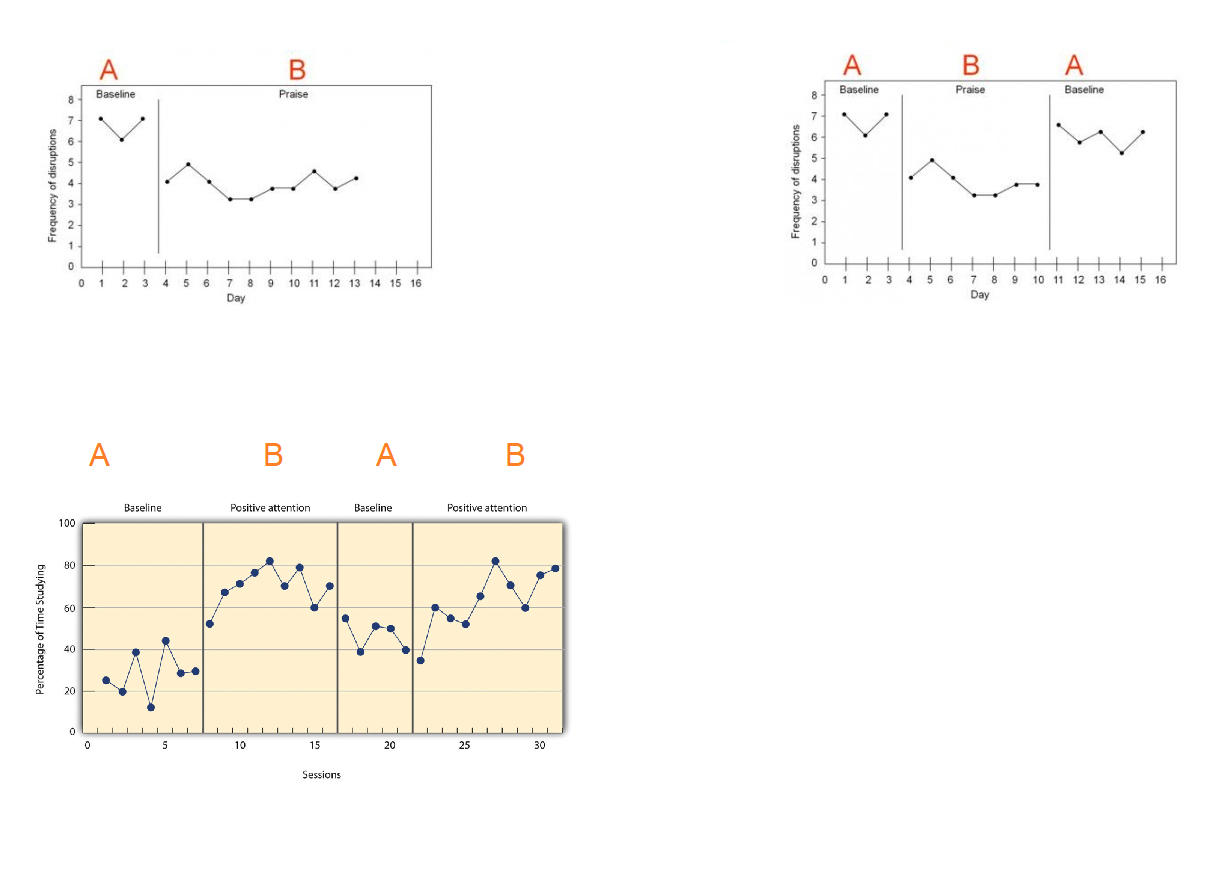
These graphs illustrate several common SCEDs. From top left to bottom: A-B (a simple, pre-experimental design), A-B-A (a true experimental design), and A-B-A-B (a more robust experimental design that ends with the treatment in place).
Let's dissect the structure:
- Phase A (Baseline): This is a period of systematic observation before you introduce a new strategy. You collect repeated measurements of the target outcome (the DV). For example, a client's daily rating of relationship satisfaction on a 1-10 scale. A stable baseline is crucial; if the data is already trending in the desired direction, it will be difficult to attribute any further improvement to your intervention.
- Phase B (Intervention): You introduce the independent variable—the specific coaching strategy you want to test. For example, a daily 10-minute "gratitude sharing" ritual. You continue to collect data on the DV just as you did during baseline.
- Phase A (Withdrawal/Reversal): You remove the intervention and ask the client to return to baseline conditions. This is the most critical phase for establishing causality. If the intervention was indeed responsible for the change seen in Phase B, the DV should revert toward its baseline level.
The following video offers a clear, practical summary of the reversal design, including its strengths and weaknesses.
Single Subject Experimental Design: Reversal, Multiple Baseline, Multielement, Changing Criterion
This video from ABA Exam Review provides a quick tutorial on the structure and logic of reversal designs.
Watch the segment on reversal and withdrawal designs. Note the discussion of the advantages (powerful demonstration of experimental control) and the ethical disadvantages (removing an effective treatment).
A Concrete Coaching Example
Let's apply this to a scenario from your practice.
- Client Problem: A couple reports frequent, minor conflicts stemming from mismatched expectations about household chores.
- Dependent Variable (DV): The number of self-reported conflicts related to chores per day.
- Independent Variable (IV): A "chore-sync" meeting held for 5 minutes every morning to align on the day's tasks.
The A-B-A design would look like this:
- Phase A1 (Baseline, 1 week): The couple tracks the number of chore-related conflicts each day without implementing the new meeting. You predict this level of conflict will continue.
- Phase B1 (Intervention, 2 weeks): The couple implements the 5-minute morning "chore-sync" meeting. They continue to track conflicts. You should see a clear drop in the level of conflict.
- Phase A2 (Withdrawal, 1 week): The couple stops the morning meetings and returns to their old habits. You perform the crucial test for verification: does the conflict level return to the original baseline? If it does, you have strong evidence that the meeting caused the reduction in conflict.
A common and often more practical extension is the A-B-A-B design, where you reintroduce the intervention in a final phase. This replicates the effect once more (strengthening your causal claim) and, importantly, leaves the client with the effective strategy in place.
Rigorous Design: A Professional Protocol
While the A-B-A structure is simple, designing a high-quality N-of-1 trial requires careful planning. Given your background, you can appreciate the need for rigor. The following academic paper provides a comprehensive framework for thinking through the necessary conditions for a valid single-case experiment.
N-of-1 Randomized Intervention Trials in Health Psychology - PMC
This paper from the Annals of Behavioral Medicine critiques the state of N-of-1 trials and provides a robust guide for their proper design. It translates the principles of experimental design into the single-case context.
First, read the introduction to understand how N-of-1 trials provide a personalized alternative to conventional RCTs. Next, carefully review the text surrounding Table 1, titled "Considerations for Conducting N-of-1 Trials," and the table itself. This section, from "N-of-1 RCTs are best suited..." to the end of the table, is essentially a design checklist. Pay close attention to: Nature of the problem: Chronic, recurring symptoms are ideal. Nature of interventions: Reversibility and speed of onset are key. Washout period: The time needed for an intervention's effect to dissipate. Finally, read the section "A Primer on Conducting N-of-1 Trials for Psychological and Health Behavior Outcomes." This provides a step-by-step summary of the design process, from establishing applicability to considering ethical implications.
This paper highlights that not all problems or interventions are suitable for reversal designs. What if an intervention is not easily reversible (e.g., a client learns a new communication skill they can't simply "unlearn") or if it's unethical to withdraw a highly effective treatment (e.g., a strategy that has eliminated severe emotional distress)?
In such cases, another type of SCED, the Multiple Baseline Design, is a powerful alternative. This design demonstrates experimental control by introducing the intervention at different times across different people, settings, or behaviors.
The Family of Single-Case Experimental Designs
This article provides a great overview of the different families of SCEDs. This section introduces the primary alternative to a reversal design.
Read the section on Multiple Baseline Designs. This will give you a robust alternative for situations where withdrawing an intervention is not feasible or ethical.
For your practice, a multiple baseline across behaviors could be very useful. For instance, you could apply a new boundary-setting technique first to a client's interactions with their partner, then (after a delay) to interactions with their friends, and finally (after another delay) to interactions with family. If the desired change only occurs in each domain after the intervention is applied, you establish a functional relationship without having to withdraw the technique.
Conclusion
Today's lesson provided a formal structure for what you may have been doing intuitively: testing strategies to see what works for your clients. By formalizing this process with Single-Case Experimental Designs, you can move from educated guessing to rigorous, personalized hypothesis testing.
Key Takeaways:
- Individualized Causality: SCEDs allow you to establish a causal link between your intervention (IV) and a client's outcome (DV), using the client as their own control.
- Baseline Logic: The strength of this causal claim rests on the principles of Prediction, Verification, and Replication.
- Reversal Designs (A-B-A): This is a powerful and straightforward design that demonstrates experimental control by introducing and then withdrawing an intervention.
- Design with Rigor: A successful SCED requires careful consideration of the problem type, the reversibility of the intervention, the stability of the baseline, and the ethics of withdrawal.
- Alternatives Exist: When a reversal design is not appropriate, a multiple baseline design offers another robust method for demonstrating causality.
You now have the experimental framework to test your coaching interventions. The next logical step is to ensure you can collect the data needed to populate these designs. In our next lesson, we will focus on how to create customized repeated-measures tracking tools for clients to monitor key variables, making the data collection for your N-of-1 experiments both seamless and reliable.