Introduction
In our previous lesson, you designed the outline for a strategic lead magnet—a white paper that packages your unique expertise to attract ideal clients. That asset is the "what" you will offer to begin a conversation. Now, we shift our focus to the "how": building the engine that brings the right people to that offer and systematically guides them toward becoming clients.
This lesson directly addresses the learning outcome: Systematize a multi-channel client acquisition strategy based on ideal client profiles. We will move from creating a single asset to designing a complete, repeatable process. You'll start by defining your target with high precision through an Ideal Client Profile (ICP). Then, you will construct a system to attract, nurture, and qualify leads from several channels, specifically chosen for their effectiveness within the unique constraints of your coaching niche.
Part 1: Defining Your Ideal Client Profile (ICP)
Before building any system, you must define its target with analytical precision. An Ideal Client Profile is not a vague persona; it's a set of firmographic, demographic, and psychographic attributes that specify the clients for whom you can deliver the most value and who, in turn, are most valuable to your practice. For your data-driven practice, the ICP serves as the core specification for all targeting and filtering.
The video below from HubSpot provides an excellent overview of what an ICP is and why it's a foundational element of a marketing strategy. It also helpfully distinguishes between related concepts like Total Addressable Market (TAM), ICP, and Persona.
How to Define Your Ideal Customer Profile (ICP)
This video defines the ICP and explains its role in building a cohesive marketing and sales strategy.
As you watch, focus on these key concepts: What is an ICP? Watch the initial definition from the beginning to understand why a documented ICP is crucial. Data Sources: Pay close attention to the discussion on gathering data, which includes customer interviews, CRM data, and even using AI to synthesize insights from transcripts. This aligns with your goal of building a data-informed practice. TAM vs. ICP vs. Persona: Absorb the clarification of these terms starting at this timestamp. For your B2C coaching service, your "ICP" and "Persona" will be very closely related, focusing on the individual's characteristics, motivations, and challenges. Key Characteristics: Finally, review the section on data points for an ICP, noting the mention of using social communities like Reddit for research—a tactic that can be very effective for niche topics.
To create your ICP, you need to translate your deep, tacit knowledge of your clients into a structured format. This infographic provides a practical, step-by-step framework for doing just that.
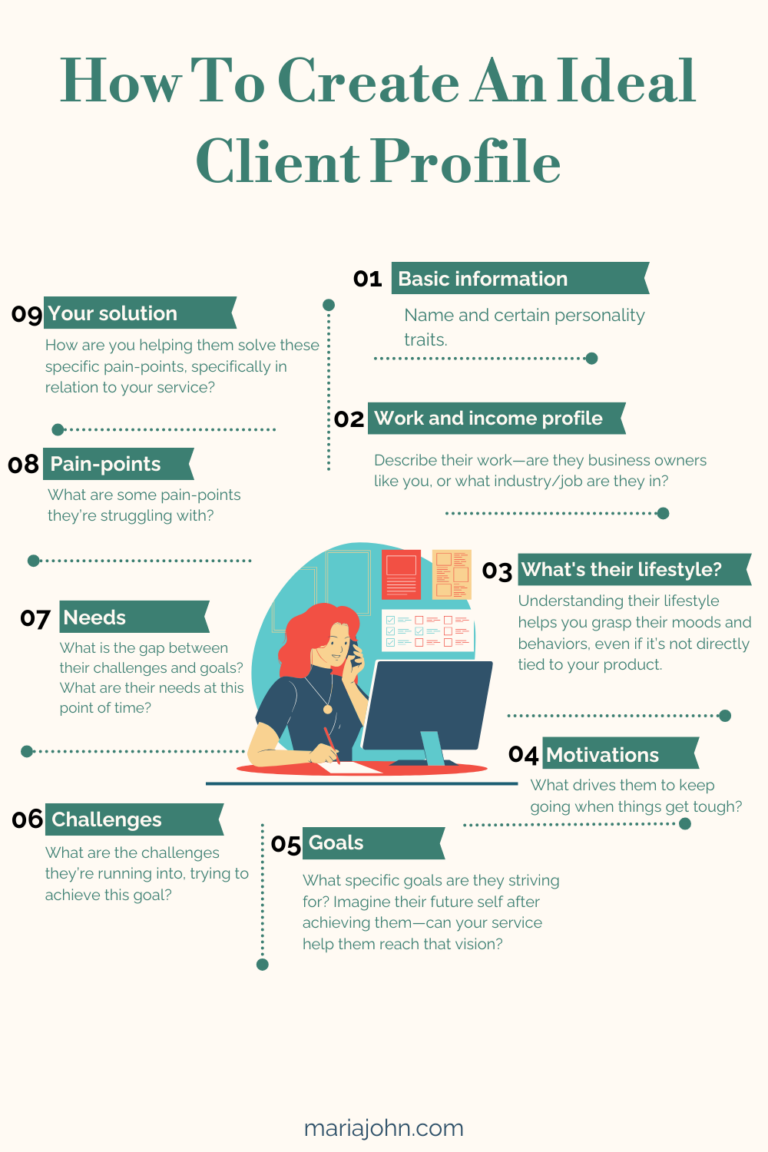
Think of your best past clients—the ones who were most engaged, got the best results, and you most enjoyed working with. Use them as the model to work through these nine points:
- Basic Information: Go beyond name. Think about age range, relationship status, personality traits (e.g., analytical, communicative, introverted).
- Work and Income Profile: What are their professions? Are they high-achievers in demanding careers? This is often a key factor in the "efficiency" challenges you solve.
- Lifestyle: How do they spend their time outside of work and the lifestyle? This gives context to their integration challenges.
- Motivations: What drives them in life and toward this specific relationship dynamic? Is it novelty, deeper connection, personal growth?
- Goals: What future are they trying to build? What does success look like for them in their relationship and life?
- Challenges: What specific obstacles are they hitting? (e.g., time management, communication breakdowns, emotional turbulence).
- Needs: What is the gap between their challenges and their goals? What do they need to bridge it?
- Pain-Points: This is where you get specific. What are the acute, felt problems? (e.g., "We fight about scheduling every weekend," "I feel burnt out and disconnected").
- Your Solution: How do your specific services (efficiency coaching, motivation analysis) directly solve these pain-points and meet their needs?
Creating this documented ICP is the first step in systematizing your acquisition. It provides the objective criteria against which all potential leads will be measured.
Part 2: The Architecture of a Client Acquisition System
Successful consulting practices don't rely on luck or sporadic marketing; they build predictable systems. A system turns the chaotic process of finding clients into a structured workflow, much like an optimized process in operations research.
The article "Beyond the Pipeline" offers a robust framework for this. It boils client acquisition down to a core three-step sequence.
Beyond the Pipeline: Building a Predictable Client Acquisition System
This article from Consulting Success provides a clear, high-level framework for how consultants actually get clients, moving beyond the "feast-or-famine" cycle.
Read the section titled "How Consultants Actually Get Clients". Focus on understanding the logical flow of the three core steps: Capture Attention, Build Trust, and Present an Offer.
This three-step sequence provides the logic, but to make it operational, you need a more detailed process flow. The "CASE Funnel" (Coaches, Agencies, Service professionals, Experts) described in the following video provides a perfect blueprint. It maps the journey from a stranger encountering your work to a qualified prospect on a call with you.
Marketing & Sales Strategy for Service Based Business (PROVEN & PROFITABLE)
This video by marketing expert Adam Erhart lays out a practical, six-step funnel specifically designed for service-based businesses like yours.
Watch the segment explaining the CASE funnel, from the introduction to the funnel until the end. As you watch, map the steps to your own practice: Traffic: The sources of attention (we'll cover this in the next section). Opt-in: This is your white paper from the previous lesson. A prospect exchanges their email for this high-value content. Authority Amplifier: A short video on the "thank you" page after they download. This is your chance to build trust immediately by giving a quick win or a key insight. Application: A short form to qualify prospects. It filters out non-ideal clients and positions you as the expert who reviews applications. Calendar Booking: Qualified applicants are invited to book a call. The Call: A warm conversation with a pre-qualified, pre-educated prospect.
This funnel is the "system" in "systematize." It's a repeatable, measurable, and optimizable process for converting attention into clients.
Part 3: Designing Your Multi-Channel Strategy
With an ICP defined and a system architecture in place, the next step is to select the channels that will feed traffic into your funnel. Your niche operates under specific constraints, as mainstream advertising platforms heavily restrict content related to sexuality. This is not a weakness; it's a strategic reality that forces a more creative, relationship-driven approach where you can excel.
The following academic paper on marketing in the adult industry provides crucial, research-backed context for which strategies are effective when standard ads are off the table.
[PDF] Marketing Strategies in the Adult Industry - Theseus
This paper details the unique challenges and successful strategies for marketing in sensitive industries. It validates a non-traditional, content-and-relationship-focused approach.
Focus on these key takeaways for your strategy: First, read the introduction to the section on Marketing in the Adult Industry (page 14) to confirm the limitations of conventional advertising. Next, review the main findings summarized in the "Results and Recommendations" section (pages 31-33). Pay close attention to the emphasis on networking, social media marketing (indirectly), influencer marketing, and differentiation. Finally, look at the specific tactics discussed in the subsections on Influencer Marketing and Social Media Marketing (pages 24-26). The idea of creating content around adjacent topics (relationships, health, workplace) to build a following is a core tactic for you.
Based on this research and best practices for consultants, your multi-channel strategy should be a calculated blend of the following:
-
Content & Authority Marketing (Inbound): This is your primary engine.
- The Lead Magnet: Your white paper is the cornerstone.
- Guest Appearances: Appearing on podcasts or YouTube channels that serve an audience interested in relationships, self-improvement, or non-traditional lifestyles. You discuss communication, time management, and emotional intelligence—not explicit topics.
- Writing: Publishing articles on platforms like Medium or guest posts on relevant blogs, again focusing on the psychological and logistical aspects of complex relationships.
-
Strategic Networking (Relationship-based):
- Referral Partnerships: Building relationships with therapists, other coaches (in non-competing niches), or content creators who serve your ICP. When they encounter someone facing logistical/efficiency issues they can't solve, they refer them to you.
- Community Participation: Engaging authentically in private, vetted online communities (e.g., specific subreddits, Facebook Groups, or Discords) where your ICP congregates. You are not selling; you are answering questions and being helpful, which naturally builds authority and attracts inbound interest.
-
Indirect Social Media Marketing:
- The "Adjacent Content" Strategy: As the paper suggests, your social media presence (e.g., on Instagram, TikTok, or LinkedIn) should focus on themes your ICP cares about that are platform-safe: productivity, relationship communication, emotional intelligence, and managing complex schedules. You are a relationship "efficiency expert." This attracts the right mindset, and the link in your bio leads them to your white paper.
The key is to not be everywhere. Select one primary channel (e.g., podcast guesting) and one or two secondary channels (e.g., LinkedIn and one online community) and execute on them with discipline.
Part 4: A Quantitative Layer: Lead Scoring
To fully systematize your process and leverage your statistical background, you can implement a simple lead scoring model. Lead scoring is a method for ranking prospects against a scale that represents their perceived value. Each lead is assigned a numerical score based on attributes and behaviors, allowing you to prioritize your time and effort.
This is a direct application of decision theory: you're creating a model to classify leads and inform your action (e.g., follow up personally, add to an automated sequence).
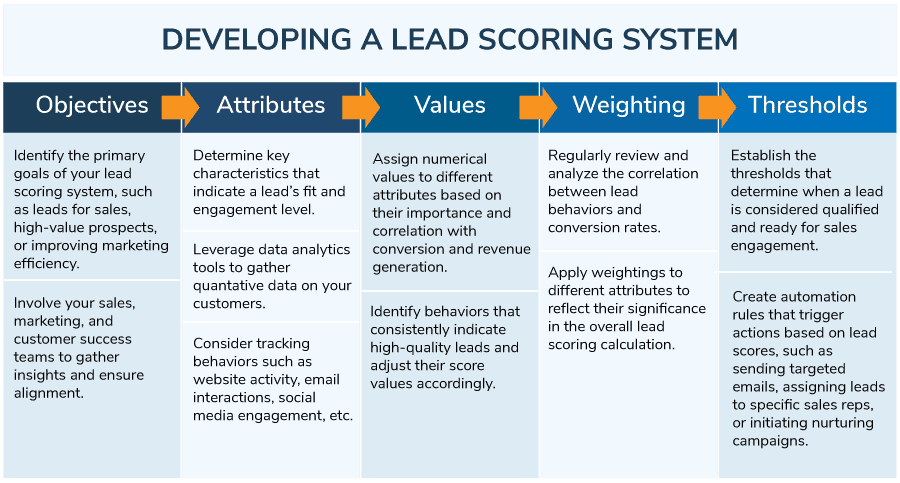
Here's how you can apply this five-step process to your practice:
- Objectives: Your primary objective is to identify prospects who are the best fit for your high-touch consulting and are most likely to be ready for a screening call.
- Attributes: These are the signals of a high-quality lead, based on your ICP.
- Explicit Data (from forms): Job title (e.g., director level or above), specific pain points mentioned in an application.
- Implicit Data (behaviors): Downloaded the white paper, visited your services page, opened a follow-up email, attended a webinar you hosted.
- Source Data: Came from a direct referral vs. a general social media post.
- Values: Assign points to each attribute. This is where your judgment comes in.
- Downloaded white paper: +10 points
- Is a Director/VP/C-level: +15 points
- Mentioned "time management" or "burnout" in application: +20 points
- Referred by a trusted partner: +30 points
- Weighting: You can refine this by applying weights. For example, a referral might be twice as valuable as any other attribute. Initially, a simple point system is sufficient.
- Thresholds: Establish score-based triggers for action.
- Score > 60: "Sales-Qualified Lead" (SQL). You send a personal email to invite them to book a call.
- Score 30-59: "Marketing-Qualified Lead" (MQL). They receive an automated email nurture sequence with more valuable content to build more trust.
- Score < 30: "Lead." They are added to your general newsletter list for long-term nurturing.
This system ensures you are spending your most valuable resource—your time—on the prospects who are most likely to convert.
Exercise: Outline Your Client Acquisition System
It's time to translate these concepts into a concrete plan for your practice. Spend the next 20-30 minutes drafting an initial version of your system.
1. Ideal Client Profile (ICP) Sketch:
- Based on the 9-point framework, list 1-2 bullet points for each of the following for your ideal client:
- Profession/Workload:
- Primary Motivation for the Lifestyle:
- Biggest Pain-Point you can solve:
2. Channel Selection:
- Primary Channel (Choose one): e.g., Podcast guesting, Writing on Medium, YouTube interviews.
- Secondary Channels (Choose one or two): e.g., Active on LinkedIn, Participating in /r/cuckold anecdotally, Networking with other coaches.
3. CASE Funnel Mapping:
- Briefly describe what will happen at each stage of your funnel:
- Traffic: How will your primary channel drive traffic? (e.g., "Podcast host will link to my white paper in the show notes.")
- Opt-in: White Paper: "The Couple's Compass."
- Authority Amplifier: What one quick-win insight could you share in a 2-minute video on your "thank you" page?
- Application: What are the top 3 questions you would ask on your application form to qualify a lead?
4. Lead Scoring Attributes:
- List your top 5 initial attributes and assign a point value to each.
- Example: Attribute: C-level executive, Value: +15 points
-
-
-
-
-
This plan is your first iteration. Like any good system, it will be tested, measured, and refined over time.
Conclusion
In this lesson, you have designed the architecture for a complete client acquisition system tailored to your unique expertise and market. You've moved beyond single tactics to create a cohesive, multi-channel process that is both strategic and systematic.
Your key takeaways are:
- An Ideal Client Profile (ICP) is the non-negotiable foundation that guides all marketing and sales efforts.
- A structured funnel like the CASE model provides a repeatable pathway from stranger to client, connecting your marketing activities to your sales process.
- Your niche requires a creative multi-channel strategy focused on content, authority, networking, and indirect social media, turning constraints into a competitive advantage.
- Lead scoring adds a quantitative layer to your system, allowing you to use data to prioritize your focus and optimize your process, perfectly aligning with your analytical background.
You now have a lead magnet and a system to promote it. The next logical step is to perfect the first human interaction in that system. In our next lesson, we will develop a script and qualification criteria for an initial screening call, ensuring that the prospects who enter your funnel are professionally and effectively guided toward becoming clients.