Bonjour ! I hope you had a good time practicing with the -er verbs.
In our last lesson, you learned how to conjugate verbs for tu (you, singular informal) and vous (you, plural/formal). For example, you now know that parler becomes tu parles and vous parlez. This is a great mechanical skill. Today, we focus on the cultural and grammatical knowledge of when to use each one.
The learning outcome for this lesson is to distinguish between 'tu' and 'vous' and use them appropriately in context. Mastering this is absolutely essential for your goal of working in a call center, as choosing the correct form of "you" is the first step to polite and professional communication in French. Using the wrong one can be seen as disrespectful or overly familiar.
1. The Two Meanings of "Vous"
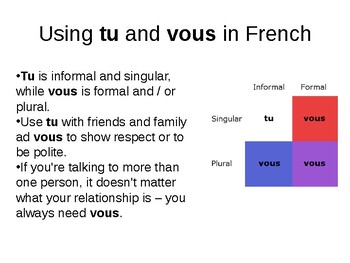
Before we dive into the choice between tu and vous, we need to clarify a simple, non-negotiable rule. The word vous has two primary functions:
- The Plural "You": When you are talking to more than one person, you always use
vous, regardless of your relationship with them. You would usevousto speak to a group of your best friends, a group of children, or a group of strangers. There is no choice to make here. - The Formal "You": When you are talking to only one person,
vousis used to show respect, formality, or distance.
This means the real choice between tu and vous only happens when you are speaking to a single individual. The chart below makes this clear.
2. The Core Rules: Informal vs. Formal
The choice between tu and vous depends on your relationship with the person you are speaking to.
Tu(informal): Used for people you are close to. This is calledtutoiement.Vous(formal): Used for people you don't know, in professional settings, or to show respect. This is calledvouvoiement.
The following video, which has Arabic subtitles, explains these fundamental rules very clearly. It will form the basis of our lesson.
😯 Découvre comment et quand utiliser TU et VOUS en français.
Let's watch the beginning of the video 'Découvre comment et quand utiliser TU et VOUS en français'. The presenter, Guillaume, will explain the basic difference and when to use each pronoun in everyday situations.
Watch from the timestamp 01:08 to 03:25. Pay close attention to the general rule he provides for strangers and the list of people with whom you would use 'tu'.
To summarize the key points from the video:
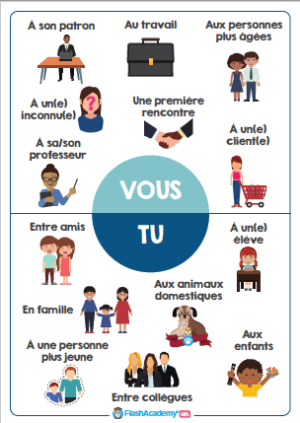
- Use
vouswith:- Strangers (
les inconnus) - People in professional contexts (e.g., a baker, a cashier, a doctor)
- People who are significantly older than you
- Strangers (
- Use
tuwith:- Friends (
un ami) - Family members (
un membre de la famille) - Children (
un enfant) - Loved ones (
un proche)
- Friends (
This infographic provides a great visual summary of these common situations.
Test your understanding!
For each person below, would you use tu or vous when speaking to them for the first time?
- The cashier at the supermarket.
- Your new classmate who is your age.
- A client calling the company you work for.
- Your best friend's mother.
- A small child in the park.
Show answer
Vous. This is a professional and formal interaction with a stranger.Tu. Among young people and classmates of similar age,tuis standard.Vous. This is a key rule for your future job. All clients are addressed withvous.Vous. To show respect to an elder, you should start withvous.Tu. You always usetuwhen speaking to children.
3. Navigating Professional and Nuanced Situations
While the basic rules are clear, real life can be more complex, especially at work. Your relationship with a colleague you see every day is different from your relationship with your boss or a client.
Let's return to the video to explore these more advanced scenarios. The presenter gives excellent, practical examples.
😯 Découvre comment et quand utiliser TU et VOUS en français.
Now, let's focus on the part of the video that is most relevant to your professional goals. We will look at how 'tu' and 'vous' are used in a work environment.
Watch the section from 06:58 to 10:11. Listen for his advice on speaking to colleagues, your boss, and professional contacts like clients.
Here are the key takeaways for the workplace:
- Clients/Professional Contacts: Always
vous. This is a strict rule of professional politeness. - Colleagues (
les collègues): Usuallytu. This helps create a friendly, collaborative atmosphere. If a colleague usesvouswith you, it might mean they want to keep a distance. - Boss (
mon chef/mon patron): Start withvousdue to hierarchy. However, if your boss usestuwith you, it is often a sign that you can also usetuwith them. The person with higher authority or who is older sets the tone.
Asking for Permission: Tutoyer and Vouvoyer
Sometimes, you might feel a formal relationship becoming more friendly. French has specific verbs for this: tutoyer (to use tu) and vouvoyer (to use vous). If you are unsure, or if you want to switch from vous to tu, you can ask!
You in French: How to Choose Between Tu and Vous
The article 'You in French: How to Choose Between Tu and Vous' has a great section that explains how to ask for permission to use 'tu'.
Read the subsections titled 'How to ask someone if you can use tu' and 'Can you ask if you should use vous with someone?'. Focus on the key questions you can ask.
The most common and friendly way to ask is:
On se tutoie ?(Can we usetuwith each other?)
This is a very normal question in French culture and shows you are sensitive to the social rules.
4. The Golden Rule for Learners
As a learner, you might worry about making a mistake. Don't worry, French people are usually very understanding! But there is a simple strategy to minimize any awkwardness.
When in doubt, use vous.
It is always better to be a little too polite than too familiar. If you use vous when tu is appropriate, the other person might simply invite you to use tu by saying, "On peut se tutoyer." However, using tu when vous is expected can be perceived as rude.
The video instructor gives one last piece of excellent advice: if you are truly unsure, you can sometimes use neutral phrases that avoid both tu and vous. For example, instead of asking "Comment allez-vous ?" or "Comment vas-tu ?", you could say "Comment ça va ?", which is more flexible.
Conclusion
Fantastic work today! Understanding the difference between tu and vous is more than just a grammar rule; it's about understanding French culture and showing respect. For your professional ambitions, it is a non-negotiable skill.
Key Takeaways:
Vousis always used when speaking to more than one person.- When speaking to one person,
tuis for informal relationships (friends, family, kids), andvousis for formal relationships (strangers, elders, professional settings). - In a professional context, you always use
vouswith clients. With colleagues,tuis common, and with a boss, you should start withvous. - You can ask
On se tutoie ?to suggest switching to a more informal mode. - The safest strategy is: When in doubt, use
vous.
In our next lesson, we will immediately apply this knowledge as we learn how to greet people formally and informally at different times of the day. You'll see how your choice of tu or vous directly connects to the greetings you use.
À la prochaine