Bonjour ! Welcome to your next lesson.
In our last session, you learned how to construct complete, simple sentences using être and avoir. This was a major step, moving you from isolated words to expressing ideas. Today, we'll build on that foundation and dramatically expand the range of actions you can describe.
Our learning outcome is to conjugate regular -er verbs in the present tense. This is one of the most powerful rules you will learn in French because it applies to approximately 90% of all French verbs! Mastering this pattern will allow you to talk about what you do, what clients do, and what you are doing in a professional context.
Let's begin.
1. The Golden Rule of Regular -ER Verbs
Most French verbs, in their basic, unconjugated form (the infinitive), end in -er. Think of verbs like parler (to speak), travailler (to work), or écouter (to listen). The great news is that almost all of them follow the same simple pattern for conjugation in the present tense.
The rule has three steps:
- Start with the verb's infinitive form (e.g.,
parler). - Remove the final
-erto find the verb's "stem" (e.g.,parl-). - Add the correct ending that matches the subject pronoun.
The image below shows this process and the endings you need to memorize.
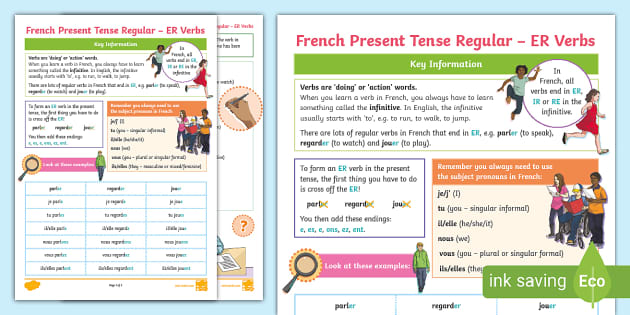
Here are the endings:
| Subject Pronoun | Ending | Example: parler (to speak) |
|---|---|---|
je |
-e | je parle (I speak) |
tu |
-es | tu parles (you speak) |
il/elle/on |
-e | il parle (he speaks) |
nous |
-ons | nous parlons (we speak) |
vous |
-ez | vous parlez (you speak) |
ils/elles |
-ent | ils parlent (they speak) |
To get a detailed explanation of this process in Arabic, the following video is an excellent resource. It walks through the conjugation of the verb marcher (to walk).
تصريف أفعال المجموعة الأولى في جميع الأزمنة (الجزء الأول: الحاضر)
The video 'تصريف أفعال المجموعة الأولى' provides a clear, step-by-step guide in Arabic on how to apply these conjugation rules.
Watch the segment from 07:10 to 09:45. The instructor will demonstrate how to conjugate the verb 'marcher' and will explicitly list the endings for each subject pronoun.
2. A Crucial Insight on Pronunciation
Now for a very important tip that will help your listening and speaking skills. Look at the conjugations for parler again: parle, parles, parle, parlons, parlez, parlent.
How do you think they are pronounced?
You might be surprised to learn that four of them sound exactly the same!
je parletu parlesil/elle parleils/elles parlent
In all these cases, the endings (-e, -es, -ent) are silent. The pronunciation is just that of the stem: /paʁl/.
The only endings that are pronounced clearly are for nous (-ons) and vous (-ez).
nous parlons(we hear the "-on" sound)vous parlez(we hear the "-é" sound)
This is a fundamental concept in spoken French. The video you just looked at has a fantastic section explaining this.
تصريف أفعال المجموعة الأولى في جميع الأزمنة (الجزء الأول: الحاضر)
Let's return to the same video to focus specifically on the pronunciation of these verbs.
Watch from 09:45 to 13:35. Pay close attention to how the instructor explains that the pronunciation for 'je', 'tu', 'il', and 'ils' forms is identical, while 'nous' and 'vous' are different.
Test your understanding!
Let's try conjugating the verb travailler (to work). Fill in the blanks.
- Je ___________ à Paris. (I work in Paris.)
- Nous ___________ ensemble. (We work together.)
- Elles ___________ beaucoup. (They work a lot.)
Show answer
travailletravaillonstravaillent
Did you notice that travaille (1) and travaillent (3) are pronounced the same, even though they are spelled differently?
3. Common Spelling Changes: -ger and -cer verbs
Your goal is to build a strong foundation, so it's important to learn two small but very common exceptions to the spelling rule. These changes are made to maintain the correct pronunciation.
Verbs ending in -ger
For verbs like manger (to eat) or voyager (to travel), we need to keep the soft "g" sound (like the 's' in "pleasure") throughout the conjugation. The g in front of an o would make a hard "g" sound (like in "go").
To fix this, we add an -e- between the g and the -ons ending for nous.
manger->nous mangeons(notmangons)
Verbs ending in -cer
For verbs like commencer (to begin) or placer (to place), we need to keep the soft "c" sound (/s/). The c in front of an o would make a hard "k" sound.
To fix this, we change the c to a ç (cédille) before the -ons ending for nous.
commencer->nous commençons(notcommencons)
For all other subject pronouns, these verbs are perfectly regular. This small change only affects the nous form. The following video explains this clearly.
👉 Les verbes du premier groupe en français (Explications + ⚠️Exceptions + QUIZ)
This video, in French with Arabic subtitles, explains these two important spelling changes. This is great practice for your listening skills.
Watch from 05:44 to 07:26. The presenter gives clear examples for verbs ending in '-ger' (like 'manger') and '-cer' (like 'commencer').
Test your understanding!
Apply the spelling change rule for the nous form of these verbs.
- We are travelling. (
voyager) -> Nous ___________. - We are starting. (
commencer) -> Nous ___________.
Show answer
voyageonscommençons
Conclusion
Excellent work today! You have just learned the single most productive grammar rule in the French language. By mastering this pattern, you've unlocked the ability to use thousands of verbs to describe actions in the present.
Key Takeaways:
- To conjugate a regular
-erverb, you remove the-erand add the endings: -e, -es, -e, -ons, -ez, -ent. - The conjugated forms for
je,tu,il/elle, andils/ellesare all pronounced the same, with a silent ending. - Only the
nous(-ons) andvous(-ez) endings are clearly pronounced. - For verbs ending in
-gerand-cer, a small spelling change is needed in thenousform (nous mangeons,nous commençons) to preserve the pronunciation.
Now that you can correctly form verbs for both tu and vous, our next lesson will focus on a crucial cultural and grammatical point: distinguishing between tu and vous and using them appropriately. This is essential for the polite, professional communication required in a call center environment.
À la prochaine (Until next time)