Bonjour ! Welcome to your next lesson.
In our last session, we covered the crucial difference between tu and vous. You now know that this choice is fundamental to showing respect and setting the right tone in French. Today, we'll build directly on that knowledge.
The goal of this lesson is to learn how to greet people formally and informally at different times of the day. This is a core skill for everyday conversation and absolutely essential for the professional environment you're aiming for. A correct greeting is the first step in any successful interaction.
1. The Foundation: Formal Greetings for Day and Evening
In French, the time of day dictates your greeting. The two most important greetings to master are Bonjour and Bonsoir.
Let's start with a video that clearly explains and demonstrates how to use these essential formal greetings. The presenter also uses titles like Monsieur (Sir) and Madame (Madam), which are vital in professional contexts.
Essential French Greetings: Formal vs. Informal
Please watch this first part of the video 'Essential French Greetings: Formal vs. Informal' from the Learn French with escargot channel. It focuses on the most common formal greetings.
Watch from the beginning until timestamp 03:35. Pay attention to the pronunciation of 'Bonjour' and 'Bonsoir' and note the approximate time of day when you switch from one to the other.
As the video explained, the rules are quite clear:
Bonjour: This means "Good day" or "Hello." It's your universal, polite greeting for the morning and afternoon. You use it until about 6 PM (18:00).Bonsoir: This means "Good evening." You start using this in the evening, from about 6 PM onwards.
This infographic provides a very clear visual summary of when to use each greeting.
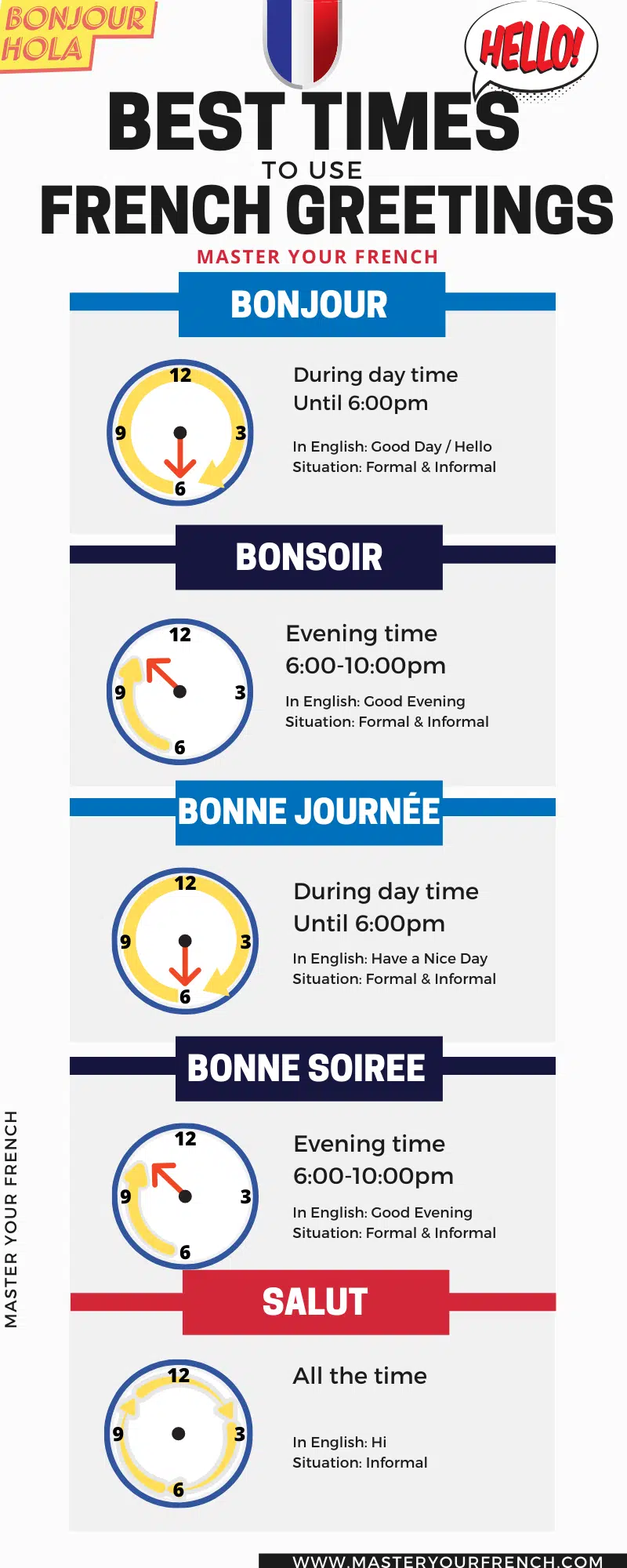
Crucially, in a formal or professional setting (like a call center), you should always add a title:
Bonjour, Madame.(Hello, Madam.)Bonjour, Monsieur.(Hello, Sir.)Bonsoir, Madame.Bonsoir, Monsieur.
2. Greetings vs. Farewells: A Common Point of Confusion
It's important to distinguish between greetings (what you say when you arrive) and farewells (what you say when you leave). This is especially true in the evening.
Bonsoiris a greeting.Bonne soiréemeans "Have a good evening" and is a farewell.
Similarly:
Bonjouris a greeting.Bonne journéemeans "Have a good day" and is a farewell.
There is one more expression for the end of the day: Bonne nuit ("Good night"). This is a special case. To make sure you understand the differences, please read the following short text.
Mastering French Greetings: Navigating the Nuances of Formality
The article 'Mastering French Greetings' has a section that perfectly clarifies the usage of these time-specific expressions. This will help you avoid common mistakes.
Please read the section titled 'Understanding Time-Specific Greetings'. Focus on the distinction between greetings ('Bonjour', 'Bonsoir') and farewells ('Bonne soirée', 'Bonne nuit').
So, to summarize:
- You arrive at a dinner party at 8 PM:
Bonsoir ! - You leave the party at 11 PM:
Bonne soirée ! - You say goodnight to someone just before they go to sleep:
Bonne nuit !
Test your understanding!
You are leaving the office at 5:30 PM. What do you say to your colleagues?
BonsoirBonne journéeBonne nuit
Show answer
The correct answer is 2. Bonne journée. Since it is still daytime (before 6 PM), "Have a good day" is the appropriate farewell. If you were leaving after 6 PM, you would say Bonne soirée. Bonsoir is for arriving, and Bonne nuit is for bedtime.
3. Informal Greetings: For Friends and Family
Now that you've mastered the formal greetings, let's look at what to say in casual situations with people you would address with tu.
Essential French Greetings: Formal vs. Informal
Let's return to the same video to learn the most common informal greetings. Notice how the tone is much more relaxed.
Watch the clip from 05:05 to 06:21. Listen for the pronunciation of 'Salut' and 'Coucou'.
The two main informal greetings are:
Salut: This is the equivalent of "Hi." It's very versatile because you can also use it to say "Bye." It is strictly informal and should only be used with friends, family, and perhaps close colleagues. Never useSalutwith a client.Coucou: This is even more informal and a bit more affectionate, like saying "Hey there!" You would reserve this for very close friends and family. It's good to recognize, butSalutis a safer informal option to start with.
4. Summary and Cultural Tip
You've now learned a range of greetings for different situations. This worksheet is a great summary. It shows formal vs. informal expressions and includes phonetic spellings to help with your pronunciation.

For a final, organized review, please look over this quick-reference table.
Mastering French Greetings: Navigating the Nuances of Formality
This table from the 'Mastering French Greetings' article is a perfect summary of everything we've covered. It links the greeting to its context and the appropriate pronoun ('tu' or 'vous').
Review the table under the heading 'A Comprehensive Guide to French Greetings'. It will help consolidate your knowledge.
A Crucial Cultural Tip: In France, it is considered polite to greet people when you enter a small space. Always say Bonjour, Monsieur/Madame when you walk into a shop, a bakery, a doctor's waiting room, or even an elevator with someone already in it. It's a small but very important sign of respect.
Conclusion
Excellent work today! You have learned the essential vocabulary and cultural rules for greeting people in French. This is a significant step towards communicating politely and effectively.
Key Takeaways:
- Use
Bonjourin the morning and afternoon (until ~6 PM). - Use
Bonsoirin the evening (after ~6 PM). Salutis an informal "Hi / Bye" for friends (people you usetuwith).- Remember the difference between greetings and farewells:
- Greeting:
Bonjour/Bonsoir - Farewell:
Bonne journée/Bonne soirée/Au revoir(general goodbye)
- Greeting:
Bonne nuitis only for saying "Good night" before sleep.- In formal or professional settings, always use
vousand addMonsieurorMadame.
In our next lesson, we will go one step further. After greeting someone, you need to introduce yourself! We will learn how to state your name, nationality, and profession using the verbs être and s'appeler.
À la prochaine ! (See you next time!)