Hello! Welcome to the sixth lesson in our module on Essential Concurrency Patterns.
In our last lesson, we learned how to use sync.WaitGroup to coordinate multiple goroutines, ensuring a parent goroutine waits for all its children to complete. However, we ended with a critical question: what happens when these concurrent tasks need to modify the same piece of data? WaitGroup helps with timing, but not with data safety.
This lesson tackles that exact problem. We will dive into race conditions—one of the most common and dangerous bugs in concurrent programming—and introduce sync.Mutex, Go's primary tool for preventing them. By the end of this lesson, you will be able to protect shared data by ensuring only one goroutine can access it at a time, a crucial skill for building reliable DevOps automation.
1. The Problem: Race Conditions
When multiple goroutines access the same memory location concurrently, and at least one of them is a write, you have a race condition. The final state of the data depends on the unpredictable order in which the goroutines execute. This can lead to corrupted data, incorrect calculations, and maddeningly intermittent bugs.
Imagine a simple counter that multiple concurrent tasks are meant to increment. Without protection, operations can overlap and overwrite each other.
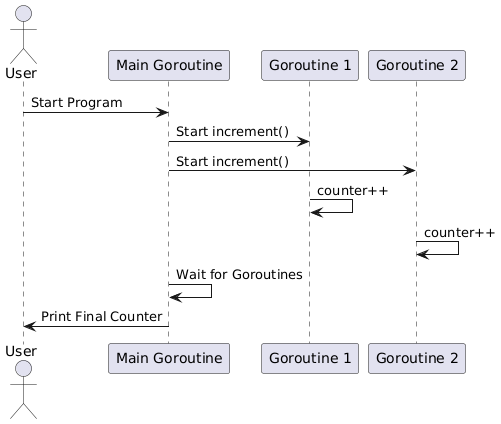
Mastering Go Concurrency: Taming Race Conditions Like ...
The article "Mastering Go Concurrency" provides a clear, concise example of what happens when you have a race condition.
Read the section "3.1 What Causes Race Conditions?". It presents a simple Counter struct with an unprotected count field, demonstrating how concurrent Inc() calls lead to an incorrect final value.
The bug in the article is not just theoretical. It's a real problem you might face when building tools that, for instance, track the number of processed jobs or aggregate metrics from multiple sources concurrently.
Detecting Race Conditions
Fortunately, Go provides a powerful built-in tool to detect race conditions at runtime. By adding the -race flag to your go run, go build, or go test command, you enable the race detector. It will report any race conditions it finds, including the exact lines of code involved.
How You Should Use Mutexes And Atomic Values In Golang?!
The video "How You Should Use Mutexes And Atomic Values In Golang?!" by Anthony GG provides an excellent demonstration of using the race detector.
Watch from 04:58 to 06:49. The presenter takes a seemingly correct program, runs it with go test -race, and immediately identifies a hidden data race. Pay attention to the race detector's output and how it points out the conflicting read and write operations.
Using the race detector should be a standard part of your development and CI/CD workflow when writing concurrent Go code. It can save you from hours of debugging.
2. The Solution: sync.Mutex
To prevent race conditions, we need to ensure that access to shared data is mutually exclusive—meaning only one goroutine can access the data at a time. Go's sync package provides the Mutex type for this purpose. A Mutex is a lock.
The basic pattern is:
- Lock the mutex before accessing the shared data.
- Perform the read or write operations (this is called the critical section).
- Unlock the mutex after you are done.
When a goroutine calls Lock(), it acquires the lock. If another goroutine tries to call Lock() while it's already held, that second goroutine will be blocked until the first one calls Unlock().
A Deep Dive into Go's sync Package: Mutex, RWMutex ...
The article "A Deep Dive into Go's sync Package" gives a concise introduction to the Mutex and its mechanism.
Read the section "3. Mutex: The No-Nonsense Lock", up to and including the first code block under "3.1 Mutex in Action". This shows how mu.Lock() and mu.Unlock() are used to protect the counter++ operation, making it safe.
3. Implementing a Thread-Safe Counter
Now let's apply this concept to build a complete, thread-safe counter. The best practice is to embed the Mutex directly into the struct that holds the data it's meant to protect. This encapsulates the synchronization logic with the data itself.
The following video provides a step-by-step guide to building a safe counter struct, using methods to control access.
Go Live: Mastering Mutexes Like a Pro!
The video "Go Live: Mastering Mutexes Like a Pro!" by The Coding Gopher walks through the entire process of creating a thread-safe struct.
Watch from 00:08 to 04:00. This covers four key steps: (00:08) Defining a Counter struct with count and sync.Mutex fields. (00:31) Implementing an Increment method that uses Lock() and Unlock() around the critical section. (01:28) Implementing a GetCount method and introducing defer c.mu.Unlock(). This is a crucial best practice that ensures the mutex is always unlocked, even if the function returns early or panics. (02:15) Tying it all together in main, using a WaitGroup (from our last lesson!) to run concurrent increments and prove that the final count is correct.
The defer mu.Unlock() pattern is the idiomatic and safest way to handle unlocking. It guarantees that the lock is released when the function exits, preventing deadlocks where a lock is never released, causing all other goroutines waiting for it to hang forever.
4. Design Patterns and Best Practices
Using a mutex correctly involves more than just Lock() and Unlock(). Here are some essential patterns and practices for writing robust and efficient concurrent code.
Encapsulation: Bundle the Mutex with its Data
As we saw in the previous video, bundling the mutex and the data it protects into a single struct is a powerful pattern. This makes it clear which lock protects which data and allows you to expose safe methods (Inc(), Get()) to the outside world, hiding the raw locking mechanism.
A Deep Dive into Go's sync Package: Mutex, RWMutex ...
The article "A Deep Dive into Go's sync Package" explicitly calls out this best practice.
Read the short subsection titled "Bundle It". It reinforces the value of creating types like SafeCounter for cleaner, safer code.
Optimization: sync.RWMutex for Read-Heavy Workloads
A standard Mutex is exclusive: only one goroutine can hold the lock, whether it's reading or writing. However, many applications read data far more often than they write it (e.g., a service that exposes configuration). It's perfectly safe for multiple goroutines to read the same data simultaneously, as long as no one is writing to it.
For this scenario, Go provides sync.RWMutex (Read-Write Mutex).
RLock()/RUnlock(): Used for read-only access. Many goroutines can hold a read lock simultaneously.Lock()/Unlock(): Used for write access. A write lock is exclusive; it waits for all read locks to be released and blocks any new readers or writers.
How You Should Use Mutexes And Atomic Values In Golang?!
The video from Anthony GG explains the RWMutex and shows how to refactor code to use it.
Watch from 06:49 to 12:02. The first part (until 10:04) explains the concept of RWMutex and demonstrates using RLock for reading and Lock for writing. The second part shows how to refactor this logic into clean GetHealth and TakeDamage methods, reinforcing the encapsulation pattern.
Keep Critical Sections Small
A mutex serializes access, which can become a performance bottleneck if the lock is held for too long. Your goal should be to keep the critical section—the code between Lock() and Unlock()—as short as possible. Perform any time-consuming operations (like I/O, complex calculations, or even fmt.Println) outside the locked section if possible.
A Deep Dive into Go's sync Package: Mutex, RWMutex ...
This is a crucial performance tip. The article "A Deep Dive into Go's sync Package" has an excellent example of this optimization.
Read the subsection "Slim Lock Scope". Compare the "Old me" and "New me" code snippets. Notice how the optimized version only locks to fetch the task from the slice, then unlocks before printing it.
Test your understanding!
You are building a monitoring tool that caches the status of various services. The cache is a map[string]string. Multiple goroutines update this map concurrently as they receive new status updates. The following code has a race condition. How would you fix it using a sync.Mutex?
package main

import (
	"fmt"
	"sync"
)

// ServiceCache holds the status of various services.
type ServiceCache struct {
	statuses map[string]string
	// Your fix will go here
}

func NewServiceCache() *ServiceCache {
	return &ServiceCache{
		statuses: make(map[string]string),
	}
}

func (sc *ServiceCache) UpdateStatus(service, status string) {
	sc.statuses[service] = status // Race condition here!
}

func main() {
	sc := NewServiceCache()
	var wg sync.WaitGroup

	services := []string{"database", "api-gateway", "logger"}

	wg.Add(len(services))
	for _, service := range services {
		go func(s string) {
			defer wg.Done()
			// In a real app, this would come from a network call
			sc.UpdateStatus(s, "OK")
		}(service)
	}

	wg.Wait()
	fmt.Println(sc.statuses)
}
Show answer
The race condition occurs because multiple goroutines are writing to the statuses map at the same time without synchronization. Writes to maps in Go are not thread-safe.
The solution is to add a sync.Mutex to the ServiceCache struct and use it to protect the write operation in the UpdateStatus method.
Here is the corrected code:
package main

import (
	"fmt"
	"sync"
)

// ServiceCache holds the status of various services.
type ServiceCache struct {
	statuses map[string]string
	mu       sync.Mutex // Add a mutex
}

func NewServiceCache() *ServiceCache {
	return &ServiceCache{
		statuses: make(map[string]string),
	}
}

func (sc *ServiceCache) UpdateStatus(service, status string) {
	sc.mu.Lock()         // Lock before accessing the map
	defer sc.mu.Unlock() // Defer unlock to ensure it's always released
	sc.statuses[service] = status
}

// A GetStatus method would also need to be protected, likely with a read lock
// if using RWMutex.
func (sc *ServiceCache) GetStatus(service string) (string, bool) {
	sc.mu.Lock()
	defer sc.mu.Unlock()
	status, ok := sc.statuses[service]
	return status, ok
}

func main() {
	sc := NewServiceCache()
	var wg sync.WaitGroup

	services := []string{"database", "api-gateway", "logger"}

	wg.Add(len(services))
	for _, service := range services {
		go func(s string) {
			defer wg.Done()
			sc.UpdateStatus(s, "OK")
		}(service)
	}

	wg.Wait()

    sc.mu.Lock() // We also need to lock when reading the map in main
	fmt.Println(sc.statuses)
    sc.mu.Unlock()
}
Note: In a real application, you would add a GetStatus method to the struct to safely read from the map, instead of accessing sc.statuses directly from main.
Conclusion
You have now learned how to identify and prevent race conditions using sync.Mutex, one of the most fundamental tools in Go's concurrency toolbox. Protecting shared data is non-negotiable for building correct and stable concurrent programs.
Key Takeaways:
- A race condition occurs when multiple goroutines access shared data concurrently, with at least one write, leading to unpredictable behavior.
- Go's race detector (
go run -race) is an essential tool for finding these bugs. sync.Mutexprovides mutual exclusion usingLock()andUnlock()to create a critical section where only one goroutine can operate at a time.- Always use
defer mu.Unlock()right aftermu.Lock()to guarantee the lock is released. - Encapsulate the mutex and the data it protects within a
structto create thread-safe types. - For read-heavy workloads, use
sync.RWMutexfor better performance by allowing concurrent reads.
Next Up
So far, we've learned to launch goroutines, communicate with them via channels, coordinate their completion with WaitGroup, and protect shared data with Mutex. In the next lesson, we will combine these primitives to build a worker pool, a powerful and common concurrency pattern used to process a queue of tasks with a fixed number of concurrent workers. This is a staple of backend systems and automation tools for managing load and processing jobs efficiently.