Hello! Welcome to the final lesson in our module on Essential Concurrency Patterns.
In our last few lessons, we’ve assembled a powerful toolkit for concurrent programming in Go: we can launch goroutines, communicate safely with channels, coordinate their completion with sync.WaitGroup, and protect shared data with sync.Mutex. Now, it's time to put all these pieces together.
This lesson focuses on building a concurrent worker pool, a fundamental pattern for managing parallel tasks. You'll learn how to create a fixed number of worker goroutines that pull jobs from a queue, process them in parallel, and return the results. For a DevOps engineer, this pattern is incredibly valuable for building tools that perform tasks like running parallel health checks on services, processing large batches of logs, or deploying configurations to multiple servers without overwhelming your system or the services you're interacting with.
1. What is a Worker Pool?
A worker pool is a design pattern where a fixed number of "worker" goroutines are created to handle tasks from a shared queue. Instead of spawning a new goroutine for every single task (which can be inefficient and exhaust resources), tasks are sent to a channel, and the available workers pick them up as they have capacity.
This pattern provides several key benefits:
- Resource Control: It limits the number of concurrent operations, preventing you from overwhelming a database, an external API, or your own system's CPU and memory.
- Throughput Management: It allows you to tune the level of parallelism to maximize performance for a given workload (e.g., CPU-bound vs. I/O-bound tasks).
- Backpressure: If jobs are produced faster than they can be consumed, the job queue (a buffered channel) fills up, naturally slowing down the producer and preventing the system from being overloaded.
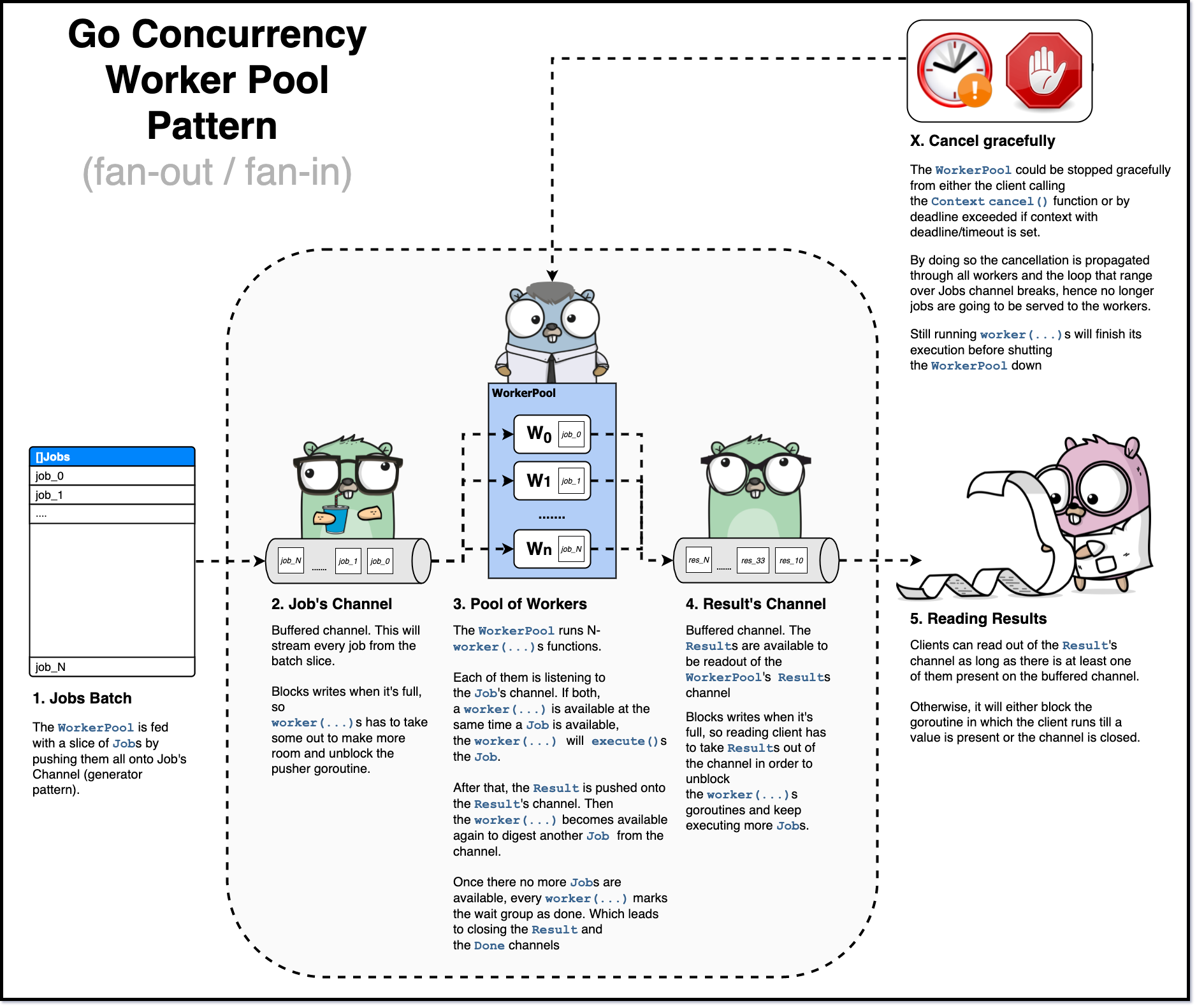
The following diagram illustrates this flow perfectly. A "Job Producer" sends tasks into a jobs channel. A pool of "Workers" (our gophers) consumes these jobs, processes them, and sends the outcomes to a results channel.

How to Implement Worker Pools in Go
For a clear definition and to understand the scenarios where this pattern shines, please read the introduction of the article "How to Implement Worker Pools in Go".
Read the sections "Understanding Worker Pools", "Why Use Worker Pools?", and "When to Use Worker Pools". This will solidify the purpose and benefits of this pattern, especially for the kinds of I/O-bound and batch-processing tasks common in DevOps.
2. The Anatomy of a Worker Pool
A typical worker pool in Go is built from a few key concurrency primitives we've already studied:
- Jobs Channel (
chan Job): A channel that acts as the task queue. The "producer" part of your application writes jobs to this channel. - Results Channel (
chan Result): A channel where workers send the outcome of their processing. The "consumer" part of your application reads from this. - Worker Goroutines: A fixed number of goroutines, each running a
workerfunction in a loop. sync.WaitGroup: Used to synchronize the main goroutine with the workers, ensuring the program doesn't exit before all jobs are processed.
Let's see how these components are structured in code.
#18 Golang - Building an Efficient Worker Pool: Mastering Concurrency in Go
The video "#18 Golang - Building an Efficient Worker Pool" provides a great, step-by-step walkthrough of creating the necessary structs and functions.
Watch from 01:09 to 04:18. This segment covers: (01:09) Defining a task struct (our job) and a workerPool struct that holds the channels and WaitGroup. (03:27) Implementing the worker method, which is the core logic for each worker. Notice the for range loop over the tasks channel and the use of wg.Done().
The core of the worker function is the for range loop over the jobs channel. This is an elegant and idiomatic Go pattern. The loop will automatically block until a job is available, and it will terminate when the channel is closed.
3. Orchestrating the Pool
Now that we have the components, let's orchestrate them to run a set of jobs. The process involves four main steps:
- Start the workers: Launch a fixed number of
workergoroutines. - Send the jobs: Loop through your tasks and send them to the
jobschannel. - Close the jobs channel: After sending all jobs, close the
jobschannel. This is a critical step that signals to the workers (in theirfor rangeloops) that no more work is coming. - Collect the results: Wait for all workers to finish and then read the results.
The following resource provides a complete, self-contained example of this orchestration.
How to Implement Worker Pools in Go
Let's return to the "How to Implement Worker Pools in Go" article. The main function in its basic example is a perfect template for orchestration.
Study the main function in the code block under the "Simple Worker Pool Structure" section. Pay close attention to this sequence: Workers are started and wg.Add(1) is called for each. Jobs are sent to the jobs channel. close(jobs) is called immediately after the job-sending loop. A separate goroutine is launched to wg.Wait() and then close(results). This prevents the main goroutine from deadlocking while it waits to read from the results channel. The final for range loop collects all the results.
The pattern of using a separate goroutine to Wait and close the results channel is crucial. If you tried to wg.Wait() in the main goroutine before reading the results, you would create a deadlock: the workers would be blocked trying to send results, and the main goroutine would be blocked waiting for the workers to finish.
4. A Practical Example: Checking Service Health
Let's ground this in a practical DevOps scenario: you need to build a tool that concurrently checks the status of a list of microservice endpoints. Spawning a goroutine for every single URL might work for a few, but for hundreds, a worker pool is the robust solution to limit concurrent network connections.
The video "WorkerPools in Go Tutorial" by TutorialEdge implements exactly this kind of I/O-bound worker pool. It uses a slightly different synchronization method, which is also valuable to see.
Watch from 01:49 to 11:15. Notice the flow: (01:49) Defining buffered channels for jobs and results. (02:36) Launching three worker goroutines. (03:22) The crawl function acts as the worker, making an http.Get request—a classic I/O-bound task. (06:59) Sending URLs to the jobs channel, closing it, and then reading a fixed number of results from the results channel. Note that this example reads a known number of results instead of using a WaitGroup. This works when you know the exact number of jobs, but a WaitGroup is more flexible for dynamic workloads.
5. Best Practices and Common Pitfalls
As with any concurrency pattern, there are common mistakes and best practices that ensure your implementation is robust and efficient.
Understanding the Worker Pool Pattern in Go
The GitHub guide "Understanding the Worker Pool Pattern in Go" provides an excellent summary of potential issues and best practices.
Read the sections "Common Issues and Pitfalls" and "Best Practices". Focus on these key takeaways: Pitfall: Deadlocks from unclosed channels. Always close the jobs channel. Best Practice: Control the number of workers. For CPU-bound tasks, a good starting point is runtime.NumCPU(). For I/O-bound tasks (like our health checks), you can use many more workers because they spend most of their time waiting. Best Practice: Graceful Shutdown. Using context.Context (as hinted at in the diagram above) allows you to signal workers to stop, which is essential for services that need to shut down cleanly. We will explore context in-depth in a future module.
Test your understanding!
You have been given the following worker pool code, which processes a list of file paths to get their sizes. However, it has a bug and will deadlock. Can you identify the bug and explain how to fix it?
package main

import (
	"fmt"
	"os"
	"sync"
)

func worker(id int, jobs <-chan string, results chan<- int64, wg *sync.WaitGroup) {
	defer wg.Done()
	for path := range jobs {
		info, err := os.Stat(path)
		if err != nil {
			results <- -1 // Indicate error
			continue
		}
		results <- info.Size()
	}
}

func main() {
	files := []string{"file1.txt", "file2.txt", "nonexistent.txt"} // Assume file1 and file2 exist
	// Create dummy files for testing
	_ = os.WriteFile("file1.txt", make([]byte, 100), 0644)
	_ = os.WriteFile("file2.txt", make([]byte, 250), 0644)
	defer os.Remove("file1.txt")
	defer os.Remove("file2.txt")

	numJobs := len(files)
	jobs := make(chan string, numJobs)
	results := make(chan int64, numJobs)
	var wg sync.WaitGroup

	// Start workers
	for w := 1; w <= 2; w++ {
		wg.Add(1)
		go worker(w, jobs, results, &wg)
	}

	// Send jobs
	for _, file := range files {
		jobs <- file
	}

	// THE BUG IS RELATED TO THIS AREA

	wg.Wait()
	close(results)

	// Collect results
	for r := range results {
		fmt.Printf("Result: %d\n", r)
	}
}
Show answer
The bug is the missing close(jobs) call after all jobs have been sent.
Explanation:
The worker goroutines are stuck in their for path := range jobs loop. They have processed all the jobs sent to the channel, but the channel is still open, so they are now blocked, waiting for more jobs to arrive.
Because the workers are blocked, they never call wg.Done(). As a result, the wg.Wait() call in the main goroutine will block forever, waiting for the WaitGroup counter to become zero. This is a classic deadlock.
The Fix:
You must close the jobs channel after you have finished sending all the jobs. This signals to the workers that no more jobs are coming, allowing their for range loops to terminate gracefully.
Add this line after the job-sending loop:
// Send jobs
for _, file := range files {
    jobs <- file
}

close(jobs) // <-- THIS IS THE FIX

wg.Wait()
close(results)
With this change, the program will run correctly and terminate as expected.
Conclusion
Congratulations on completing the Essential Concurrency Patterns module! You've just built a worker pool, combining everything you've learned about goroutines, channels, and synchronization primitives into a powerful, practical, and highly reusable pattern.
Key Takeaways:
- A worker pool is a pattern for controlling concurrency by processing tasks from a queue with a fixed number of goroutines.
- It is built using channels for
jobsandresults, a pool ofworkergoroutines, and async.WaitGroupfor coordination. - Closing the
jobschannel is essential to signal workers to stop. - A separate goroutine should be used to
Waiton theWaitGroupand thenclosetheresultschannel to prevent deadlocks. - The number of workers should be tuned based on whether the task is CPU-bound or I/O-bound.
Next Up
You now have a solid foundation in Go's most important concurrency patterns. In our next module, "Interacting with Web Services and APIs," we will shift our focus to networking. You'll learn how to use Go's standard library to make HTTP requests, parse JSON from API responses, and build reusable clients for services like GitHub or GitLab—skills that are central to modern DevOps automation. The I/O-bound worker pool we built today is a perfect pattern for interacting with those APIs at scale.