Здравствуйте!
In our last lesson, we focused on the practical skill of typing in Russian. You learned about the different keyboard layouts and practiced using the phonetic layout to type your first Russian words. This skill is essential for using Russian in any digital context.
Today, we complete our foundational module by tackling what is arguably the most important aspect of Russian pronunciation: word stress. The learning outcome for this lesson is to be able to read simple Russian words aloud with correct stress placement.
Mastering stress is the key to being understood. Unlike in English, where misplaced stress might just sound a little odd, in Russian, it can change the sound of a word so much that a native speaker might not understand you at all. It also governs the rules of vowel reduction, which we touched on in a previous lesson. Let's dive in!
1. What is Russian Stress and Why is it Crucial?
In any Russian word with more than one syllable, one—and only one—syllable is emphasized. This is the stress, or ударе́ние (udaréniye). This stressed syllable is pronounced longer, louder, and more clearly than the others.
To understand why this is so critical, let's start with a short, clear video.
EVERYTHING you need to know about Russian stress in 5 minutes
The video 'EVERYTHING you need to know about Russian stress in 5 minutes' from the Real Russian Club channel provides an excellent introduction. It explains how stress affects pronunciation and can even change the meaning of a word.
Please watch from the beginning until 02:55. Focus on two key points: How Russian stress is stronger and more emphatic than in English. The examples of 'homographs'—words that are spelled the same but have different meanings based on stress.
As the video highlighted, getting the stress wrong can completely change a word's meaning. Here are the examples from the video, which are worth reviewing:
| Stressed on 1st Syllable | Stressed on 2nd Syllable |
|---|---|
| за́мок (zá-mak) - castle | замо́к (za-mók) - lock |
| му́ка (mú-ka) - suffering, torment | мука́ (mu-ká) - flour |
| а́тлас (át-las) - atlas (book of maps) | атла́с (at-lás) - satin (fabric) |
This is why you must learn the stress as part of learning any new Russian word.
2. The Unpredictable Nature of Stress
So, how do you know which syllable to stress? Here's the challenge: Russian stress is unpredictable. There are very few reliable rules to predict where the stress will fall in a word. It can be on the first, last, or any middle syllable.
This might sound daunting, but there are practical ways to manage it. Let's watch the rest of that video to see the solution.
EVERYTHING you need to know about Russian stress in 5 minutes
The second half of the video discusses how to deal with the unpredictable nature of stress.
Please watch from 02:55 to the end. Pay attention to the main takeaway for beginners: you must look up the stress for each new word.
The key strategy is simple: when you learn a new word, you must also learn its stress. All good dictionaries, apps, and learning materials (including this course) will mark the stress for you, usually with an acute accent mark (´) over the stressed vowel.
3. How Stress Changes Vowel Sounds: Vowel Reduction
Here is where everything comes together. The position of the stress determines how the vowels in a word are pronounced.
- The stressed vowel is pronounced clearly and fully.
- Unstressed vowels are "reduced"—they become shorter, less clear, and often change their sound.
You've already been introduced to the most important rule of vowel reduction: an unstressed 'о' is pronounced like an 'а'. The following video provides a great walkthrough of this and other key reduction rules.
Tips on Russian pronunciation, stressing and intonation
The channel 'Learn Russian with Denis Fedorov' has a helpful video on pronunciation. We will watch a few key clips that break down vowel reduction.
Please watch the following segments: 02:38 - 03:29: This part details how unstressed 'o' is pronounced as 'a', using the word 'голова' (head) as a great example. 03:29 - 03:45: This short clip introduces another rule: unstressed 'е' is pronounced like 'и'. 03:45 - 04:32: This segment explains the general principle of pronouncing unstressed vowels shorter.
To visualize this, let's look at a classic example: the word молоко́ (milk). It's spelled with three 'o's, but only the last one is stressed.
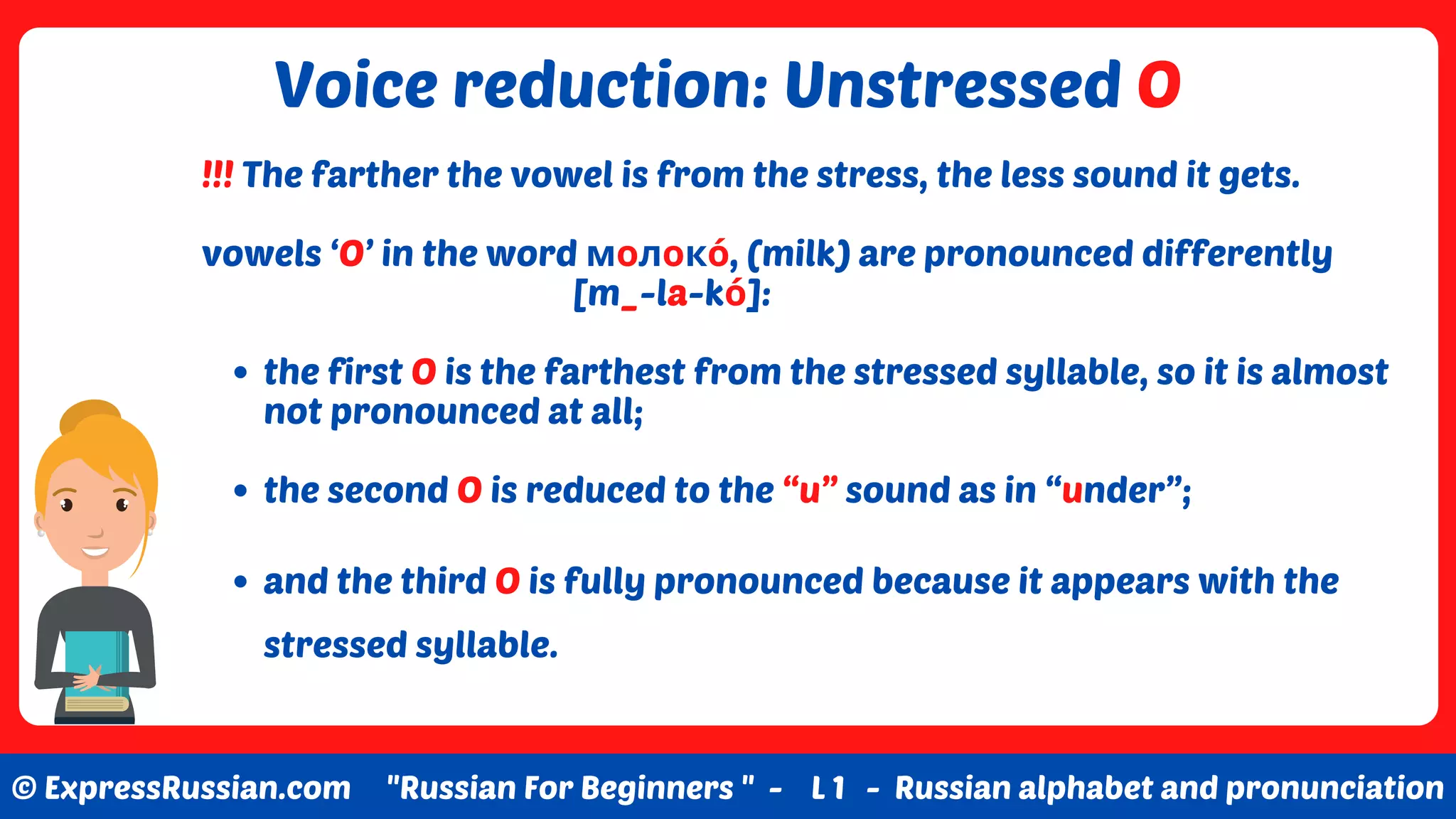
Here is a summary of the most common vowel reduction rules you need to know:
| Vowel | In a Stressed Syllable | In an Unstressed Syllable | Example | Pronunciation |
|---|---|---|---|---|
| О | Sounds like [o] | Sounds like [a] | хорошо́ (good) | [ха-ра-шо́] |
| Е | Sounds like [ye] | Sounds like [i] | телефо́н (telephone) | [ти-ли-фо́н] |
| Я | Sounds like [ya] | Sounds like [i] | язы́к (language) | [и-зы́к] |
Note: The reduction of Е and Я to [i] is a very common simplification for learners. The actual sound can be a bit more complex, but thinking of it as [i] will make your pronunciation much more natural.
4. The One Golden Rule: The Letter Ё
While most stress is unpredictable, there is one letter you can always count on.
Tips on Russian pronunciation, stressing and intonation
Let's return to the video from 'Learn Russian with Denis Fedorov' for one last, very important rule.
Please watch from 13:18 to 15:16. This section explains the 'golden rule' of Russian stress.
As the video explains, the letter Ё (ё) is always stressed. You will never see a stress mark over it because it's automatic.
The video also points out a tricky real-world issue: native speakers often write the letter 'е' when the sound is actually 'ё'. For example, they might write еще instead of ещё (yeshchyó - more/still). As a learner, it is excellent practice to always write and type the letter 'ё' with its dots to remind yourself of the pronunciation and stress.
5. Practice Reading Aloud
Now, let's put it all into practice. Read the following words aloud. I have marked the stress and provided a pronunciation guide in brackets showing the effects of vowel reduction. Try to say the word first by just looking at the Russian, then check your pronunciation with the guide.
- спаси́бо [спа-си́-ба] - thank you
- хорошо́ [ха-ра-шо́] - good
- вода́ [ва-да́] - water
- пого́да [па-го́-да] - weather
- кни́га [кни́-га] - book
- язы́к [и-зы́к] - language
- Росси́я [ра-си́-я] - Russia
- инжене́р [ин-жэ-н'е́р] - engineer
- игра́ [иг-ра́] - game
- рисова́ть [ри-са-ва́т'] - to draw
- актёр [ак-т'о́р] - actor (notice the 'ё'!)
- компью́тер [кам-п'ю́-тэр] - computer
Spend some time saying these words. Tap out the syllables, making a stronger tap for the stressed one. This will help you feel the rhythm of the language.
Conclusion
Congratulations on completing the final lesson of our foundational module! You've tackled the core components of reading and pronouncing Russian.
Key Takeaways:
- Russian words have only one stressed syllable, which is pronounced more strongly and clearly.
- Stress is unpredictable and must be learned with each new word.
- Unstressed vowels are reduced: the most important rules are that unstressed о sounds like а, and unstressed е and я sound like и.
- The letter ё is always stressed.
You now have a solid base in the mechanics of Russian. In our next lesson, we will begin Module 2, "First Encounters," and use these skills in a practical, conversational context. We'll start by learning how to greet people, which involves understanding the crucial difference between the formal вы (vy) and the informal ты (ty).