Здравствуйте!
Welcome back. In our last lesson, we covered how to use numbers 2, 3, and 4 in Russian, which required the noun to be in the genitive singular (e.g., два стола). You might have been wondering what happens with all the other numbers. Today, we'll complete the picture.
This lesson focuses on using numbers 5 and higher, as well as common quantity words like много (many) and мало (few). By the end of our session, you will be able to correctly count any number of objects, a skill you'll use constantly in Russian.
1. The Second Big Rule: Numbers 5+ and the Genitive Plural
Where numbers 2, 3, and 4 use the genitive singular, numbers from 5 upwards use the genitive plural. This rule applies to numbers 5-20, and then to any number ending in 5, 6, 7, 8, 9, or 0 (like 25, 30, 107).
Let's see the full pattern with a simple example:
- 1 + Nominative Singular:
один друг(one friend) - 2, 3, 4 + Genitive Singular:
два друга(two friends) - 5+ + Genitive Plural:
пять друзей(five friends)
To solidify this core concept, let's look at a clear written explanation.
У меня шесть друзей. - I have six friends.
This article provides a fantastic breakdown of the rule using the word 'friend' (друг) to clearly illustrate the shift from genitive singular to genitive plural.
Please read the section that begins with 'Why is it друзей and not друзья or друга?'. Focus on the bulleted list that breaks down the pattern for 1, 2-4, and 5+ friends. The summary table near the end is also a great quick reference.
2. Forming the Genitive Plural
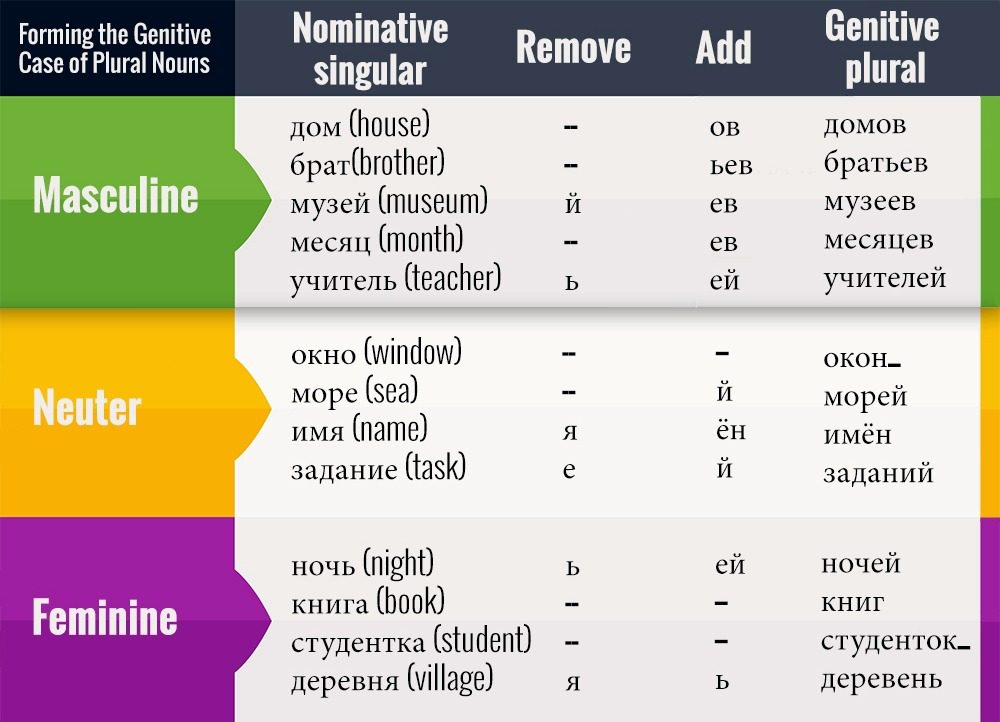
To apply this rule, you need to know how to form the genitive plural of a noun. This is a new set of endings, but they follow predictable patterns.
Here's a summary of the most common endings:
| Gender & Ending | Genitive Plural Ending | Example (Nom. Sing. -> Gen. Pl.) |
|---|---|---|
| Masculine (ends in a consonant) | -ов |
стол -> столов (tables) |
Masculine (ends in -й, -ь) |
-ев or -ей |
музей -> музеев (museums) |
Feminine (ends in -а) |
zero ending (remove -а) |
книга -> книг (books) |
Feminine (ends in -я) |
-ь |
неделя -> недель (weeks) |
Neuter (ends in -о) |
zero ending (remove -о) |
слово -> слов (words) |
Neuter (ends in -е) |
-ей |
море -> морей (seas) |
Note on "Zero Endings": When an ending like -а or -о is removed, it sometimes leaves a difficult-to-pronounce cluster of consonants. In these cases, a "filler vowel" (-о- or -е-) is inserted. For example, девушка (girl) becomes девушек, not девушк. You'll get a feel for this over time.
This chart provides more great examples to help you visualize these changes.
3. Quantity Words: Много and Мало
The genitive plural isn't just for numbers. It's also used after words that describe an indefinite quantity. The most important ones for you to know now are:
- много (mnogo) - a lot, many
- мало (malo) - a little, few
- сколько (skol'ko) - how many?
- несколько (neskol'ko) - several, a few
Examples:
много книг- many booksмало времени- little time (время is an irregular noun)Сколько у вас вопросов?- How many questions do you have?несколько интересных игр- several interesting games
This brief reading will reinforce the use of these quantity words.
A Complete Guide to the Russian Genitive Case
The same genitive plural rule applies to these common quantity words. This guide provides a concise list and examples.
Scroll down to the heading '5. Numbers + Quantitative Descriptions'. Read the short list that begins with 'Ско́лько + чего́ / кого́?'. Notice how 'много', 'мало', and the other words all require the noun to be in the genitive plural.
4. Putting It All Together: The Complete System
Now we can combine everything you've learned. How do we handle numbers like 12, 13, 14 (which were exceptions in the last lesson) and compound numbers like 21, 22, 25?
Here's the full system:
-
Rule for 21+: The noun agrees with the last number in the phrase.
двадцать **один** стол(21 tables) - ends in 1 -> nom. singularдвадцать **два** стола(22 tables) - ends in 2 -> gen. singularдвадцать **пять** столов(25 tables) - ends in 5 -> gen. plural
-
Rule for 11-19: These numbers are special. They all behave like 5+ and take the genitive plural.
одиннадцать столов(11 tables)двенадцать столов(12 tables)четырнадцать столов(14 tables)
This video explains this complete system very clearly.
ГОДА или ЛЕТ? ЧАСА или ЧАСОВ? - Genitive with numbers
Let's watch a detailed breakdown of how all numbers—including the teens and compound numbers—work with nouns.
Watch from 03:59 to 09:07. The first two minutes recap the 5+ rule. The crucial part begins at 05:58, where she explains that numbers 11-19 all use the genitive plural, and that for numbers 21 and up, you simply look at the last digit to choose the correct rule.
5. Practice
Let's test your understanding. Combine the number or quantity word with the noun in parentheses. Remember to form the genitive plural correctly.
- 5 + (
машина- car, f.) - 10 + (
доллар- dollar, m.) много+ (человек- person, irregular)- 12 + (
месяц- month, m.) - 38 + (
студент- student, m.)
Click for answers
пять машиндесять долларовмного людей(Человек has an irregular plural,люди, and its genitive plural isлюдей.)двенадцать месяцевтридцать восемь студентов
Conclusion
Congratulations! You now have the complete set of rules for counting objects in Russian. This is a major step forward.
Key Takeaways:
- Numbers 5 and up (including 11-19) and quantity words (
много,мало,сколько) require the noun to be in the genitive plural. - Forming the genitive plural involves specific endings like
-ов,-ей, or a "zero ending." - For compound numbers (21+), the noun form is determined by the last digit in the number.
Preview of the next lesson:
In our next lesson, we'll immediately apply this knowledge to a very practical topic: asking for and stating your age. You'll learn the construction Мне ... лет/год/года, which directly uses the number rules we've covered today and in the previous lesson. For example, the word лет is the genitive plural of год (year), used after numbers 5 and up