Здравствуйте!
In our last two lessons, we assembled the complete system for counting objects in Russian, covering how nouns change after numbers like 1, 2-4, and 5+. Today, you'll see this knowledge pay off as we apply it to one of the most common questions in any language: "How old are you?".
By the end of this lesson, you will be able to ask for and state your age using the construction Мне ... лет/год/года. This combines the number rules you just learned with a new application of the dative case, which you've seen before with phrases like мне нравится (I like).
Let's start by looking at the core question and the puzzle it presents.
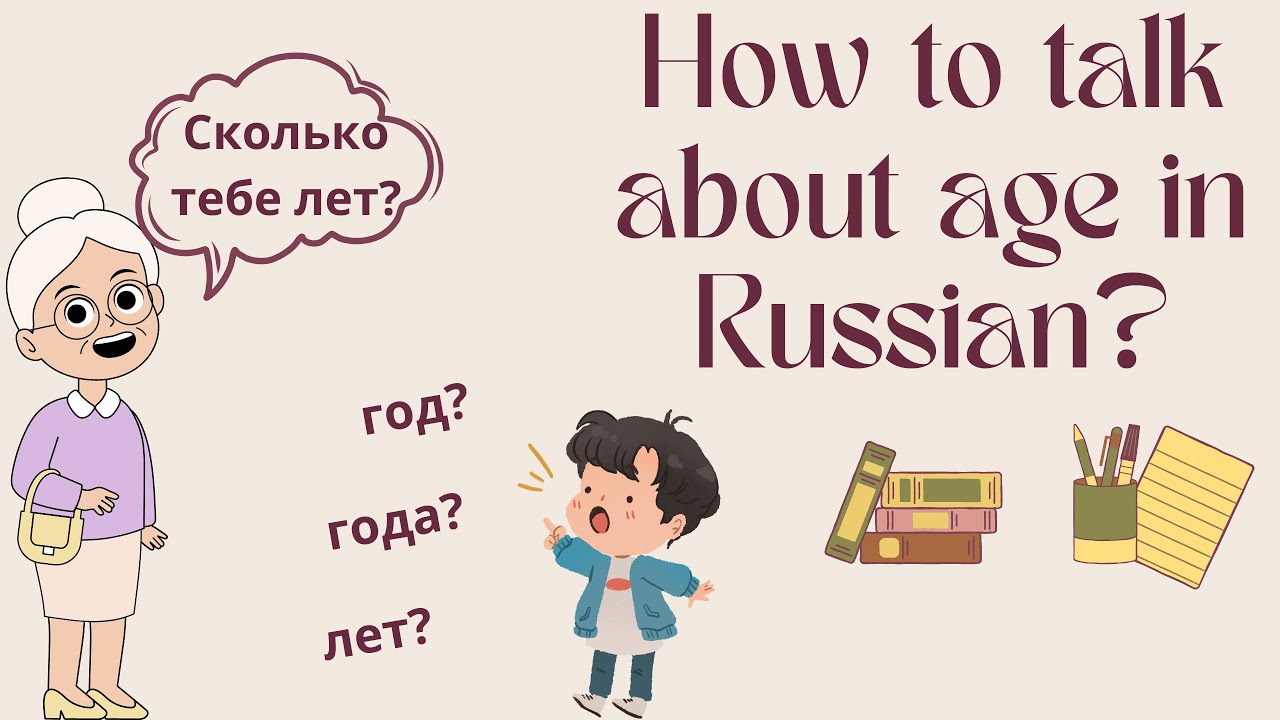
1. "How many years to you?" - The Dative Case
In English, we say "I am 20 years old." In Russian, the logic is different. You say that 20 years are attributed to you. This is why, instead of the nominative pronouns (я, ты), you'll use the dative case (мне, тебе).
The question is:
- Ско́лько тебе́ лет? (Skól'ko tebyé let?) - How old are you? (informal, to 'ты')
- Ско́лько Вам лет? (Skól'ko Vam let?) - How old are you? (formal or plural, to 'вы')
The literal translation is "How many years to you?". This video explains this concept and provides the full set of dative pronouns you'll need.
Expressing Age in Russian with Dative Case Pronouns
This video, 'Expressing Age in Russian with Dative Case Pronouns,' clearly explains the 'to someone' logic and provides a handy list of all the dative personal pronouns.
Watch from the beginning to 01:17. Pay close attention to the list of nominative vs. dative pronouns. You've seen some of these before, but it's a great refresher.
Here is that list for your reference. You'll use these to talk about anyone's age.
| Nominative (Who?) | Dative (To whom?) |
|---|---|
| я (I) | мне (to me) |
| ты (you, inf.) | тебе́ (to you) |
| он (he) | ему́ (to him) |
| она́ (she) | ей (to her) |
| мы (we) | нам (to us) |
| вы (you, form.) | вам (to you) |
| они́ (they) | им (to them) |
2. The Answer: Using год, года, and лет
Now for the answer. This is where your new knowledge of number rules comes directly into play. The structure is:
[Dative Pronoun] + [Number] + [Correct form of 'year']
The word for 'year' is год. Its form changes based on the number, exactly following the rules from our previous lessons.
- год is used after numbers ending in 1 (except 11). This is the nominative singular form.
- го́да is used after numbers ending in 2, 3, or 4 (except 12, 13, 14). This is the genitive singular.
- лет is used after numbers ending in 5, 6, 7, 8, 9, 0 and for all teens (11-19). This is the genitive plural (an irregular one!).
Let's watch a video that puts it all together.
Lesson 28: RUSSIAN basics: AGE in Russian. ГОД, ГОДА vs ЛЕТ | Russian Comprehensive
The video 'RUSSIAN basics: AGE in Russian' from Russian Comprehensive walks through this rule with clear, practical examples for each number ending.
Please watch from 02:15 to 04:30. The speaker breaks down the rule for 'лет', then 'года', and finally 'год'.
To reinforce this, the table in the following resource provides a perfect summary.
This article, 'How old are you? in Russian,' contains a simple and effective table that summarizes which form of 'год' to use.
Please read the section titled 'Answers'. Focus on the table that shows the rule for the last digit of the age and look at the examples provided below it.
Here are some examples putting it all together.
- Мне 21 год. (I am 21 years old.)
- Ему́ 33 го́да. (He is 33 years old.)
- Ей 15 лет. (She is 15 years old.)
- Им 40 лет. (They are 40 years old.)
This image provides a final, simple visual summary of the rule in action.

3. Practice
Now, let's try it out. As a university student, you are likely around 20 or 21. How would you state these ages in Russian?
- How do you say, "I am 20 years old"?
- How do you say, "I am 21 years old"?
- Your friend is 23. How do you say, "He is 23 years old"?
- You're asking a professor their age respectfully. What do you ask?
Click for answers
- Мне два́дцать лет. (The number 20 ends in 0, so we use
лет.) - Мне два́дцать оди́н год. (The number 21 ends in 1, so we use
год.) - Ему́ два́дцать три го́да. (The number 23 ends in 3, so we use
го́да.) - Ско́лько Вам лет? (Using the formal/respectful
Вам.)
Conclusion
Well done! You have successfully learned a very important and practical conversational skill. This lesson was a great way to consolidate your knowledge of numbers and cases.
Key Takeaways:
- To ask someone's age, you use Ско́лько тебе́/Вам лет?
- To state an age, you use a dative pronoun (мне, ему́, ей, etc.) + the number.
- The word for "year" changes based on the last digit of the age:
- Ends in 1 (but not 11): год
- Ends in 2, 3, 4 (but not 12, 13, 14): го́да
- Ends in 5-9, 0, or is 11-19: лет
Preview of the next lesson:
This lesson concludes our module on the genitive case. We are now ready to move on to a new major topic: verb tenses and aspect. In our next lesson, we will begin by learning fundamental time expressions like вчера́ (yesterday), сего́дня (today), and за́втра (tomorrow) as we prepare to talk about the past and future.