Здравствуйте!
In our last lesson, we learned how to count from 21 to 100 and beyond. Now it's time to put those numbers to use. What's the difference between saying "one book," "two books," and "five books"? As you'll see, Russian has a fascinating and specific system for this.
Today, we'll focus on the first part of this system: how to combine nouns with the numbers два (two), три (three), and четыре (four). This is a fundamental rule in Russian grammar that differs significantly from English, and mastering it will make your speech sound much more natural.
1. The Core Rule: 2, 3, 4 + Genitive Singular
Let's start with the main idea. In Russian, when you have two, three, or four of something, the noun that follows is not in the plural form as you might expect. Instead, it goes into the genitive singular case.
This might seem counterintuitive at first—using a singular form for multiple items—but it's a crucial rule. To see it in action, let's watch a short explanation.
Russian Cases - Nouns after два/две, три, четыре
This video from the 'Russian grammar' channel clearly introduces the concept that nouns after 'два/две', 'три', and 'четыре' take the genitive singular form.
Watch from the beginning to 00:50. Notice how the noun endings for 'suitcase' and 'book' change after the numbers 2 and 3, and how they match the genitive singular form.
2. A Quick Genitive Singular Refresher
You've already encountered the genitive singular case when you learned to express absence with нет (e.g., у меня нет брата - I don't have a brother). The same endings apply here.
Here is a chart to refresh your memory on how to form the genitive singular.
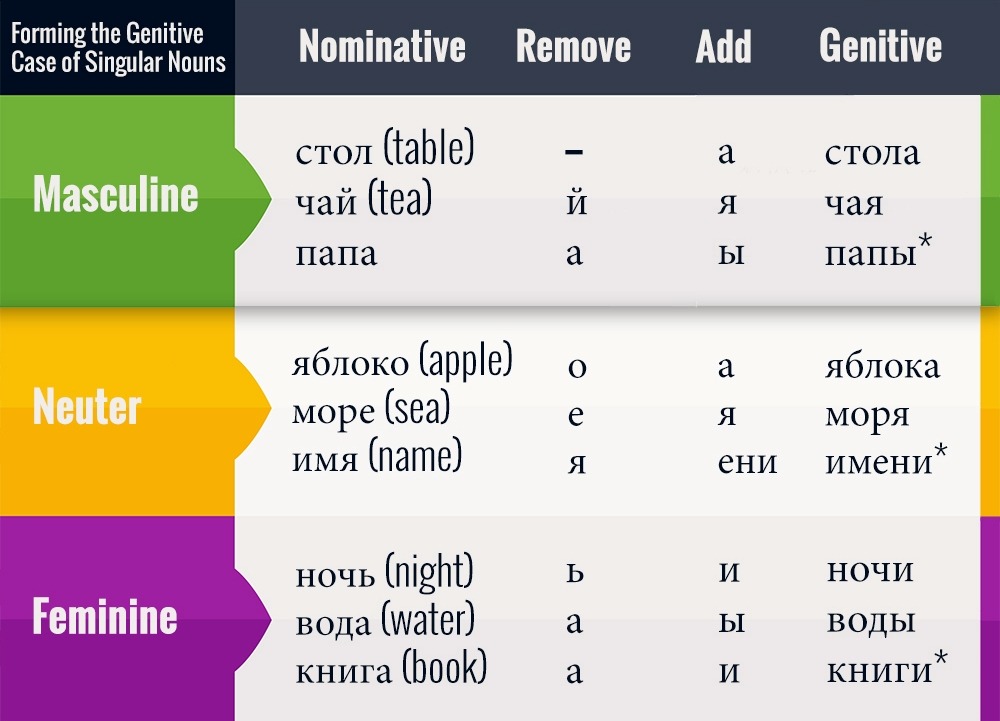
3. Два vs. Две: A Gender Distinction
One important detail concerns the number two. It has two forms that depend on the gender of the noun it describes:
- Два is used for masculine and neuter nouns.
- Две is used for feminine nouns.
The numbers три (3) and четыре (4) have only one form for all genders.
Let's see how this works:
| Nominative Singular | With Number 2 | With Number 3 | With Number 4 |
|---|---|---|---|
(m) один стол (one table) |
два стол**а** |
три стол**а** |
четыре стол**а** |
(f) одна книга (one book) |
две книг**и** |
три книг**и** |
четыре книг**и** |
(n) одно окно (one window) |
два окн**а** |
три окн**а** |
четыре окн**а** |
As you can see, стол (m) and окно (n) use два, while книга (f) uses две. All the nouns (стола, книги, окна) are in the genitive singular.
4. Compound Numbers (22, 33, 104...)
This rule isn't just for the numbers 2, 3, and 4. It applies to any compound number that ends in 2, 3, or 4. The grammar follows the last word in the number phrase.
- 22 students =
двадцать **два** студент**а** - 43 books =
сорок **три** книг**и** - 104 words =
сто **четыре** слов**а**
However, there's a key exception! This rule does not apply to the numbers 12, 13, and 14. This is because their words (двенадцать, тринадцать, четырнадцать) don't end in два, три, or четыре. We will cover the rule for these numbers in the next lesson.
This video segment explains both the compound number rule and the exception for the "teens."
Russian Cases - Nouns after два/две, три, четыре
Let's continue with the same video to see how this rule extends to larger numbers and where it doesn't apply.
Watch from 00:50 to 01:34, and then from 01:57 to 02:32. The first part explains how compound numbers like '132' work. The second part clarifies why '12', '13', and '14' are exceptions to this rule.
This concept is also summarized well in this text.
This page from RussianLessons.net provides a clear, text-based summary of the rule. Reading it will help solidify your understanding.
Read the section under the heading 'Numbers ending in : 2,3,4'. It gives several clear examples. Then, look at the summary table under 'So in summary...' to see the rule in a simple format.
5. Time to Practice
Now, let's put it all together. Try to form the correct phrases for the following. Remember to choose between два and две and to use the genitive singular ending for the noun.
- 2 +
карандаш(pencil, m.) - 3 +
ручка(pen, f.) - 4 +
письмо(letter, n.) - 32 +
дом(house, m.) - 24 +
машина(car, f.)
Click for answers
два карандаш**а**три ручк**и**четыре письм**а**тридцать два дом**а**двадцать четыре машин**ы**
Conclusion
Great work! You've just learned one of the most distinctive rules in Russian grammar for counting.
Key Takeaways:
- After the numbers 2, 3, and 4, the noun must be in the genitive singular.
- The number "two" has two forms:
дваfor masculine/neuter nouns andдвеfor feminine nouns. - The rule applies to any compound number ending in 2, 3, or 4 (e.g., 22, 53, 104).
- The rule does not apply to 12, 13, and 14.
Preview of the next lesson:
You might be wondering what happens with numbers like 5, 10, or 25. In our next lesson, we will cover the rule for numbers ending in 5 through 0, which uses the genitive plural. Once you have that, you'll be able to count any number of objects in Russian