Welcome to the first lesson of our second module. Having established a solid foundation in systems thinking, we are now ready to delve into the history and core concepts of the field that most interests you: cybernetics. In the previous module, we concluded by seeing how a system's structure fundamentally determines its behavior over time, and we glimpsed the cybernetic ideal of designing structures that produce adaptive and stable behavior.
This lesson will trace the origins of that ideal. We will explore the specific historical circumstances of the 1940s that gave birth to cybernetics, focusing on the pivotal work of the mathematician Norbert Wiener and the legendary Macy Conferences where this new science was forged. Understanding this origin story is not just an academic exercise; it reveals the intellectual and philosophical motivations that drove the field and which later inspired ambitious undertakings like Project CyberSyn.
A Science Forged in War
Like many transformative technologies and ideas of the 20th century, cybernetics has its roots in World War II. The war presented complex problems that defied traditional, single-discipline solutions. One such problem was how to improve the accuracy of anti-aircraft guns against fast, evasive enemy planes.
This task was assigned to one of the leading mathematicians of the era, Norbert Wiener. To hear the story of his involvement and the intellectual climate of the time, please watch this first video segment featuring Stafford Beer, a central figure in management cybernetics whom we will encounter frequently.
Cybernetics, History & Origins 1994
In this clip from a 1994 lecture, Stafford Beer introduces Norbert Wiener and the context of his wartime work.
Watch the segment from the introduction to Norbert Wiener. Pay attention to how the practical problem of tracking an aircraft requires a theory of feedback and prediction, and note the crucial, interdisciplinary friendship between Wiener (a mathematician) and Arturo Rosenbluth (a neurophysiologist).
This collaboration between a mathematician studying automated systems and a physiologist studying the nervous system was the seed of cybernetics. They began to suspect that the principles governing a machine trying to achieve a goal and an animal trying to do the same might be fundamentally identical. This led them, along with engineer Julian Bigelow, to publish a landmark paper in 1943 titled "Behavior, Purpose, and Teleology," which sought to explain purposeful, goal-seeking behavior in purely mechanistic, non-mystical terms using the concept of feedback.
The Spark of Unification: A Famous Anecdote
The idea that the engineering of machines and the biology of animals shared deep, universal principles was revolutionary. It suggested that a new, unified science was waiting to be discovered. A famous story, which you will now hear from Stafford Beer, perfectly captures the electrifying moment of this discovery.
What is Cybernetics? Conference by Stafford Beer
In this video, Stafford Beer recounts the "shiver down the spine" story that illustrates the convergence of ideas at the heart of cybernetics.
Please watch this phenomenal anecdote, from the beginning of the story to its mind-bending conclusion. The story involves three key steps: An engineer designs a schematic for a machine to help blind people read. A neuroanatomist recognizes the schematic as a diagram of the brain's visual cortex. Norbert Wiener mathematically analyzes the diagram and calculates its operating frequency, which turns out to be the brain's "alpha rhythm." Focus on how this single event brought together electronics, neuroanatomy, and mathematics, revealing a common structure for a common function in both a machine and an animal.
This story is more than just a historical curiosity; it is the genesis myth of cybernetics. It demonstrates in the most powerful way possible the core belief that abstract principles of organization, communication, and control exist independently of their physical embodiment, whether in metal and wires or in flesh and neurons.
The Macy Conferences: A Crucible for a New Science
The intellectual excitement sparked by these discoveries led to one of the most famous series of academic meetings in the 20th century. Between 1946 and 1953, the Josiah Macy, Jr. Foundation sponsored a set of ten conferences to explore these new ideas.
[PDF] A Short History of Cybernetics in the United States - CORE
This introductory section from a paper by Stuart Umpleby sets the scene for the conferences.
Please read the first three paragraphs, from The Origin of Cybernetics. Note the original, descriptive title of the conferences and how they were later renamed.
Initially titled "Circular Causal and Feedback Mechanisms in Biological and Social Systems," these meetings brought together an extraordinary group of leading thinkers from a dizzying array of fields: mathematicians like John von Neumann, anthropologists like Margaret Mead and Gregory Bateson, physicists, psychiatrists, and engineers. Their goal was to create a common language to discuss the principles of regulation and communication that they were all observing in their disparate fields.
The conferences were finally given a name in 1949, following the 1948 publication of Norbert Wiener's foundational book.

Wiener coined the term cybernetics from the Greek word kubernetes, meaning "steersman" or "governor." The choice was deliberate. It was meant to evoke the image of a helmsman steering a ship—not through brute force, but through a continuous process of observation, correction, and adjustment, navigating a complex and unpredictable environment to reach a desired goal. This is the essence of feedback control.
An Experiment in Interdisciplinary Science
The Macy Conferences were legendary for their intellectual ferment and, at times, their sharp disagreements. They were a true experiment in breaking down disciplinary walls. To get a feel for who was there and the kinds of topics they wrestled with, you can explore the following detailed resource from the American Society for Cybernetics.
Summary: The Macy Conferences - American Society for Cybernetics
This document provides a detailed chronological account of the ten Macy Conferences. It's a rich but dense resource, so we will focus on a few key points.
First, scroll down to the heading PART 1 and skim the list of the ten conferences. You don't need to read every detail. Just get a sense of the cast of characters. You'll see names like Wiener, von Neumann, Bateson, Mead, and McCulloch, but also W. Ross Ashby and Claude Shannon, whose crucial work we will study in later modules. Read the entry for the 1st Conference more closely. This describes the inaugural meeting and the foundational presentations by Wiener (on self-regulation) and von Neumann (on computers). Now, find the entry for the 6th Conference. Look for the bullet point that describes how Heinz von Foerster recommended adopting the label "cybernetics" for the conferences, and Wiener's emotional reaction. This is the moment the movement gets its official name.
As you can see, the conferences were a dynamic and sometimes contentious forum. The "hard scientists" like the mathematicians and engineers often clashed with the "soft scientists" like the psychiatrists and anthropologists over standards of rigor and evidence. Yet, it was precisely in this intellectual friction that new ideas were generated.
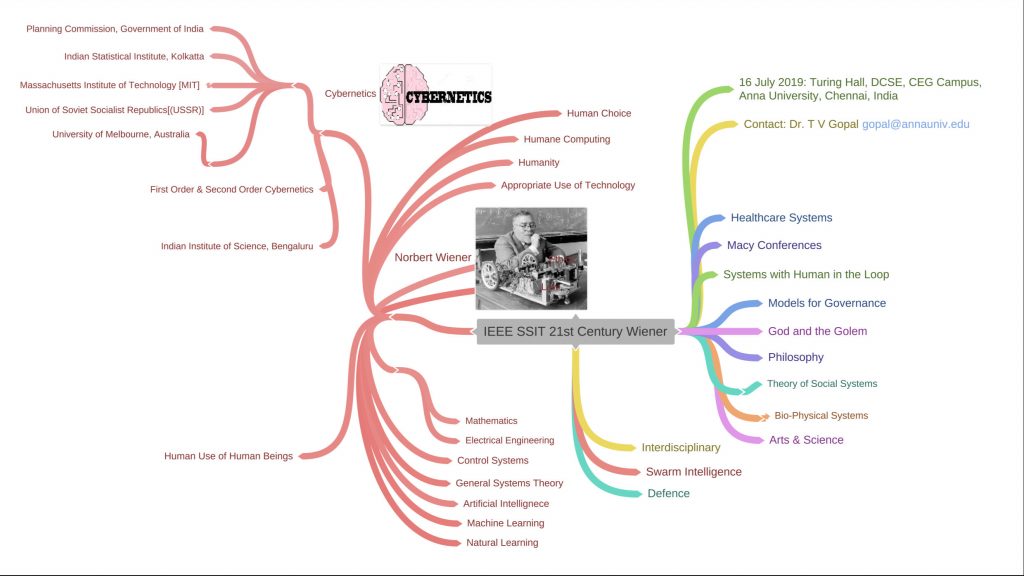
Ultimately, the Macy Conferences did not produce a single, unified theory. As Margaret Mead later reflected, after the conferences, "the whole thing fragmented." The various participants returned to their home disciplines, taking the cybernetic ideas with them. The computer scientists focused on artificial intelligence, the engineers on control systems, the anthropologists on social systems, and so on. This course, in many ways, is an attempt to reconstruct that original, holistic vision.
Conclusion
In this lesson, we have journeyed back to the 1940s to witness the birth of cybernetics. We've seen how a new science was catalyzed by the pressures of war and brought into being by a unique group of interdisciplinary thinkers.
Here are the key takeaways:
- Cybernetics emerged from wartime problem-solving, specifically Norbert Wiener's work on anti-aircraft systems, which required a deep understanding of feedback, prediction, and control.
- The field was founded on the revolutionary idea that common principles of control and communication apply to both machines and living organisms.
- The Macy Conferences (1946-1953) were the crucible where these ideas were debated and developed by a remarkable group of thinkers from mathematics, engineering, biology, and the social sciences.
- Norbert Wiener named the field in his 1948 book, Cybernetics: Or Control and Communication in the Animal and the Machine, defining its scope and giving the nascent movement a banner to rally under.
Now that we understand the historical context of why and how cybernetics emerged, we can proceed to define its core ideas more precisely. In our next lesson, we will do just that, formally exploring Wiener's definition of cybernetics and a concept that lies at its very heart: circular causality.