Welcome to the final lesson of our first module on the foundations of systems thinking. In our last session, we developed the crucial skill of identifying the two fundamental engines of system dynamics: reinforcing and balancing feedback loops. We saw how these circular patterns of causality appear everywhere, from engineering to biology and even art.
This lesson brings all the concepts of this module together to address a core principle: describing how a system's structure determines its behavior over time. Understanding this link is what elevates systems thinking from a simple descriptive tool to a powerful predictive and diagnostic one. It is the key to understanding how a system like Project CyberSyn could even be conceived—by assuming that if you design the right structure, you can generate the desired behavior.
The Iceberg and the Illusion of Events
We live in a world of events. A product launch is a success. The stock market crashes. A project falls behind schedule. Our natural tendency is to react to these events directly. However, systems thinking encourages us to look deeper.
A powerful metaphor for this is the "iceberg model." The events we see are just the tip of the iceberg. Beneath the surface lie the patterns of behavior that produce these events, and deeper still is the systemic structure that generates those patterns.
To truly understand a system, we must understand its structure. Let's explore this principle further.
Beyond the Tip of the Iceberg: Using Systems Archetypes ...
This article introduces the Iceberg Model as a way to conceptualize the different levels of a system.
Please read the section that begins with the introduction to the iceberg model. Pay close attention to the hierarchy: Mental Models -> Structure -> Patterns -> Events. The key insight is that the lower, hidden levels generate what we see at the top.
The article emphasizes that our traditional, reductionist approaches often focus only on the "events" or isolated components, missing the bigger picture. The real leverage for changing a system lies in altering its underlying structure.
From Open Loops to Closed Loops
Why do so many well-intentioned plans and policies fail or produce unexpected negative consequences? Often, it is because they are based on a flawed, "open-loop" mental model of the world.
Introduction to System Dynamics: Overview
In this introductory lecture from an MIT course on System Dynamics, Professor John Sterman explains why understanding feedback structure is essential for effective decision-making.
Please watch the following segments: The problem with our solutions: The professor uses a memorable cartoon to illustrate how solutions often have unintended side effects. The open loop mental model: Here, he critiques the linear, step-by-step view of projects, highlighting that reality is always iterative and full of feedback. Formalizing feedback: This section presents the closed-loop perspective, where our decisions change the state of the world, which in turn feeds back to influence our next decisions. The core idea: This is a concise summary of the entire lesson's learning outcome. The crucial point is that "side effects" are not random. They are the result of parts of the system's structure that our mental model failed to include. The behavior of the whole system—intended and unintended effects alike—is generated by its complete feedback structure.
From Structure to Behavior: A Visual Dictionary
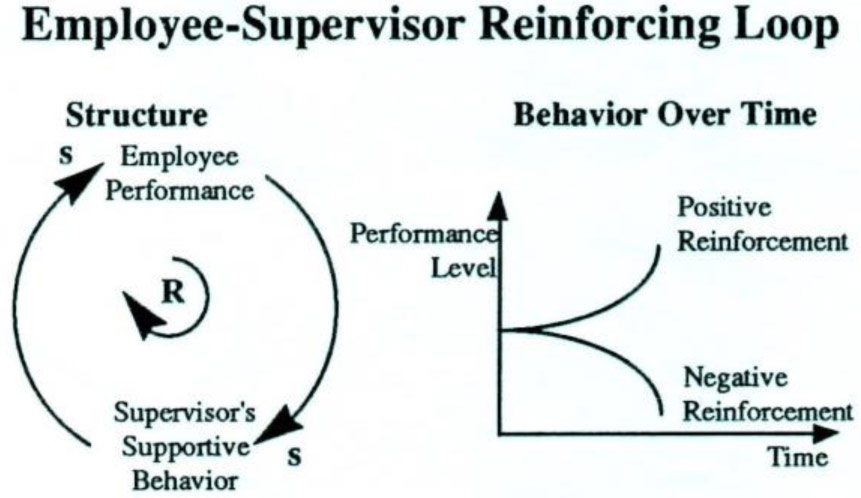
We can now connect the feedback loops from our previous lesson directly to the behaviors they generate. There is a direct correspondence between the type of loop and the shape of a graph plotting the system's behavior over time.
Beyond the Tip of the Iceberg: Using Systems Archetypes ...
This section of the same article explicitly shows the graphs associated with different feedback structures.
Please read the section titled Behavior Over Time Graphs. Focus on Figures 3A, 3B, and 3C. These show the classic signatures of reinforcing and balancing loops.
As the text explains:
- Reinforcing loops produce behavior that accelerates away from its starting point. On a graph, this looks like an exponential curve, either growing (a "virtuous cycle") or collapsing (a "vicious cycle").
- Balancing loops produce goal-seeking behavior. On a graph, this often looks like a variable moving towards a target and stabilizing, or oscillating around that target as it continually over- and under-corrects.
This visual dictionary allows us to look at a graph of a system's behavior and infer the type of feedback structure that is likely dominating it. Conversely, if we can map a system's structure, we can predict its likely behavior.
Systems Archetypes: Common Structures, Common Behaviors
This link between structure and behavior is so reliable that systems thinkers have identified a set of common structures, or "systems archetypes," that produce predictable (and often problematic) patterns of behavior. Recognizing these archetypes is a powerful diagnostic skill.
Let's examine one of the most common archetypes: "Success to the Successful."
Beyond the Tip of the Iceberg: Using Systems Archetypes ...
This section details the "Success to the Successful" archetype, a structure that explains how initial advantages can become locked in over time.
Read the section titled Success to the Successful. As you read, analyze the causal loop diagram (Figure 10/11A) and the corresponding behavior over time graph (Figure 11B).
In this archetype, two reinforcing loops are in competition for a limited set of resources. Whichever person or project gets an initial advantage (Player A) is allocated more resources. This increased support leads to better performance, which in turn justifies allocating even more resources to Player A, while starving Player B.
- The Structure: Two identical reinforcing loops coupled by a "zero-sum" allocation of resources.
- The Behavior: The performance of the two entities, which may have started at similar levels, diverges exponentially over time. One becomes a runaway success, and the other withers.
This structure is independent of the individuals involved; it almost guarantees this unequal outcome. The problem isn't the people, it's the system. This is a profound insight that moves us from blame to structural analysis.
The Cybernetic Ideal: Structure for Adaptability
This principle—that structure determines behavior—is the philosophical and practical foundation of cybernetics. The goal of a cybernetician like Stafford Beer is not just to analyze existing structures, but to design new ones that produce a desired behavior, specifically the behavior of viability and adaptation in the face of an unpredictable world.
A classic embodiment of this ideal is a device you'll encounter often in your studies: Ashby's Homeostat.
[PDF] The Science of the Unknowable: Stafford Beer's Cybernetic Informatics
This article by Andrew Pickering, a historian of science, discusses the philosophical underpinnings of cybernetics. This section describes a foundational cybernetic device.
Please read the section titled The Homeostat.
The Homeostat was an electromechanical device designed to automatically maintain stability. When its "environment" pushed it out of equilibrium, its internal structure was designed to randomly reconfigure itself until it found a new configuration that was stable.
- The Structure: An error-detecting circuit coupled to a random wiring switcher.
- The Behavior: Homeostasis, or ultrastability. The system always returns to a stable state, regardless of the perturbation.
The Homeostat is a perfect, tangible example of a structure explicitly designed to produce a specific, adaptive behavior over time, without needing to know or predict the future. This is the essence of the cybernetic approach that Beer would later formalize in his Viable System Model and attempt to implement in Project CyberSyn.
Conclusion
This lesson concludes our journey through the foundations of systems thinking. We have moved from identifying system components to understanding the dynamic interplay that brings them to life.
Here are the key takeaways from this lesson:
- Structure Determines Behavior: This is the central principle of systems thinking. The observable events and patterns in a system are generated by its underlying structure of feedback loops.
- Behavior Over Time Graphs: These are our tools for visualizing a system's dynamics. The shape of the graph (e.g., exponential growth, goal-seeking, oscillation) is a signature of the dominant feedback loops in the system's structure.
- Systems Archetypes: These are recurring structural patterns that produce predictable, often problematic, behaviors. Identifying them is a key diagnostic skill.
- Cybernetic Design: The ultimate goal of applied cybernetics is to design system structures that generate desirable behaviors like stability, adaptation, and viability.
You are now equipped with the fundamental concepts needed to think like a systems analyst. You can look at a situation, identify the feedback loops at play, and make an educated hypothesis about how that structure will cause the system to behave over time.
In our next module, we will begin our formal study of Cybernetics. We will trace its origins with Norbert Wiener and the Macy Conferences, and define its core concepts, such as circular causality, homeostasis, and goal-directed behavior, building directly on the foundation we have established here.