In our previous lesson, we journeyed back to the 1940s to witness the birth of cybernetics, tracing its origins to Norbert Wiener's wartime work and the vibrant, interdisciplinary Macy Conferences. We concluded with the promise of formally defining this new science. Now, we will fulfill that promise by dissecting Wiener's famous definition, moving from the historical context to the conceptual core of cybernetics itself.
This lesson will unpack what it truly means to study "control and communication in the animal and the machine." We will explore how cybernetics redefines "control" not as forceful command, but as elegant regulation. We will see why "communication" is the indispensable medium for this control. And, most importantly, we will grapple with the revolutionary proposal that the same fundamental principles of organization govern both living organisms and complex machines.
The Canonical Definition
In his 1948 book, Cybernetics: Or Control and Communication in the Animal and the Machine, Norbert Wiener gave the field its name and its enduring definition. Let's begin by reading a concise summary of his foundational idea.
This document from MIT provides a clear and direct overview of Wiener's contribution and the core definition of the field.
Please read the first paragraph of the document, from the beginning. This sets out the definition and highlights the central role of feedback. Then, skip to the section "3. Key Concepts" and read the first full paragraph of that section, Wiener's articulation of the new approach. This passage emphasizes the unification of control and communication theory and the powerful analogies between technology and biology.
As you've just read, Wiener coined the term cybernetics from the Greek word kubernetes (κυβερνήτης), meaning "steersman" or "governor." This choice of metaphor is profoundly important. The steersman does not power the ship; they guide it. They observe the waves, the wind, and the ship's direction relative to a desired course, and make small, continuous adjustments to the rudder. This is the essence of cybernetic control: a goal-oriented system navigating a dynamic environment through a constant flow of information and corrective action.

Control as Regulation, Not Domination
The word "control" can conjure images of rigid command and brute force. In the cybernetic sense, this is a profound misunderstanding. Cybernetic control is about regulation—the maintenance of stability and the pursuit of goals within a complex, changing world.
In a fantastic lecture, Stafford Beer, one of the leading figures in management cybernetics, explains how this single word, "control," took on entirely different meanings in different scientific disciplines, and how the early cyberneticians sought a universal principle underlying them all.
What is Cybernetics? Conference by Stafford Beer
In this clip, Stafford Beer uses evocative examples to contrast various disciplinary notions of "control" and introduces the cybernetic idea of self-regulation.
Please watch from the introduction of the topic of control. As you watch, consider these points: How does the astrophysicist's concept of control (laws of motion) differ from the neurophysiologist's (maintaining balance)? Pay close attention to his example of the cabbage aphid population. This is a perfect illustration of natural regulation. The system isn't "controlled" by an external agent with a plan; it's regulated by the internal feedback dynamics of predator-prey relationships. This avoids both explosion and extinction, achieving a dynamic balance.
Beer's example of the aphids gets to the heart of it. Cybernetic control is what allows a system to remain viable and coherent—"in control" of itself—despite internal and external pressures. It's not about a puppeteer pulling strings, but about the internal logic of the system that allows it to adapt and persist.
Communication: The Lifeblood of Control
How does a system achieve this regulatory control? Wiener's definition provides the answer: through communication. Control is not possible without a flow of information. The steersman needs to see the compass; your nervous system needs proprioceptive feedback from your muscles to stand upright; the population of aphid-eaters needs to "sense" the abundance of aphids to thrive and, in turn, regulate them.
This next video provides a beautifully clear and intuitive distinction between a system without feedback communication and one that is rich with it.
Cybernetics Just Solved Consciousness (Sort Of)
This clip, featuring narration from Norbert Wiener himself, contrasts the "clockwork" action of a music box with the adaptive behavior of a kitten.
Watch the segment from the music box comparison. Focus on the key difference: The Music Box: The message is one-way, from the pre-set mechanism to the figures. The figures are "blind, deaf, and dumb"; their past actions have no influence on their future actions. The Kitten: Messages are sent and received. It senses the world, acts, and then senses the results of its own actions. This "communication with the outer world" is what allows for skillful, adaptive behavior. Note the crucial clarification at the end: not all machines are like the music box. Modern machines have "sense organs" (receptors) that allow them to participate in this two-way communication.
The kitten batting a spool is a perfect microcosm of cybernetics. It's a goal-directed activity ("catch the spool") achieved through a continuous loop of control and communication. The kitten's brain (controller) sends signals to its muscles (actuators), but it simultaneously receives a torrent of information back from its eyes, joints, and tendons (sensors) about the spool's position and the state of its own body. This feedback is what enables learning and skill. Without it, the kitten would be as clumsy and rigid as the music box figures.
In the Animal and the Machine
This brings us to the most radical and philosophically potent part of Wiener's definition: the assertion that these principles of control and communication are universal, applying equally "in the animal and the machine."
This idea shattered the traditional intellectual wall between the life sciences (biology, psychology) and the physical sciences (engineering, physics). The cyberneticians argued that if you want to understand how a system maintains its identity and achieves its goals, the important thing is not what it's made of (flesh or silicon), but how it is organized—its patterns of feedback and information flow.
Perhaps the most famous and compelling demonstration of this principle was a set of simple robots built in the late 1940s by the British neurophysiologist W. Grey Walter.
Cybernetics Just Solved Consciousness (Sort Of)
This part of the video describes Grey Walter's "tortoises," Elmer and Elsie, and the surprisingly complex behaviors that emerged from their very simple design.
Please watch the segment on Grey Walter's robots. As you watch, consider the connection between this experiment and the core cybernetic idea. The tortoises had no "program" in the modern computing sense. Their lifelike, seemingly purposeful behavior—exploring, seeking light, avoiding obstacles, and even "recognizing" themselves in a mirror—was an emergent property of a simple feedback loop between a light sensor, a motor, and the environment.
Grey Walter's tortoises were a profound statement. They showed that behaviors we instinctively label as "biological" or "psychological"—like curiosity, hesitation, or even vanity—could be replicated in a simple machine, not by programming that behavior explicitly, but by engineering the right kind of circular feedback between the system and its world.
Stafford Beer beautifully summarizes the revolutionary impact of this thinking.
What is Cybernetics? Conference by Stafford Beer
Here, Beer explicitly unpacks the "animal and the machine" part of Wiener's definition and its challenge to traditional scientific divisions.
Watch this final clip from Beer's explanation of the definition. He drives home the point that principles like homeostasis (self-regulation) apply regardless of the system's physical makeup, be it a brain, a computer, or an economy.
An Aside: Cybernetics and AI
Given your background in computer science and interest in philosophy, it's worth taking a moment to contrast the cybernetic viewpoint with that of classical Artificial Intelligence, a field that also grew from these post-war explorations. While they are often intertwined, their foundational philosophies differ in a crucial way.
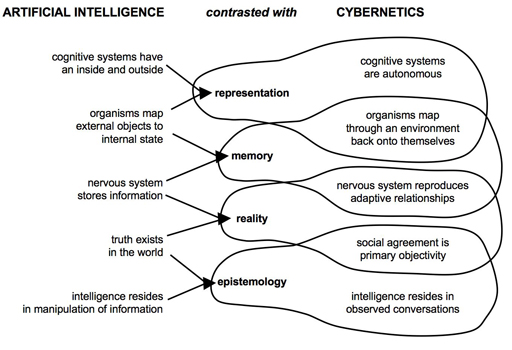
Let's break this down:
- Representation: Classical AI often begins with the premise that intelligence involves creating an internal model or "representation" of an external world. The task is to map objects "out there" to data structures "in here." Cybernetics, especially second-order cybernetics which we'll discuss later, sees this differently. The focus is on the autonomous system's interaction with its environment. The system's "knowledge" is not a picture of the world, but is embodied in its capacity for effective action within it.
- Memory: In the AI view, memory is about storing and retrieving information. In the cybernetic view, memory is about reproducing adaptive relationships. An organism "remembers" how to ride a bike not by recalling a set of stored facts, but by re-instantiating the complex neural and muscular coordination that constitutes that skill.
- Intelligence: For classical AI, intelligence often resides in the manipulation of information or symbols according to rules (as in a chess program). For cybernetics, intelligence resides in the dynamics of interaction—in observed conversations, in the dance between a system and its environment.
This is not to say one is "right" and the other "wrong." They are different lenses for understanding complex systems, and modern approaches in both fields have borrowed heavily from one another. But their distinct starting points—one focused on internal representation, the other on external interaction—have profound consequences for how one designs and analyzes intelligent systems.
Conclusion
In this lesson, we have moved beyond the historical narrative to establish a firm conceptual grasp of what cybernetics is. We have seen that it is a science of effective organization, defined by Wiener as the study of "control and communication in the animal and the machine."
Here are the key takeaways:
- The Cybernetic Definition: Cybernetics is the science of control (regulation, goal-seeking) through communication (feedback, information flow).
- The Steersman Metaphor: Control is not domination, but skillful guidance based on continuous feedback, like a helmsman steering a ship.
- The Unity of Animal and Machine: Cybernetics proposes that the principles of organization are universal. The focus is on the system's form and dynamics, not its material substance.
- Interaction over Representation: In contrast to classical AI, the cybernetic tradition emphasizes that intelligence is embodied in the dynamic interaction between a system and its environment.
We've repeatedly touched on the idea of feedback loops and systems that "loop back on themselves." In our next lesson, we will give this fundamental mechanism its proper name and explore it in depth: circular causality. This concept is the engine that drives all cybernetic processes.