Introduction
In our recent lessons, we have meticulously assembled the internal regulatory machinery of the Viable System Model. We've explored System 1 (Operations), System 2 (Coordination), System 3 (Control), and the vital System 3* (Audit). Together, these functions create a robust framework for managing an organization's internal environment—what Stafford Beer calls the "inside and now." This is the world of operational efficiency, resource allocation, and immediate problem-solving.
However, a system that only focuses inward is brittle and blind to the larger currents of change in its environment. To be viable in the long run, it must not only manage the present but also anticipate and adapt to the future. This brings us to the focus of today's lesson: System 4, the VSM's intelligence function. We will explore how System 4 is designed specifically for "outside-and-then" management, serving as the organization's bridge to the future and its window to the external world.
Beyond Firefighting: The Need for a Future-Oriented Function
The systems we've studied so far are, by necessity, preoccupied with the present. The demands of production, coordination, and internal regulation generate a constant stream of high-variety information that must be handled. Stafford Beer himself describes this as a state of perpetual "firefighting."
In this first video clip, listen to Beer explain why the relentless demands of the "inside and now" necessitate a completely separate function dedicated to the future.
The Intelligent Organization, PART I Stafford BEER // Javier Livas
This clip is from a lecture by Stafford Beer, where he explains the rationale for System 4.
Watch the segment where Beer describes why Systems 1, 2, and 3 are inevitably caught in "crisis mode" and how this creates the need for a function to look at the outside world. He makes a crucial distinction between the sum of the local environments of System 1 and the total environment, which includes an emerging future.
Beer's argument is fundamental. The day-to-day management function (System 3) is so consumed with maintaining internal stability that it lacks the capacity to engage in deep, strategic thinking about the external environment. An organization needs a dedicated function that is insulated from these daily crises to scan the horizon, identify long-term trends, threats, and opportunities, and develop adaptive strategies. This is the domain of System 4.
Defining System 4: The Organization's Intelligence
System 4 is the organization's strategic nerve center. Its purpose is to build a model of the entire organization within its total environment, not just for today but for tomorrow. It is concerned with questions like:
- How is our market changing?
- What new technologies are on the horizon?
- What are the evolving political or social trends that might affect us?
- Given these changes, what new capabilities will our organization need to develop to remain viable?
This function is not just about gathering data; it's about synthesis, modeling, and simulation. It's an active, creative process of exploring possible futures.
Andrew Pickering, in his analysis of Beer's work, describes System 4 as a dedicated decision-making environment.
[PDF] The Science of the Unknowable: Stafford Beer's Cybernetic Informatics
This excerpt provides a vivid description of System 4's intended function and structure.
Please read the paragraph that begins "Very briefly...". Pay close attention to the analogy of the World War II operations room and the description of its key activities: displaying information, running computer models, and acting as a hub for senior management.
The image of an "operations room" is powerful. It's a space where information from the inside (current capabilities from System 3) and the outside (environmental intelligence) comes together. It's a laboratory for strategy, where management can "consult on the possible future effects of major decisions."
This next video provides a concise modern summary of System 4's role.
This video from the channel Auxiliary Statements gives a clear overview of the VSM.
Watch the short segment explaining System 4. Notice how it is described as the "all-important link between autonomy and control" and a "partner" to System 3 in an ongoing conversation.
Visualizing the "Outside-and-Then" Connection
The VSM diagrams visually encode this "outside-and-then" function. System 4 is shown with a direct channel to the external environment, distinct from the local environments of the System 1 operational units.
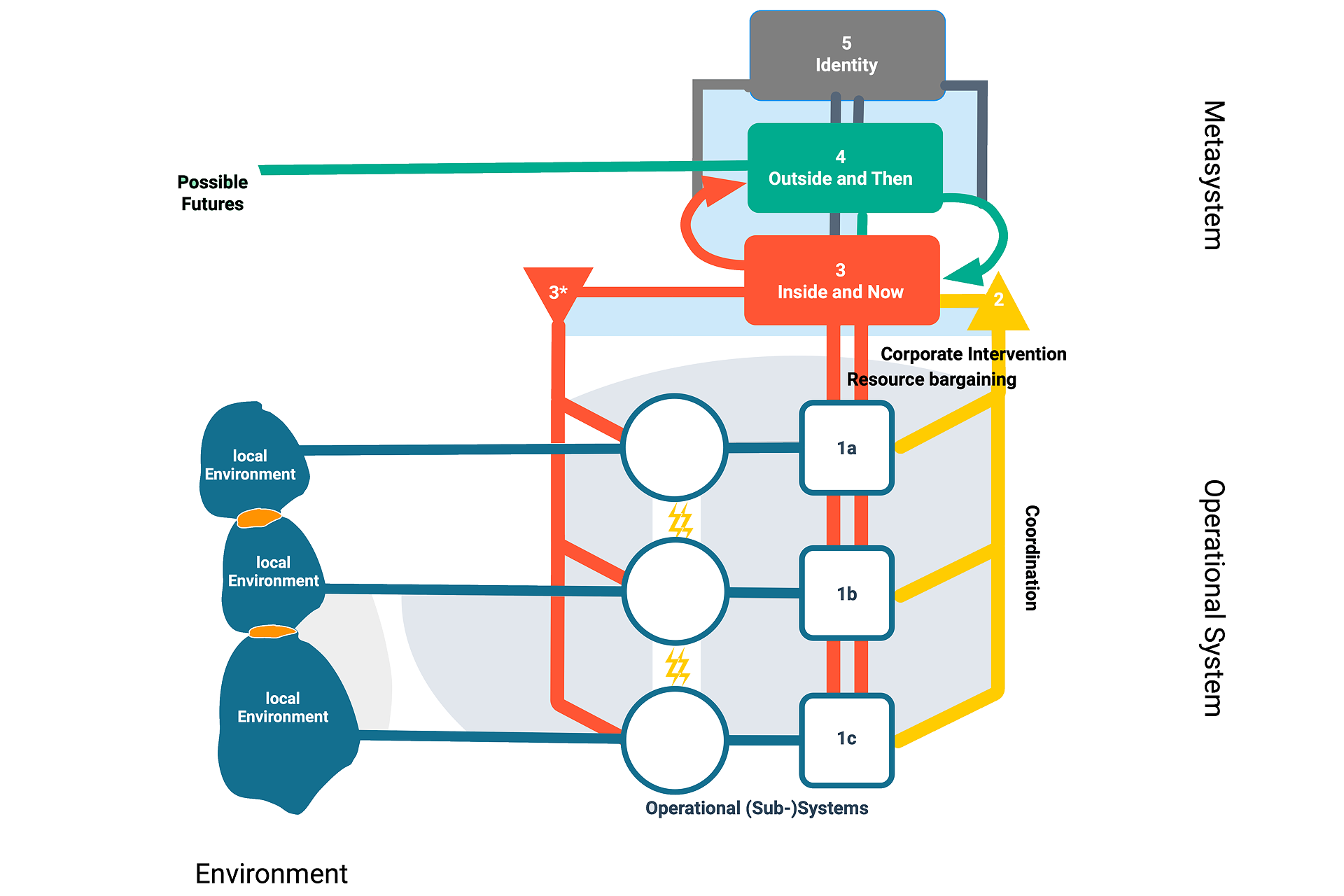
System 4 doesn't just look outward; it must also communicate inward. It engages in a critical dialogue with both System 3 (Control) and System 5 (Policy).

The Dialogue Between Now and Then
The relationship between System 3 and System 4 is one of the most dynamic and critical axes in the VSM. It represents the perpetual tension between stability and change, exploitation and exploration.
- System 3 asks System 4: "Given our current resources, operational capacity, and performance, what are our realistic constraints?" It provides the internal reality check.
- System 4 asks System 3: "Given the future we anticipate, what new capabilities must you develop? What changes to our operations are necessary for survival and growth?" It provides the external strategic imperative.
This is not a top-down command; it is a homeostatic loop, a balanced conversation. An organization that only listens to System 3 becomes rigid and obsolete. An organization that only listens to System 4 becomes detached from reality, pursuing futures it cannot operationally deliver.
Beer emphasizes the existential importance of balancing the investment of resources—time, money, and attention—between these two functions.
The Intelligent Organization, PART I Stafford BEER // Javier Livas
In this final clip from his lecture, Beer explains the consequences of an imbalance between System 3 and System 4.
Watch the segment where he discusses the danger of imbalance. He warns that over-investing in the future causes the present to collapse, while over-investing in the present starves the function of adaptation.
System 4 in Action: Project CyberSyn's CHECO
Your interest in Project CyberSyn provides the perfect real-world example of a System 4 function. While the Cyberstride program was designed for near-real-time operational control (a System 3 function), the project also included a component specifically for strategic, long-term modeling.
[PDF] The Science of the Unknowable: Stafford Beer's Cybernetic Informatics
This part of the text discusses the implementation of the VSM in Chile.
Read the paragraph detailing the VSM in action, starting from "The VSM was not...". Specifically, note the description of the program called CHECO.
The CHECO (CHilean ECOnomy) program was a dynamic simulation model of the entire Chilean economy. Its purpose was not to track daily factory output but to allow Allende's government to ask "what if" questions about major policy decisions. What would be the long-term impact of a large investment in copper versus agriculture? How might a global shift in energy prices affect the national economy over the next five years? CHECO was the embodiment of a national-level System 4.
The Pathology of a Missing System 4
What happens to an organization that lacks a functioning System 4? It effectively loses its 'eyes' for the future. The consequences are cybernetically predictable and severe.
[PDF] The Viable System Model: its provenance, development ...
This text by Stafford Beer includes a section on common VSM pathologies.
Find point number 3 in the list under the heading "Next, there are four diagnostic points...". Read the short but critical diagnosis for what happens when System 4 is absent.
This is a profound diagnostic insight. Without System 4 to mediate, the long-term, identity-defining function of System 5 gets dragged down into the day-to-day squabbles and crises of System 3. The "board of directors" (System 5) ends up micromanaging operations instead of steering the ship. The organization loses its strategic direction and becomes purely reactive, lurching from one crisis to the next until it is overwhelmed by a change in the environment it never saw coming.
Conclusion
In this lesson, we have explored the crucial role of System 4 as the intelligence and adaptation function of the Viable System Model. It stands as the necessary counterbalance to the internal, present-day focus of the operational systems.
Here are the key takeaways:
- System 4's purpose is "outside-and-then" management: It scans the total external environment to model and plan for the future.
- It is the organization's intelligence function: It's an "operations room" for strategy, allowing management to simulate the effects of major decisions before committing to them.
- It exists in a vital dialogue with System 3: This balances the need for future adaptation with the reality of current operational capabilities. An imbalance here is catastrophic.
- A missing System 4 is a critical pathology: Without it, long-term strategic direction is lost, and the organization's highest policy-making functions are consumed by day-to-day crises.
System 4 develops the strategic options and models the future, but it does not, on its own, define the organization's ultimate purpose or identity. That is the role of the final system in our model. In the next lesson, we will ascend to System 5, the function responsible for policy, ultimate authority, and the normative closure that defines what the viable system is and what it stands for.