Introduction
Welcome to the final stage of our journey through the fundamental components of the Viable System Model. In previous lessons, we assembled the VSM's intricate machinery piece by piece. We started with the operational heart in System 1, moved to the stabilizing function of System 2, explored the internal management of the "inside and now" in System 3, and most recently, we examined the strategic, future-oriented intelligence of System 4's "outside-and-then."
This leaves us with a profound question. All these systems are designed to regulate, adapt, and perform, but towards what end? What provides the ultimate purpose, defines the non-negotiable values, and gives the entire organization its unique identity? Today, we ascend to the apex of the metasystem to answer this. Our focus is on System 5, the function that provides policy, defines identity, and grants the system its ultimate closure and meaning.
Defining System 5: The Guardian of Identity
At the very top of the VSM diagram sits System 5. Its position is not accidental; it represents the ultimate source of authority and purpose for the entire viable system.
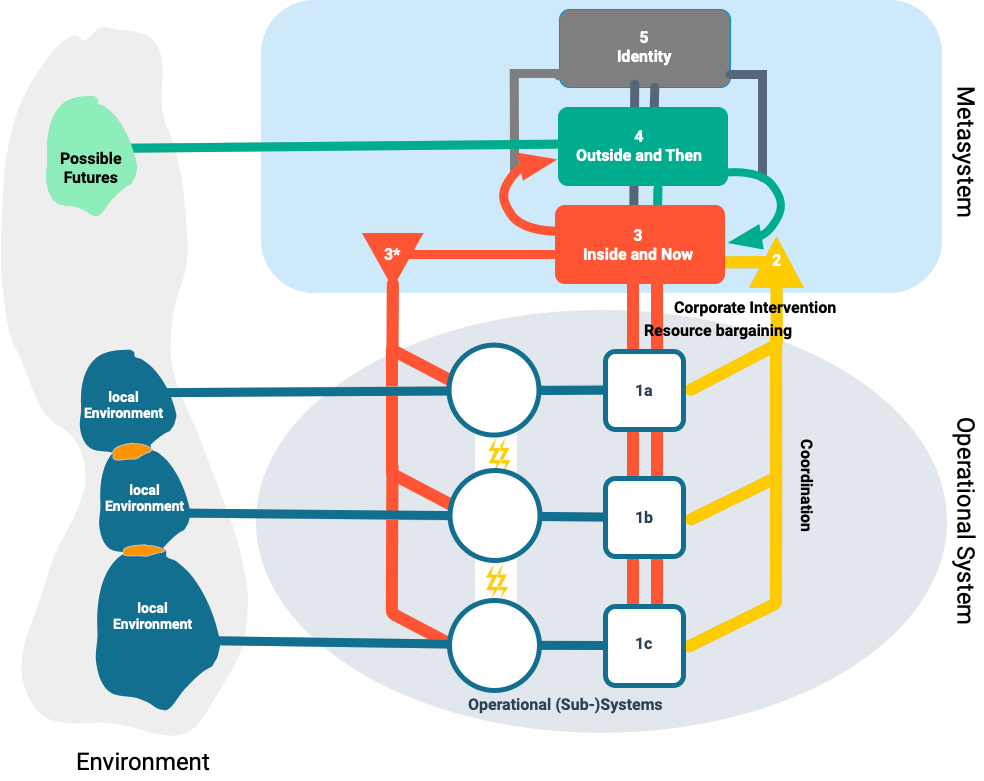
System 5 is responsible for creating the foundational principles, the "ground rules," within which the entire organization operates. It is the custodian of the system's identity.
[PDF] Chapter 5: The Viable System Model - ScienceOpen
This excerpt from a chapter on the VSM provides a concise and clear definition of System 5's role.
Please read the paragraph beginning "System 5 defines...". Notice how it's described not just as rule-setting, but as creating a "corporate ethos" and providing "closure" for the system.
As the text highlights, System 5 is not merely a bureaucratic function. Its role is to embody and broadcast the system's core values, creating an "atmosphere" or "ethos" that permeates the entire organization. Without this unifying force, the autonomy granted to the operational units would lead to fragmentation and the system would lose its coherence.
However, it is crucial to avoid a common misinterpretation. System 5 is not simply "the boss" in a traditional, hierarchical sense. Stafford Beer himself was keen to distinguish its cybernetic function from a simple concentration of power.
The Intelligent Organization, PART I Stafford BEER // Javier Livas
In this clip from his lecture, Stafford Beer explains the true cybernetic function of System 5, moving beyond simplistic reductionist ideas.
Watch the segment from his explanation where he contrasts the System 5 role with the typical model of "the boss" and defines its main, active function.
The Primary Function: Balancing Present and Future
As Beer clarifies in the video, the primary, ongoing function of System 5 is to monitor and maintain the critical balance between System 3 ("inside and now") and System 4 ("outside and then"). We've previously discussed the inherent tension between these two: System 3 strives for current operational stability, while System 4 pushes for future-oriented adaptation.
An unchecked System 3 leads to stagnation and obsolescence. An unchecked System 4 leads to unrealistic strategies and a disconnect from operational reality. System 5 acts as the ultimate homeostat, the final arbiter that ensures the dialogue between the present and the future serves the long-term viability and identity of the whole system.
This concept map provides an excellent visualization of this role.

System 5 doesn't necessarily generate the strategies itself, but it ensures that the process of strategy creation—the push and pull between System 3 and System 4—adheres to the organization's overarching policy and identity.
Providing Closure: Policy as a Constraint Hierarchy
The term "closure" is central to System 5's role. In a cybernetic sense, closure means defining the system's identity so definitively that it is operationally closed. The system knows what it is, and therefore what it is not. This is achieved through policy. Policies are the ultimate set of guiding principles and non-negotiable values.
Given your background in computer science, you can think of this in a more formal way. A policy set by System 5 is not just a mission statement; it's the highest-level constraint in a decision-making process. Any action or strategy proposed by the lower systems must satisfy this ultimate constraint to be considered valid.
One academic paper formalizes this idea in a way that should resonate with you, by translating the VSM's structure into a priority hierarchy for an autonomous system.
[PDF] From Biological Analogy to Formal Control A Cybernetic and Active ...
This paper proposes a formal framework for self-regulating systems that maps directly onto the VSM. You don't need to dive into the mathematics, but focus on the conceptual structure.
Read the subsection Formal Specification. Pay close attention to the priority ordering: H > C > M > O. The highest priority, H, stands for "Homeostasis (system integrity...)." This is the formal equivalent of System 5's ultimate policy. The system will always prioritize actions that maintain its integrity, as defined by this top-level constraint, even at the cost of efficiency or other goals.
This perspective frames System 5's policies as the foundational axioms of the system's logic. All other behaviors and optimizations (like System 3's resource bargaining or System 4's strategic planning) are conducted within the feasible set defined by these top-level constraints. If a proposed plan violates the core identity or threatens the system's integrity, it is rejected, no matter how optimal it may seem from a lower-level perspective.
The Source of Ethos: From Corporate Values to Political Will
System 5 policies define the system's ethos. This can be seen clearly when considering broad, value-laden goals like sustainability. If System 5 decides that sustainability is a core component of the organization's identity, this single policy decision reshapes the metrics, goals, and behaviors of all other systems.
[PDF] Chapter 5: The Viable System Model - ScienceOpen
This final section of the chapter discusses future developments of the VSM.
Read the paragraph beginning "If System 5 places...". This powerfully illustrates how a System 5 policy decision can cascade through the entire organization, changing its relationship with the environment.
This brings us to the political and philosophical dimension of the VSM that so interests you, particularly in the context of Project CyberSyn. Who, or what, constitutes System 5? In a corporation, it might be a board of directors. But in a nation-state?
Stafford Beer tells a powerful story about this very question when he presented the VSM to Chilean President Salvador Allende.
The Intelligent Organization, PART I Stafford BEER // Javier Livas
This is one of the most famous anecdotes in the history of cybernetics, and it gets to the heart of the VSM's political potential.
Listen to the story Beer tells about his meeting with Allende, starting around "I'd love to tell the story...". When Beer pointed to the System 5 box, Allende had an immediate, profound realization about who it represented in his vision for Chile.
Allende's response—"¡Ah, el pueblo!" ("Ah, the people!")—is a revolutionary reinterpretation of the model. He saw instantly that in a democratic socialist state, the ultimate source of policy, identity, and closure—System 5—was not a committee of technocrats, but the people themselves. This single anecdote transforms the VSM from a tool for corporate management into a potential framework for radical democracy, where the will of the populace sets the ultimate constraints for the state's entire operational and strategic apparatus.
Conclusion
We have now reached the summit of the Viable System Model, understanding the indispensable role of System 5. It is far more than just a final box on a chart; it is the system's soul.
Here are the essential functions of System 5:
- It defines identity and policy: System 5 establishes the ultimate purpose, values, and "ethos" of the viable system, providing normative closure.
- It acts as the ultimate arbiter: Its primary active function is to monitor and manage the homeostatic balance between the internal focus of System 3 and the external focus of System 4, ensuring the system remains both stable and adaptive.
- It provides the highest-level constraints: Policies set by System 5 are the non-negotiable axioms within which all other systemic activity must occur.
- It embodies ultimate authority: This authority can be a board of directors in a firm, or, as Allende envisioned, the people in a nation.
With our tour of the five individual systems complete, you now have a full picture of the functional components required for viability. However, one of the VSM's most powerful features is how this five-system structure repeats itself at different scales. In our next lesson, we will explore the principle of recursion, which explains how any viable system contains, and is contained within, other viable systems.