Welcome back. Last lesson followed a bill that both chambers had passed in identical form to the President: a signature makes it law, while an ordinary veto returns it with objections to its chamber of origin. This lesson takes up the third possibility—the President does nothing. You will calculate the ten-day action deadline and determine when an unreturned bill becomes law without a signature. The distinction that matters throughout is between ten counted days and ten ordinary calendar days.
Start the count after presentment
The President’s action period begins the day after presentment. The day the enrolled bill reaches the President is day 0, even if it arrives early in the day. Count ten days after that, skipping Sundays. Saturdays and holidays count. This is not a ten-business-day rule.
Read the “Bill Presentment” section of the Congressional Research Service explanation before putting the rule on a calendar.
Bill Presentment and the Pocket Veto at the Conclusion of a Congress
The Congressional Research Service states the counting rule directly. Read this short section to establish what starts the clock and which days count.
Read the entire “Bill Presentment” section, from its explanation of the bill presentment period through the paragraph ending with the Congress.gov action label “Presented to President.” Pay particular attention to the day exclusions and the statement that the presentation day is day 0.
A reliable method is to write 0 on the date of presentment, then move forward one date at a time. Leave every Sunday unnumbered; give every other date the next number, including Saturdays and holidays. The date labeled 10 is the final day of the action period. If the President neither signs nor returns the bill by the end of that day, the consequence of inaction takes effect—provided Congress’s adjournment has not prevented its return.
Put the rule on a calendar
The Congressional Research Service flowchart below uses a bill presented on a Monday. Its calendar labels Monday 0, Tuesday 1, and Saturday 5. Sunday says “SKIP”; the following Monday is 6, and the second Friday is 10. The deadline marked at midnight means the end of that second Friday, not its beginning.
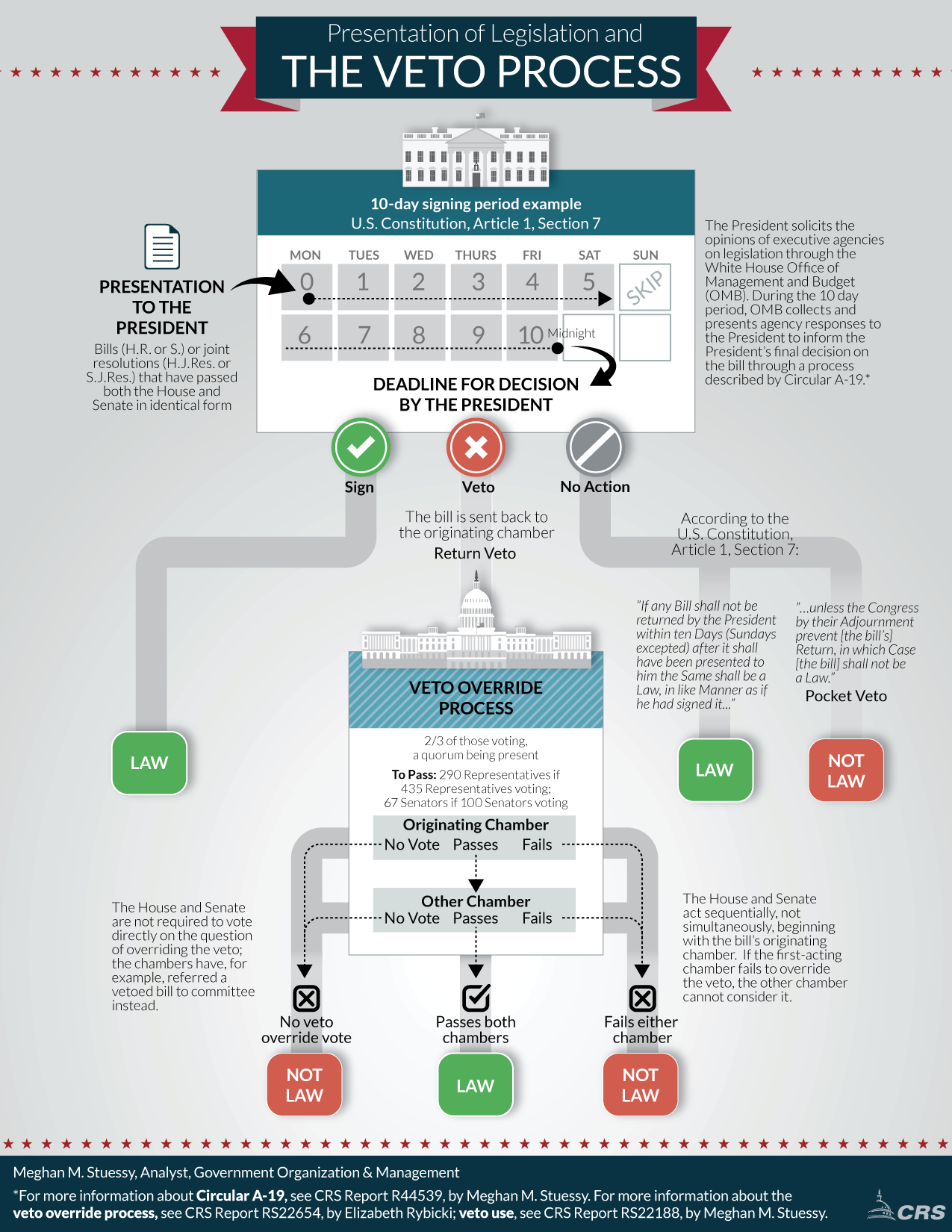
The chart contains later stages of the veto process, but for now concentrate on its calendar and the “No Action” branch. Those are enough to see why the date ten calendar days after a Monday presentment is not necessarily the action deadline.
Now change the starting day. Suppose the hypothetical H.R. 42 from the previous lesson is presented on a Thursday, and the following Monday is a holiday. The count looks like this:
| Date relative to presentment | Counted day |
|---|---|
| Thursday, bill presented | 0 |
| Friday | 1 |
| Saturday | 2 |
| Sunday | Not counted |
| Monday, holiday | 3 |
| Tuesday | 4 |
| Wednesday | 5 |
| Thursday | 6 |
| Friday | 7 |
| Saturday | 8 |
| Sunday | Not counted |
| Monday | 9 |
| Tuesday | 10 |
The President’s action period runs through the end of the second Tuesday. The first Monday counts despite being a holiday, and both Saturdays count. Only the two Sundays are skipped. If that final Tuesday were itself a holiday, it would still be day 10.
Notice what the arithmetic does—and does not—establish. It identifies the deadline. It does not, by itself, tell you whether the bill becomes law: you also need to know whether it was signed or returned and whether Congress’s adjournment prevented its return.
What happens when day 10 expires
Article I, Section 7 supplies the consequence of inaction. In the same Congressional Research Service resource, read the opening of “Options for Presidential Action and the Pocket Veto,” including the constitutional passage quoted there.
Bill Presentment and the Pocket Veto at the Conclusion of a Congress
Return to the Congressional Research Service explanation for the rule that determines whether an unsigned, unreturned bill becomes law.
In “Options for Presidential Action and the Pocket Veto,” read from the opening paragraph beginning “While a President may sign a bill” through the constitutional quotation ending “it shall not be a Law.” Focus on the constitutional condition: the general rule for a bill not returned within the period, followed by its exception concerning adjournment.
Apply that rule to the Thursday-presentment example. Suppose the President neither signs H.R. 42 nor returns it with objections by the end of day 10, and return remains possible. The bill becomes law without a presidential signature, just as it would have become law upon signature. Inaction is not an ordinary veto; the President has not returned the bill.
The qualification about return matters. The Constitution makes an exception when Congress by its adjournment prevents the bill’s return. Merely noticing that Congress is not holding a floor session on a particular date is not enough to settle that issue. The next lesson will examine when an adjournment actually prevents return and how that changes the result. For this lesson, keep the two decisions separate: first find day 10; then apply the stated facts about action and the possibility of return.
Key takeaways
Treat presentment as day 0. Count the next ten days, excluding Sundays only: Saturdays and holidays remain in the count. Day 10 is the final action day. If it expires without a signature or return, and Congress’s adjournment has not prevented return, the bill becomes law without a signature.
Next, you will examine the exception: when presidential inaction and an adjournment that prevents return leave a bill not law instead.