Hello. In the preceding module, you followed a bill through presentment and learned to count the President’s ten-day action period, excluding Sundays. This module turns to what happens when Congress adjourns during that period. The central distinction is not simply whether Congress is on a break. It is whether the adjournment prevents the President from returning the bill to the chamber where it originated.
By the end of this lesson, you should be able to tell when presidential inaction makes a bill law without a signature, when it produces a pocket veto, and why only one of those outcomes leaves Congress with a bill to reconsider.
The rule turns on return, not on silence alone
Article I, Section 7 gives an unsigned bill a default outcome: if the President does not return it within ten days after presentment, Sundays excepted, it becomes law as though signed. The Constitution then adds an exception: if Congress, by its adjournment, prevents the bill’s return, it does not become law.
Read the constitutional language alongside the Constitution Annotated’s explanation of the two outcomes.
Veto Power | Constitution Annotated | Congress.gov | Library of Congress
Read “Veto Power” from the Constitution Annotated, published by Congress.gov, for the precise condition that separates enactment without signature from a pocket veto.
Under “ArtI.S7.C2.2 Veto Power,” read the constitutional clause, from its opening words through its final sentence about adjournment. Then read the paragraph beginning “When Congress is in session” and ending “the legislature must reintroduce the bill and enact it again.” In particular, the adjournment passage explains why inaction sometimes has the opposite effect from the usual ten-day rule.
Notice what the exception does not say. It does not say “unless Congress takes a recess” or “unless the President prefers not to sign.” It says unless adjournment prevents return. An ordinary veto requires the President to return the bill with objections to its originating chamber. A pocket veto occurs when the President leaves the bill unsigned and an adjournment prevents that return within the allowed period. There is then no returned bill for Congress to reconsider and override. Congress can pursue the measure again, but it must pass and present a new bill.
The infographic below is useful for locating those outcomes on the same ten-day timeline. Its “No Action” branch divides according to the constitutional condition: whether return is prevented. Do not read the branch as saying that every recess automatically creates a pocket veto.
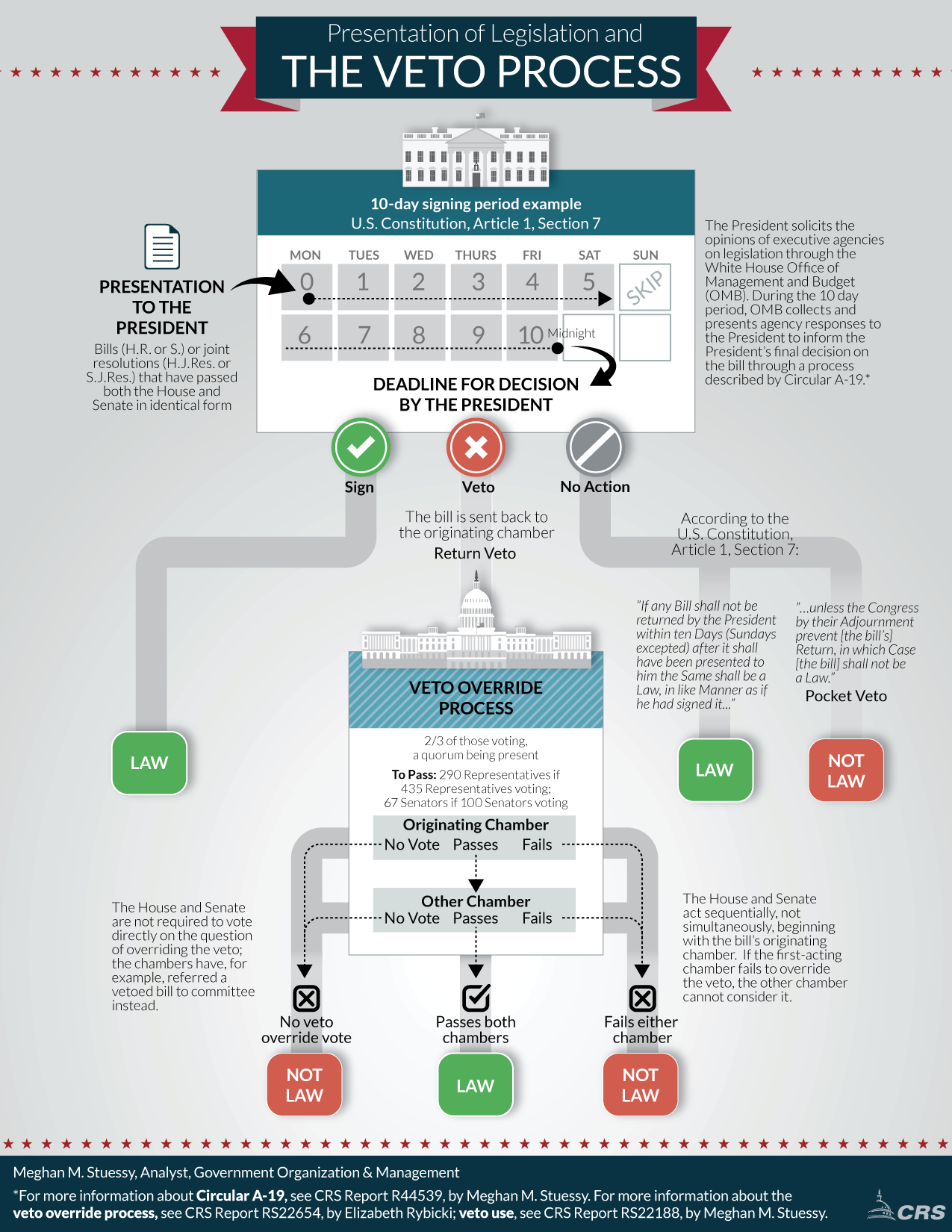
What does it mean for an adjournment to “prevent” return?
The reason this question matters is that return serves a purpose. It tells the originating chamber the President’s objections and gives Congress an opportunity to reconsider the bill. An adjournment that genuinely obstructs return can defeat that process; a temporary absence that still allows effective delivery need not.
Two Supreme Court decisions in the Constitution Annotated show why the length or label of a break is not, by itself, a complete test. Read them as contrasting sets of facts, rather than as rules that every short break permits return or every longer break prevents it.
Veto Power | Constitution Annotated | Congress.gov | Library of Congress
Continue the Constitution Annotated’s “Veto Power” discussion to see how the Supreme Court has assessed whether an adjournment actually prevents return.
Still under “ArtI.S7.C2.2 Veto Power,” begin with the paragraph opening “The Supreme Court has explained that the Constitution’s veto provisions serve two functions.” Continue through the discussion of The Pocket Veto Case and Wright v. United States, ending with the sentence about reconsideration “immediately after the short recess is over.” In The Pocket Veto Case discussion, focus on the decisive question. In the Wright discussion, note the functioning receiving officer described in the Senate’s arrangements.
In The Pocket Veto Case (1929), Congress had adjourned its first session before the ten-day period expired. Neither chamber was in session to receive the bill. The Court treated the adjournment as preventing return. Importantly, the Court did not make final adjournment of an entire Congress a necessary condition for a pocket veto; an adjournment between sessions could suffice on those facts.
In Wright v. United States (1938), only the Senate—the bill’s originating chamber—had taken a three-day break. Its organization remained intact, and the President delivered the bill to the functioning Secretary of the Senate on the tenth day. The Court held that this was an effective return. The short break had not prevented it.
These decisions establish a useful discipline for reading a scenario: identify which chamber originated the bill, what kind of adjournment occurred, and whether an effective return to that chamber was possible within the ten-day period. Do not extend Wright into a blanket claim that delivery to an officer works during every adjournment. Equally, do not extend The Pocket Veto Case into a claim that every time a chamber is not meeting, a pocket veto is available. The status of return during some adjournments has been disputed; the stated facts about receiving arrangements matter.
Following the deadline through three adjournments
Use the calendar from the previous lesson as a reference point. Suppose a bill is presented on a Monday, which is day zero. Saturday counts, Sunday does not, and the following Friday is day ten. Assume throughout the examples that the President neither signs nor attempts to return the bill.
Congress remains able to receive a return through day ten. Perhaps it briefly recesses but resumes in time for a return. When the deadline passes with no return, the bill becomes law without a signature. A break occurred, but it did not prevent return.
Congress adjourns before day ten, and return is prevented through the deadline. Suppose both chambers adjourn for the remainder of the session, and on the given facts there is no effective way to return the bill to its originating chamber. If the President leaves it unsigned, the bill does not become law. That is a pocket veto, not an ordinary veto waiting for an override vote.
The originating chamber takes a short break, but a functioning officer receives the returned bill. This resembles the material fact in Wright. A return made within the ten-day period can be effective despite the chamber’s brief absence. If, instead, the President does nothing through the deadline while return remains possible, the bill becomes law without signature. Merely calling the break an “adjournment” does not change that result.
Timing matters in both directions. An adjournment after the ten-day deadline cannot retroactively pocket-veto a bill that has already become law without signature. And a recess that ends before the deadline does not itself prevent a timely return. When a scenario says only “Congress was in recess,” without telling you whether return was possible, it leaves out the fact needed for a confident pocket-veto conclusion.
A reliable way to classify presidential inaction
Keep the two outcomes separate from an ordinary veto. First establish that the bill was presented and that the President took no action through the ten-day deadline, counting Sundays correctly. Then apply the adjournment condition:
| At the deadline | Result of presidential inaction | Can Congress override this outcome? |
|---|---|---|
| Return was not prevented by Congress’s adjournment | Bill becomes law without signature | No veto to override |
| Congress’s adjournment prevented return | Bill does not become law: pocket veto | No; Congress must pass and present a new bill |
This table is about inaction, not about every choice available to a President during an adjournment. The President can still sign a bill within the action period. Where a timely return with objections is possible, the President can instead make an ordinary veto. The word “pocket” describes the combination of no signature and an adjournment that prevents return—not a special veto message or a power triggered by any congressional holiday.
Conclusion
Presidential silence normally allows a presented bill to become law after ten days, Sundays excepted. The exception is a pocket veto: the bill remains unsigned and Congress’s adjournment prevents its return within that period. The Pocket Veto Case and Wright show why the question is effective return, not simply whether lawmakers are away. A pocket-vetoed bill cannot be overridden; Congress would have to pass and present legislation again.
The next lesson takes up the other path: when the President does return a bill with objections, how the originating chamber and then the other chamber can vote to override that ordinary veto.