Hello. In the last lesson, you distinguished a pocket veto from a bill becoming law without a signature: the deciding issue was whether Congress’s adjournment prevented return. Now consider a bill the President does return, with objections, to its chamber of origin. That ordinary veto gives Congress a route to enact the bill despite the President’s objection—but only if each chamber meets its own voting threshold.
This lesson focuses on how to read the vote tallies. You will identify which chamber acts first, check that a quorum is present, and calculate whether two-thirds of those voting in each chamber supported the bill.
Why the bill returns to its chamber of origin
Article I, Section 7 sets out the order of reconsideration. The President returns the bill with objections to the chamber where it originated. That chamber records the objections and reconsiders the bill. Only if it agrees to pass the bill by the required two-thirds vote does the other chamber reconsider it. Both chambers’ votes must be recorded as yeas and nays, with members’ names entered in their respective journals.
Veto Power | Constitution Annotated | Congress.gov | Library of Congress
Read the constitutional text reproduced by the Library of Congress. It supplies the order of action and the requirement for recorded votes.
In “Article I, Section 7, Clause 2,” find the paragraph beginning “Every Bill which shall have passed the House of Representatives and the Senate.” Read the override language, beginning with return of the bill and ending with the journal requirement. Focus on what must happen in the originating chamber before the bill reaches the other chamber.
“Originating” refers to where the measure began, not which chamber voted most recently before sending it to the President. For an H.R. bill, the House reconsiders first; for an S. bill, the Senate reconsiders first. If that first chamber does not override, the other chamber does not get an override vote on the returned bill.
The Congressional Research Service report below connects that constitutional sequence to congressional practice. It also clarifies a point that matters when calculating tallies: the threshold is two-thirds of members voting, provided a quorum is present—not automatically two-thirds of every seat in the chamber.
Veto Override Procedure in the House and Senate | Congress.gov | Library of Congress
Read this Congressional Research Service report for the order of reconsideration and the voting rules in each chamber.
Begin with “Summary,” then move to the main text immediately below it. Starting where the text describes return and reconsideration, read through the explanation of why a failed first-chamber vote stops the process. In the House voting discussion, locate the paragraph beginning “To override a veto” and read the House rule. Under “Voting in the Senate,” read the Senate rule. Focus on the shared two-thirds requirement and the recorded-vote requirement.
The chambers may refer a returned bill to committee rather than vote directly on an override. For this lesson’s tallies, assume the stated votes are votes on whether to pass the bill over the veto.
Two checks for each chamber: quorum and two-thirds
A quorum is the minimum number of members who must be present for a chamber to conduct this business. In a full 435-member House, that is 218 members; in a 100-member Senate, it is 51. In the examples below, assume those full membership figures and use the supplied attendance figures. The voting threshold is a separate check.
For each chamber, sort members into four categories: yea, nay, present but not voting yea or nay, and absent. Members recorded as “present” help establish a quorum, but their “present” votes do not enter the two-thirds calculation. Absent members enter neither calculation as voters, though the quorum requirement still has to be met.
If members vote yea and vote nay, the number voting is . The smallest passing yea tally is:
The ceiling means round up whenever two-thirds is not a whole number. First verify the quorum using everyone present, including nonvoters. Then compare the yeas with . Repeat both checks in the second chamber only if the originating chamber passes.
The infographic from the Congressional Research Service places that sequence beneath the ordinary-veto branch. Its examples of 290 House votes and 67 Senate votes assume that all 435 representatives or all 100 senators vote yea or nay; they are not fixed thresholds for every override vote.
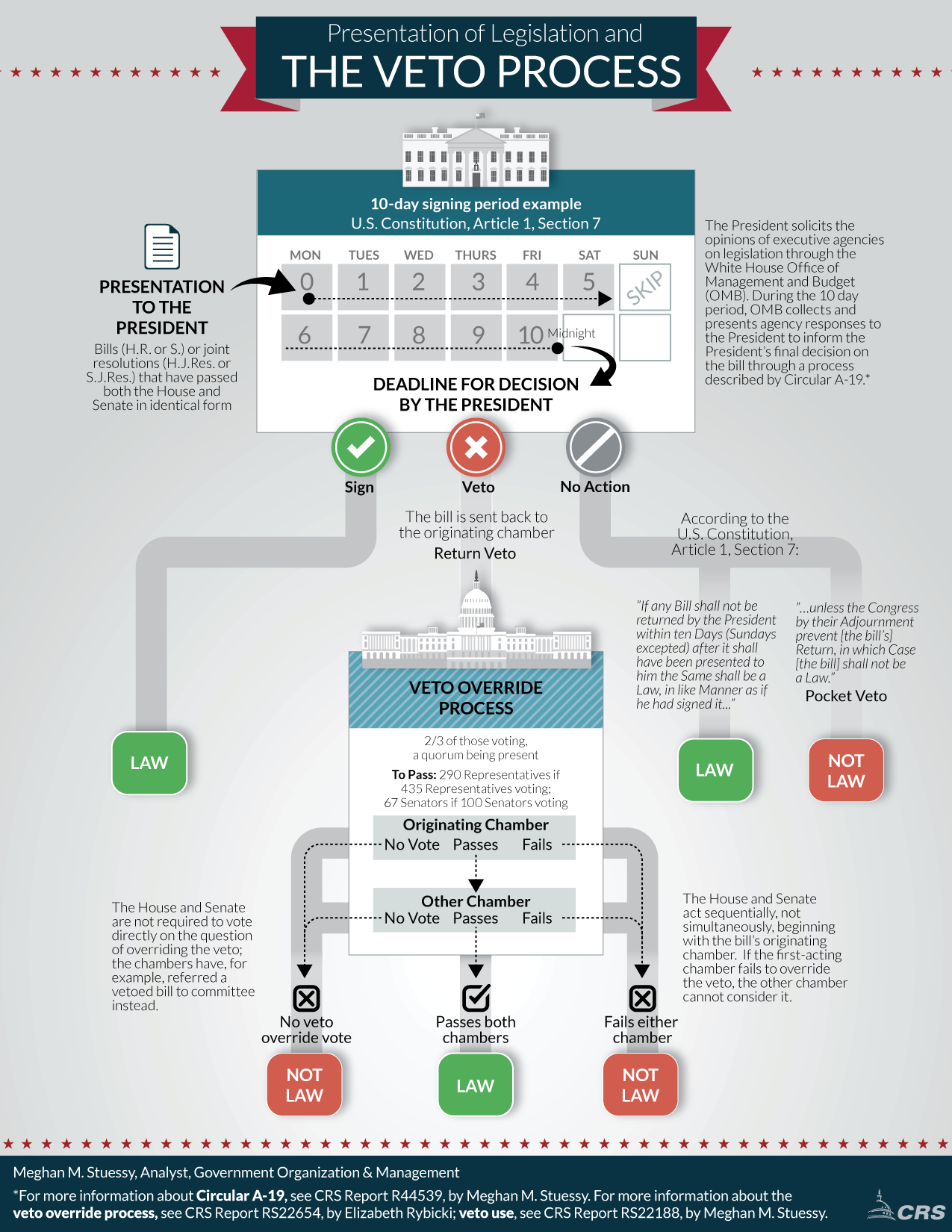
Worked tally: the first chamber passes, the second fails
Suppose the President returns an H.R. bill with objections. The House must act first. Assume these recorded tallies:
| Chamber | Yea | Nay | Present, not voting | Absent |
|---|---|---|---|---|
| House | 240 | 120 | 20 | 55 |
| Senate | 62 | 32 | 6 | 0 |
In the House, 380 members are present, so there is a quorum. Of those, 360 vote yea or nay. Two-thirds of 360 is 240: the 240 yeas meet the threshold exactly. The 20 “present” votes count toward the quorum but not toward the 360-vote denominator.
Because the House succeeds, the Senate can reconsider the bill. All 100 senators are present, so quorum is not in doubt. But only 94 vote yea or nay. Its threshold is:
The 62 yeas fall one short. The ordinary veto is not overridden, even though the originating chamber passed by exactly two-thirds. If one senator in this tally had voted yea instead of nay, the Senate would have recorded 63 yeas out of the same 94 voting; with both chambers then meeting their thresholds, the bill would become law over the veto. It would not need another presidential signature.
Notice the two common errors this example exposes. Requiring 290 House yeas would wrongly treat every House seat as a vote cast. Adding the two chambers’ yeas together would wrongly treat their votes as one combined election. Each chamber must independently reach two-thirds of its own members voting.
Worked tally: fewer yeas can still pass
Now suppose the returned bill is an S. bill, so the Senate acts first:
| Chamber | Yea | Nay | Present, not voting | Absent |
|---|---|---|---|---|
| Senate | 59 | 29 | 7 | 5 |
| House | 210 | 104 | 21 | 100 |
The Senate has 95 members present, more than enough for a quorum. Its 88 yea-or-nay voters require:
The Senate passes, so the House may reconsider. In the House, 335 members are present, satisfying its quorum. Of the 314 who vote yea or nay, two-thirds rounded up is:
The House also passes, and the bill becomes law over the President’s veto. The 210 yeas are fewer than a majority of all 435 House seats, yet they meet the constitutional override threshold for this vote: two-thirds of those voting, with a quorum present.
A quorum cannot be skipped just because the fraction looks sufficient. For example, 30 yeas and 15 nays would give 30 of 45 votes—exactly two-thirds. But if only five additional senators were present, attendance would total 50, below the 51 needed for a Senate quorum under the full-membership assumption. That tally would not establish a valid override vote.
Conclusion
An ordinary veto is overridden only through sequential reconsideration. The chamber where the bill originated acts first; if it fails to repass the bill, the other chamber does not vote on that override. In each chamber that acts, confirm a quorum, divide yeas by yeas plus nays, and require at least two-thirds, rounding the needed number of yeas up. A successful vote in both chambers makes the bill law without further presidential approval.
You can now distinguish a pocket veto, which leaves no returned bill to override, from an ordinary veto, which Congress may overcome. The next module examines a different limit: whether a President can accept a bill while vetoing only selected provisions of it.